Tskaltubo, Georgia: Visiting the Abandoned Soviet Sanatoriums With a Guide (Day Trip from Kutaisi)
Last Updated on November 10, 2026 by Kimberly
Planning a trip to Kutaisi and keep seeing photos of a ruined Soviet spa town just 20 minutes down the road? That’s Tskaltubo, and it makes an easy day trip from Kutaisi.
I’d seen a version of Tskaltubo before I ever got there. A couple of years ago, I toured Nowa Huta, the socialist-realist district built on the edge of Kraków, with a guide who grew up there, and I took away how little I’d have understood on my own. Empty benches where a Lenin statue once stood. A square now officially named after Ronald Reagan. You walk straight past it all without someone to tell you what you’re looking at.
Tskaltubo taught me the same lesson. It isn’t a ruin that happened by accident. The Soviet state built it on purpose, around the idea that rest was something a government owed its citizens: more than twenty sanatoriums arranged around a central park, laid out according to a plan, with a direct train from Moscow carrying people whose doctor had prescribed a holiday. What you see now is what happens to that kind of project when the state behind it no longer exists.
I went with a small group, organized by Laura of Type 2 Travel, and a local guide. A security guard refused us entry to one building, and a section of the ceiling came down inside another while we were standing in the room. Both things taught me more about where Tskaltubo currently stands than the photographs did.
What This Tskaltubo Guide Covers
Almost everything written about this place in English is written by and for urban explorers, so it’s organized around access: which fences have gaps, which guards are lenient, and which buildings reward the climb. This guide is organized around a different question. What the day actually looks like with a guide, what you’ll understand that you wouldn’t alone, where access stands as of October 2026, what Bathhouse No. 6 requires before you show up, and how to visit a place where people still live.
In a Rush?
Where I’d Stay in Kutaisi
Base yourself here, not in Tskaltubo. I stayed two nights in October 2026.
Where I Stayed
Newport Hotel Kutaisi
Where I stayed. Spacious rooms, central location, a decent breakfast buffet, and an elevator, which matters more than you’d think in Kutaisi.
What a Soviet Sanatorium Actually Was
Start with the word itself. English speakers hear “sanatorium” and picture a tuberculosis ward or a psychiatric institution, which is why visitors sometimes arrive confused about why anyone holidayed here.
A Soviet sanatorium was neither. It was a state-run medical resort, built on the principle that preventive care and rest belonged inside the healthcare system rather than outside it.
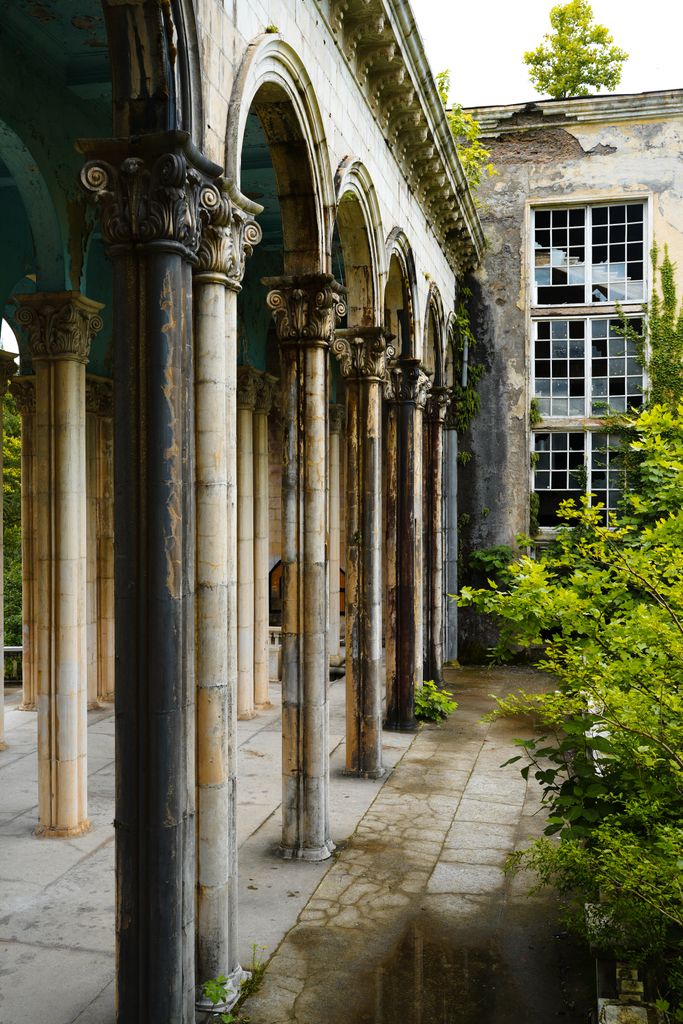
Guests arrived with a doctor’s referral and a state-funded voucher, typically for a stay of two weeks or more, and followed a prescribed daily regimen of treatments alongside the dining halls, libraries, theaters and conference rooms that made the stay feel like a holiday.
The Soviet constitution guaranteed laborers a right to rest and leisure. Tskaltubo was one of the places that right physically existed.
It was worth building because it was underground. The springs here are radon-carbonate, emerging naturally between 33 and 35°C, warm enough to bathe in without heating, and prescribed for rheumatism, arthritis, inflammation and skin conditions.
Why the Town Was Built Around the Baths
One constraint shaped the entire town: the water is said to lose its therapeutic properties within minutes of leaving the ground, so it can’t be bottled or piped any distance. Every bath had to be built directly over the source.
That’s why the balneological zone sits at the center of the park, and why more than twenty enormous buildings are arranged in rings around it rather than scattered across the region.
The Georgian Soviet Republic designated Tskaltubo an official balneotherapy center in 1931, and by the 1950s it was drawing up to 125,000 visitors a year. Stalin is said to have come in 1951 to treat arthritis in his leg, though the records of his visits are thin and most careful accounts hedge it. His name is attached to a great deal here. Treat the attributions loosely.
The buildings themselves were assigned by profession, which is what makes the place legible once you know it. Sanatorium Metallurgist housed steelworkers and miners. Rkinigzeli belonged to the railway workers. The Ministry of Defense had its own. You weren’t choosing a hotel. You were sent to your industry’s building, and its grandeur said something about where your industry sat in the Soviet order. Go figure.
What Changed in 1991
Then, in 1991, the state that paid for it all stopped existing, and the vouchers stopped coming.

Who Lives in Tskaltubo Now
What happened next is the part most visitors don’t know, and it’s why the word “abandoned” is only half right.

The 1992 conflict in Abkhazia displaced more than 200,000 Georgians inside their own country. About 10,000 were housed in Tskaltubo’s emptied sanatoriums. The arrangement was explicitly temporary. It lasted three decades. Children were born and raised in these buildings. People died in them. Families bricked up balustrades to turn balconies into kitchens, planted vegetables in the ornamental gardens, and burned what was left of the parquet flooring to get through winters.
Lucas, our guide, explained this as we stood inside Metallurgist, the right place to hear it, because you can see the evidence from the entrance hall.
Only in the past couple of years have most of those families been rehoused in proper apartment blocks.
Here’s what that means for your visit. Tskaltubo was never a ghost town, and parts of it still aren’t. You will walk past doors with mats outside them and laundry strung between them. Behave accordingly.
What Happens to Tskaltubo Next
The town is being sold.
The government’s “New Life for Tskaltubo” plan, launched in 2022, aims to turn it into a modern, world-class spa destination. Investors from Georgia, Egypt, Qatar and elsewhere have bought several of the former resorts. A few are under renovation. Others are now fenced and closed, which is why access is so unpredictable month to month.
On paper, that’s good news. The families who spent three decades in these buildings are getting actual apartments, thirty years late, and a town of around 7,000 people gets an economic future.
Who the New Tskaltubo Is For
The concern is who it’s for. Writing for Matador, Eloise Stark notes that a night at the reopened Legends resort runs about $80 in a country where the average monthly salary sits under $800, and that critics of the redevelopment expect the new properties to price out the people who live here. She goes further, describing the sanatoriums as having worked as a kind of third space, neither operational nor entirely abandoned, belonging to everyone and no one at once, and argues that privatization ends that condition for good.
I think she’s right, and it’s something most visitors miss. These buildings weren’t just sitting empty. They were in use. Medea, the one we couldn’t get into, is a favorite backdrop for wedding photographs. Buildings here have served as polling stations. Teenagers meet in them.
So when you read that Tskaltubo is being restored, keep in mind what’s being restored and what’s being closed off. The buildings will be saved. The arrangement by which a town of 7,000 people had the run of twenty palatial buildings will not be.
How to Visit Tskaltubo Respectfully
I’m putting this near the top because it changes how you plan the day.
- Don’t photograph people, their doorways, their laundry, or anything that identifies where someone lives
- Don’t enter occupied wings, stairwells or apartments, even when a door is standing open
- Hire a local guide so the money stays in Tskaltubo, and accept it when a guide or a guard tells you no
- Leave everything exactly where you found it. Nothing goes home as a souvenir
- Never force entry into a locked building
- Don’t publish entry points or workarounds for buildings that are closed
Residents here are long accustomed to visitors walking through their buildings. That familiarity is not the same as consent, and it is worth not spending down.
Is It Legal to Visit the Tskaltubo Sanatoriums?
Generally, yes. The word “abandoned” makes people assume otherwise, so I want to be clear about it.
Many empty sanatoriums sit on publicly accessible land, and visiting them is lawful. The exceptions are the properties bought by private investors, which are increasingly fenced, gated or guarded, and those you should treat as closed whether or not you can find a way in.
My objection to going in alone was never legal. The floors are unsound, and you can’t always tell which rooms are occupied. Different problems, same answer.
Can You Actually Get Inside the Tskaltubo Sanatoriums?
Sometimes. Not reliably, and often not the building you came for.
We attempted four in a single morning and got inside one. I’m giving you the sequence rather than a list, because the pattern is the useful part.
Bathhouse No. 6 and Bathhouse No. 8
We started at Bathhouse No. 6, the functioning spa at the center of the park, where Lucas laid out the history before we saw a single ruin. Starting with a working building rather than an abandoned one turns out to be the right order. You understand the ruins better once you’ve stood in a room that still does the job it was built for. We didn’t get past the lobby, for reasons I’ll come to.
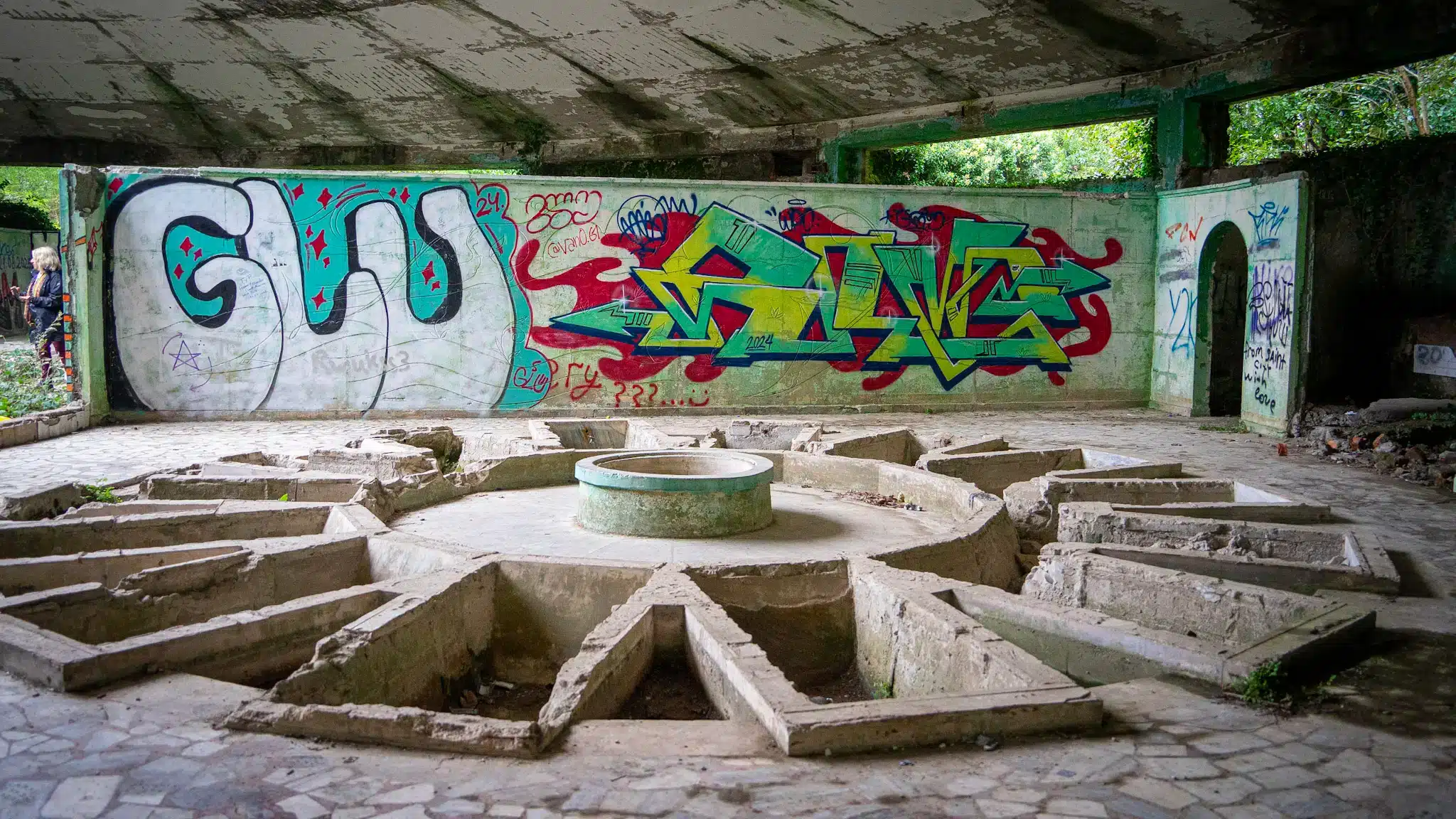
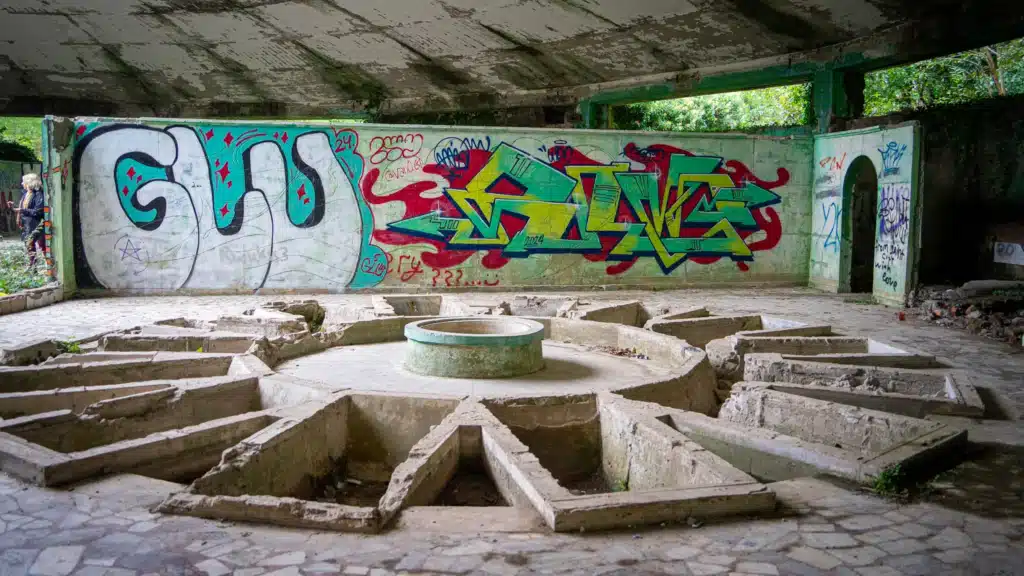
From there it’s a short walk to Bathhouse No. 8, which is abandoned, open, and the most architecturally confident thing in town. Where No. 6 is Stalinist and heavy, No. 8 is a low circular concrete shell with individual baths arranged like petals around central fountains and a wide opening in the roof. Faded nature scenes are still legible on the walls under the algae. It reads as optimistic in a way almost nothing else here does.
Sanatorium Medea
Then we drove to Sanatorium Medea, the building you have definitely seen photographed, and we were refused.

A visitor fell inside Medea in July 2026 and lost her life. The building has been taped off and guarded ever since. Our group arrived with a licensed guide and the right credentials, and the security guard politely turned us away, with no room for negotiation. Had we gone around him, we’d have been trespassing on guarded property, which is a different kind of travel day altogether.
Before you book anything, know this: Medea still appears on the published itineraries of Kutaisi day tours sold online. Don’t choose a tour on the strength of it.


Sanatorium Metallurgist
That brings us to Sanatorium Metallurgist, the one that justifies the trip.
Metallurgist was built for the steelworkers and miners, and it has survived in better condition than almost anything else in Tskaltubo. The entrance hall still holds its original molding and the chandelier everyone comes to photograph. Deeper in, there’s an old library, the doctors’ offices, a theater.


On the second floor, two elevators, one pink and one blue, one for women and one for men. Lucas walked us through the building’s history as we stood inside, which is a fundamentally different experience from reading the same information on a screen beforehand.
Then a section of the ceiling gave way in the front room by the chandelier, and we were asked to leave. Our guide Giorgi and Lukas didn’t want any liability.
Nobody was hurt, and I don’t want to make it sound more dramatic than it was. It wasn’t a storm or a crowd or anything that announced itself. It was an ordinary weekday morning in a building that hadn’t been maintained in thirty-five years, and it stayed a non-event because the people responsible for us recognized what was happening and moved us out without debate.
The Children’s Playground
We finished at the children’s playground behind Sanatorium Gelati, which was the only facility in Tskaltubo built specifically for mothers and children.

Geometric climbing frames set with colored mosaic tiles, animals and figures worked into the patterns. It’s one of the best surviving examples of Soviet mosaic work in Georgia; it’s rusted and small, and nobody plays on it, and it’s the part of the morning I’ve thought about most since.
If you want a complete inventory of all twenty-plus buildings, plus a verified map and walking route, Emily Lush at Wander-Lush lives nearby and maintains the most thorough English-language guide. I’d read hers alongside this one. Her guide served as an excellent resource for my trip.
I wanted to know what I was walking into prior and maybe after becasue there was a bit of an issue with our city guide. Even though our guide for our group trip did the best to fill in the blanks after meeting with the city guide. I found Emily’s guide helped out a ton, big shout out to her!
Should You Visit Tskaltubo With a Guide?
Yes, for two reasons.
The first is comprehension. These buildings don’t explain themselves. Without someone to tell you that this one housed miners and that one housed railway staff, that the grandeur of each facade encoded the standing of an industry, that the families whose laundry you’re walking past arrived as refugees in 1993 and were promised something better within the year, you’re looking at handsome ruins and photographing the light. That’s exactly what I found in Nowa Huta, where the most significant thing in the central square was an absence I’d never have noticed alone.
The second reason is structural and specific to Tskaltubo. Access changes week to week, and the buildings are genuinely unsound.
If you go through a guide, knowing which floors hold, which wings are occupied, which guards to speak to, and when to stop asking is a real skill, and you don’t pick it up from a blog post an hour before you arrive.
Is Tskaltubo Safe for Solo Female Travelers?
I traveled Georgia as a woman and felt safe doing it. Tskaltubo is a narrower question, and my answer is: go, but don’t go into the buildings alone.
I hike solo and I travel solo. I still wouldn’t do this one by myself, and it has nothing to do with the town or the people in it.
A ceiling came down in a room near us. Stairwells are unlit and open to drops. Occupied wings aren’t always distinguishable from empty ones until you’re already in one. A guard turned away a credentialed guide with a full group, which tells you how little margin there is for improvising. And if something happens to you three floors inside an empty sanatorium, no one knows where you are.
A guide, a tour or a group resolves all of that. Walking the park, photographing the facades and booking a treatment at the working bathhouse on your own is a completely different proposition and a perfectly good afternoon.
I saw Tskaltubo as part of a small group trip through Georgia, and it was one of the days I’d have handled badly alone.
How to Get to Tskaltubo from Kutaisi
Tskaltubo sits about 15 km from central Kutaisi, 20 to 25 minutes by road, and roughly the same from Kutaisi International Airport. Half a day minimum, a full day if you’re adding the baths or a cave.
Guided tour from Kutaisi. Explore Tskaltubo Soviet Era Sanatoriums from Kutaisi
What I’d recommend. Tours start around $28 per person and typically cover the railway station, Metallurgist, Spring No. 6 and Bathhouse No. 8, with the small Metallurgist entrance fee included.
Taxi. A Bolt from the city center runs roughly 15 to 20 GEL each way. Flexible, and you’re navigating the buildings yourself.
Marshrutka. The number 30 leaves from the end of the Red Bridge every 15 to 20 minutes and costs 2 GEL. Cheapest, slowest, and you’ll want a plan for getting back.
If you come independently, most of the sanatoriums are free to enter, while at Metallurgist a resident or caretaker usually asks for around 5 GEL. Bring small notes. Some restaurants in town are cash only, though there are ATMs that take international cards.
Download your maps before you go. I used a Holafly eSIM for the whole eleven days in Georgia and hit a few dead zones out in the regions, so I wouldn’t count on signal here. Get your eSim for Georgia
Planning Your Georgia Trip?
Start with these guides from my October trip.
Bathhouse No. 6: Reserve Before You Go
This is the most actionable thing in the post, and I learned it by getting it wrong.

Bathhouse No. 6, now signed as Spring No. 6, is one of the rare Soviet-era spas here that never closed. It was built over the spring in 1951, it’s privately owned and fully restored, and it still offers the complete balneological menu: radon baths, sports massage, speleotherapy, the lot. A private cabin bath runs 25 GEL. The shared pool at Spring No. 1 is 20 GEL. Both are open daily, 10:00 to 17:00.
On paper that reads like a walk-in. In practice a physician typically assesses visitors and prescribes an individual course, and what you pay depends on which treatments you’re given, a structure inherited directly from how the place worked in 1951. Lucas was unambiguous that reservations were required, particularly for a group. We hadn’t made them. We saw the lobby and the history, and that was as far as we got.
Tetra Cave: A Georgian Wine Tasting Underground
Prometheus Cave sits six kilometers up the road and appears on nearly every Kutaisi itinerary. We went to a different cave instead, and I am not sure if I’d make the same choice again. While Tetra was a wonderful experience, please know that both promise something completely different.
Tetra Cave lies a couple of kilometers east of town near Tsivi Lake. Its history is the interesting part: it was used for speleotherapy in the Soviet period, the same breathing treatment still on the menu at Bathhouse No. 6, which makes it part of the same medical infrastructure as the sanatoriums rather than a separate attraction. It’s now used to age wine from the surrounding Imereti vineyards.
Imereti is the region most visitors fly over on the way to Kakheti, and it makes wine in its own style. We tasted a classic Georgian lineup, whites, reds and amber, which is the right expectation to set. This isn’t a rare-bottle tasting. It’s the wine Georgians drink, served cold underground by the people who make it.
The rosé was my favorite, and I bought a bottle for easy drinking in the van on our group’s drive the following day.
Tetra Cave is also called White Cave, lies a couple of kilometers east of town near Tsivi Lake and sits within Georgia’s protected areas network. The cave was used for speleotherapy during the Soviet period, the same breathing treatment still on the menu at Bathhouse No. 6, which means it belongs to the same medical infrastructure as the sanatoriums rather than being a separate attraction bolted onto the day. Tskaltubo prescribed both the water and the air.
Tetra Cave Tickets and Tours
What it costs. Entry alone runs 20 GEL, roughly $7.50. The tasting package, which covers entry plus a degustation of the cave-aged wines, is 35 GEL, around $13. At a 15 GEL difference, skipping the wine to save five dollars is a strange economy, though the option is there if you’re the one driving.
If you’d rather do this as part of a guided day, the sanatoriums and cave tasting tour covers both halves of this post and handles the transport in between.
Bring a layer. Fourteen degrees is pleasant for wine and cold for standing around in.
Kimberly’s Tip
If a wine lands with you at a tasting, buy the bottle there. It improves the next long transfer considerably.
Read Next
For more on Georgian wine and the harvest season, see my 10-day Georgia itinerary.
See the 10-Day Georgia Itinerary →Where to Stay in Kutaisi
Base yourself in Kutaisi rather than Tskaltubo. There are spa hotels in Tskaltubo itself, including the restored Legends resort, but Kutaisi gives you the restaurants, the airport, and the rest of the region.
We stayed two nights at the Newport Hotel Kutaisi, and I’d book it again. Spacious rooms, central, a decent breakfast buffet, and an elevator.
Kimberly’s Tip
Check for an elevator before you book anywhere in Kutaisi. A lot of the central stays are in older buildings with stairs and no lift, and that’s a real problem after a day on your feet in Tskaltubo.
Tskaltubo FAQ
Is Tskaltubo worth visiting?
Yes, if you’re interested in Soviet history, architecture, or what happens to a place after its purpose disappears. No, if you want a tidy attraction with a gift shop.
Can you go inside the abandoned sanatoriums in Tskaltubo?
Some of them, some days. Metallurgist is usually accessible for a small fee. Medea has been closed since July 2026 after a visitor was injured. Access changes constantly, which is the single most important thing to understand before you go.
Is it legal to explore them?
Generally, yes, since many sit on publicly accessible land. Buildings bought by private investors are fenced or guarded and should be treated as closed.
Do you need reservations for Bathhouse No. 6?
Our guide said yes, and we couldn’t get in without them. Book ahead, especially as a group.
How long do you need in Tskaltubo?
Half a day for the sanatoriums. A full day if you’re adding a bath or a cave.
Should you visit Tskaltubo with a guide?
In my opinion yes, and not only for safety. The buildings don’t explain themselves, and a guide knows which ones are open that week.
Is it disrespectful to visit Tskaltubo?
It depends entirely on how you do it. A local guide puts money into the town and keeps you out of occupied spaces. Going in alone and treating people’s homes as a photo set is a different trip.
Sources and Further Reading
Most of this guide comes from my own visit in October 2026. I want to make it very clear after my visit, I did more research and wanted to bring something different to the blogging space.
On the Way Home (2024), directed by Giorgi Kvelidze. A documentary following three generations of one displaced family in Tskaltubo through the pandemic and into government-provided housing. Premiered in Tbilisi on 1 October 2026 and streaming on Cavea+. The single best thing you can watch before visiting.
Review: On the Way Home by Xandie Kuenning, OC Media. My source for the film’s content, including the detail about housing being allocated by raffle in a local football stadium. OC Media covers the Caucasus independently and is worth following generally if the region interests you.
Inside Tskaltubo, Georgia: the Abandoned Wellness Resort About to Change Forever by Eloise Stark, Matador Network. The source of the third-space framing I quote in the redevelopment section, and the clearest account I’ve read of what the New Life for Tskaltubo plan actually means for the people who live there.
The Ultimate Guide to Tskaltubo by Emily Lush, Wander-Lush. The most thorough English-language inventory of Tskaltubo’s buildings, with a verified map and a walking route. Lush lives nearby and updates it continuously, so it’s where I’d check current access before a trip, alongside the comments, where readers report what they found.
Tskaltubo Spa Resort for current treatments and pricing at Bathhouse No. 6.
Prices, opening hours, and access were accurate as of October 2026. Tskaltubo changes faster than most places, so verify before you travel.
Keep Planning
More From My Georgia Trip
Save This Guide for Your Trip to Georgia
Pin this so you have the history, the Bathhouse No. 6 booking tip and the drive from Kutaisi handy when you plan your visit to Tskaltubo.