
10 Day Georgia Itinerary: Tbilisi, Kakheti, Kutaisi and Rabati Fortress
Last Updated on November 10, 2026 by Kimberly
Planning a 10-day Georgia itinerary? This is the exact route I traveled in October 2026: Tbilisi, the Kakheti wine region during the Rtveli grape harvest, Kutaisi and Tskaltubo, and Rabati Fortress. For each day you’ll get the drive times, where I stayed and what to book ahead.
I traveled this route on a small group trip with Type 2 Travel, hosted by Laura Ericson, and you can read Laura’s recap of our trip for her side of it. Follow the days as they are, or skip to my notes on how to do this route on your own.
In a Rush?
Where I Stayed on This Route
| Tbilisi | Khedi Hotel, Avlabari Check rates and availability |
| Telavi | Esquisse Hotel Check rates and availability |
| Kutaisi | Newport Hotel Check rates and availability |
| Akhaltsikhe | Hotel Gino Wellness, Rabati Check rates and availability |
| Airport | Ibis Tbilisi Airport Check rates and availability |
Georgia Itinerary at a Glance
- Day 1: Arrive in Tbilisi
- Day 2: The Dry Bridge Market and the sulfur baths
- Day 3: Old Tbilisi walking tour, a Tbilisoba wine walk, Mtskheta and Jvari
- Day 4: Kakheti wine harvest in Manavi and Sighnaghi
- Day 5: Alaverdi Monastery and a wool workshop in Alvani
- Day 6: Kutaisi, Tskaltubo and wine in a cave
- Day 7: Katskhi Pillar, Chiatura and Rabati Fortress
- Day 8: Tenili cheese in Chobareti and a family marani
- Day 9: Uplistsikhe, Gori and a final supra in Khidistavi
- Day 10: Departure
Why October Is the Best Time for This Georgia Itinerary
If you have any flexibility, plan this trip for October. It’s Rtveli, Georgia’s grape harvest season, when families across Kakheti bring in their grapes and small wineries open their cellars to visitors. I was also in Tbilisi for Tbilisoba, the city’s autumn festival, which meant food stalls, music, and crowds in the streets on Friday and Sunday evening.
The weather was kind to us, too. I had temperatures in the high 60s to the 70s°F in Kakheti and Borjomi, and 70s to 80°F in Tbilisi and Kutaisi, where we also got rain. Pack layers and a rain jacket, and you’ll be comfortable for every stop on this route.
Kimberly’s Tip
Georgia has required foreign visitors to carry travel health insurance for the length of their stay since January 1, 2026. Buy your policy before you fly and keep a digital copy on your phone in case you’re asked for it at the border.
Map of Your 10 Day Georgia Itinerary
Every stop on this route, color-coded by day. Tap a pin for details, or open the map full screen to save it to your phone.
Drive times are Google Maps estimates without stops. Allow extra time for photo stops, mountain roads and traffic leaving Tbilisi.
Day 1: Arrive in Tbilisi
Clearing Customs With Proof of Travel Insurance
Passport control and customs at Tbilisi International Airport took a while when I arrived, so have your proof of travel insurance ready before you reach the desk. I used World Nomads, on the Explorer plan. It added about $200 USD to my trip; it worked well for me, and I don’t regret the expense.
For Military Travelers
If you’re military or a military family member headed to Georgia, don’t rely on Tricare alone. When I called the Tricare hotline, the representative told me it was wise to carry supplemental insurance, because they couldn’t say whether Tricare would be able to help right away. An extra layer of coverage is worth having.
Book Your Airport Transfer Before You Land
Flights into Tbilisi International Airport tend to land at odd hours, and many arrivals from Europe come in late at night or before dawn. Rather than sorting out a taxi when you’re tired, book a Welcome Pickups transfer ahead of time so a driver is waiting for you when you leave arrivals.
Trust me, you WANT to do this prior to arriving in Tbilisi.
Landing in the middle of the night? Skip the drive and stay at the Ibis Tbilisi Airport instead. It’s about a five-minute walk from the terminal, and you can head into the city after a proper night’s sleep.
My Top Pick
Tbilisi Airport Transfer with Welcome Pickups
| What | Private transfer from Tbilisi Airport to your hotel |
| Why | Flights land at odd hours, and your driver tracks your arrival |
| Best For | Solo travelers and late-night arrivals |
Where to Stay in Tbilisi
Before the group trip, I spent three nights with a friend in an apartment on Erekle II Street in the Old Town. Once the trip began, we moved to the Khedi Hotel in Avlabari, across the river. Khedi is where I’d send you if you want a little luxury between long days on the road: the food was good, the amenities were comfortable, and it was an easy place to reset before heading into the regions.
Read Next
For a full breakdown of neighborhoods, read my guide to where to stay in Tbilisi.
Getting Around Tbilisi
Download Bolt, the ride-hailing app, before you arrive. It’s how I got around the city, and it saves you from negotiating fares with taxi drivers. For data, I used a Holafly eSIM (the 12-day plan) for the whole trip, and it worked well, except for a few dead zones between towns.
Kimberly’s Tip
Google Maps can go haywire in Georgia, so don’t rely on it alone. Save your hotel address and your key stops offline before you leave the Wi-Fi, and use Bolt rather than walking directions when you’re unsure.
Day 2: The Dry Bridge Market and the Sulfur Baths
Give yourself one full day in the capital before you head into the countryside. This itinerary keeps Tbilisi short so you have more time in the regions.
Morning: Ease Into Tbilisi
Since flights into Tbilisi tend to land at odd hours, keep this morning open. Sleep in, find coffee near your hotel, and get your bearings in the Old Town before the afternoon.
Afternoon: The Dry Bridge Market and the Painters’ Stalls
By mid-afternoon, head to the Dry Bridge Market, an open-air flea market selling Soviet-era odds and ends, jewelry and vintage finds. It’s busiest on weekends, so plan around that if you want the full spread of stalls.
Right beside the market, local artists set up their work in an open-air art area, and the quality of the paintings there is astounding. I bought a simple painting for 65 lari from a father and son, who told me the father’s father started this square.
Kimberly’s Tip
Bring Georgian lari in cash for the market and the art stalls. Take a few minutes to talk with the artists before you buy, since many of them are glad to tell you about their work.
Evening: The Orbeliani Baths in Abanotubani
Tbilisi exists because of these hot springs. According to legend, King Vakhtang Gorgasali was hunting here in the 5th century when his hawk chased a wounded pheasant, and both birds were later found in a boiling spring. The discovery convinced him to build his city there, and he named it after the Georgian word tbili, meaning warm. I credit Giorgi with telling us this so enthusiastically; otherwise I wouldn’t have remembered it.
The same springs still feed the domed brick bathhouses of Abanotubani, the old bath district below Narikala Fortress, where the water rises naturally hot and smelling of sulfur. There were 65 bathhouses here in the 12th century. For generations, locals socialized, settled business, and spent entire afternoons there, and visitors fell for them too: Alexandre Dumas visited them often during his month in Tbilisi in 1858, and Alexander Pushkin wrote that he had never experienced anything more luxurious than a Tbilisi bath.


Our group went to the Orbeliani Baths, also called Chreli Abano or the Colorful Bath. It dates to the 17th century, and you’ll recognize it by its tiled blue facade. We had a private suite, and it was a comfortable space for the whole group. If you’ve been to a hammam, the experience will feel familiar, except this time our whole group was in on the action. You can read all about it in my guide to the Tbilisi sulfur baths.
If you’re curious how it compares, here’s what it’s like to get a hammam in Morocco.
Day 3: Old Tbilisi on Foot, a Tbilisoba Wine Walk, Mtskheta and Jvari
Drive Time Tbilisi to Mtskheta, about 35 minutes each way
This was the fullest day in Tbilisi, and yes, we did it all in one day. If you’d rather slow down, split the walking tour and Tbilisoba from Mtskheta and Jvari, and give each its own day.
Morning: A Walking Tour of Old Tbilisi With Giorgi
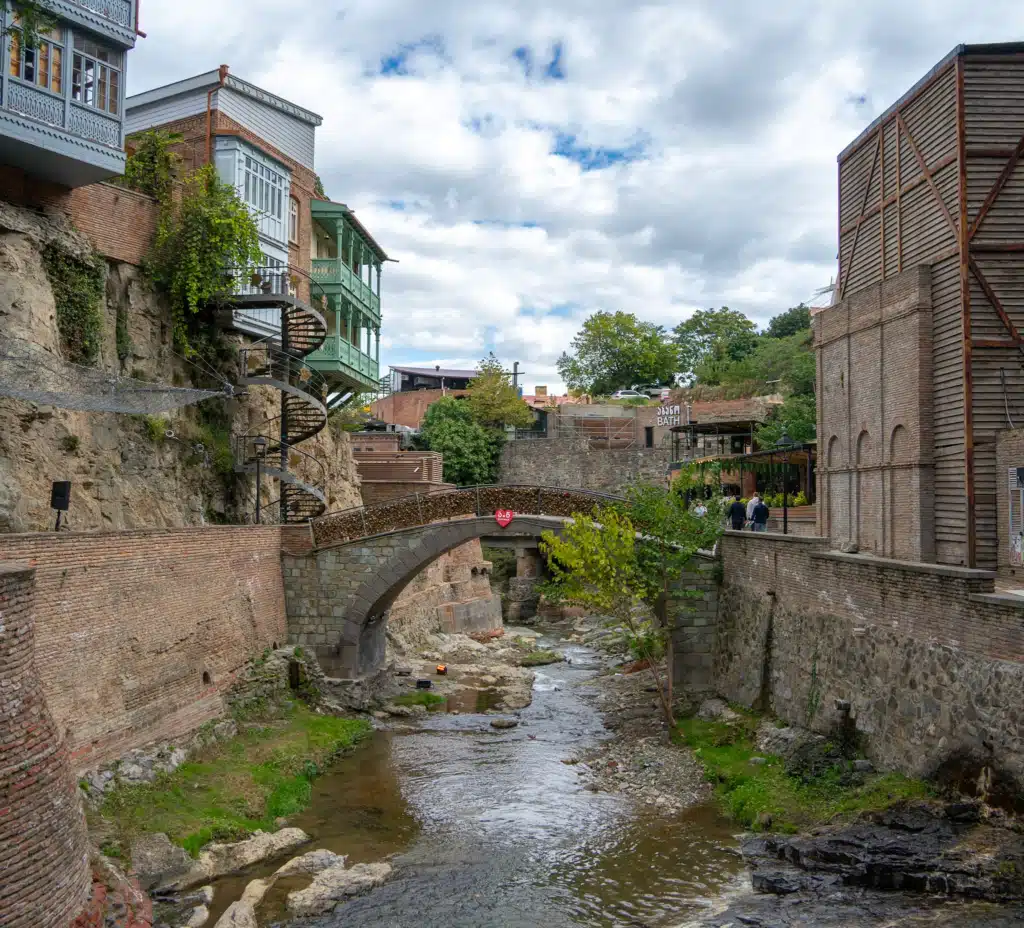
Our guide, Giorgi, started us at the waterfall tucked in the gorge behind the sulfur baths, then led us up through the Old Town as he walked us through Tbilisi’s history, from its founding to the Persian, Ottoman, and Russian influences you can still see in its streets. We finished underground at the Meidan Bazaar, a market of spices, churchkhela, wine, and souvenirs built beneath the square, which is a good place to pick up gifts before you leave the city.

Not Traveling With a Guide?
Book an Old Tbilisi Walking Tour
If you’re not traveling with a guide, this Old Tbilisi walking tour covers much of the same ground.
Check Availability on GetYourGuideLunch: Balcony No 12
We stopped for lunch at Balcony No 12, where I had the chicken in blackberry sauce and a glass of tarkhuna, the bright green Georgian tarragon soda. For more places I loved, see my guide to the best restaurants in Tbilisi. We also had several glasses of wine.


Afternoon: A Wine Walk Through Tbilisoba
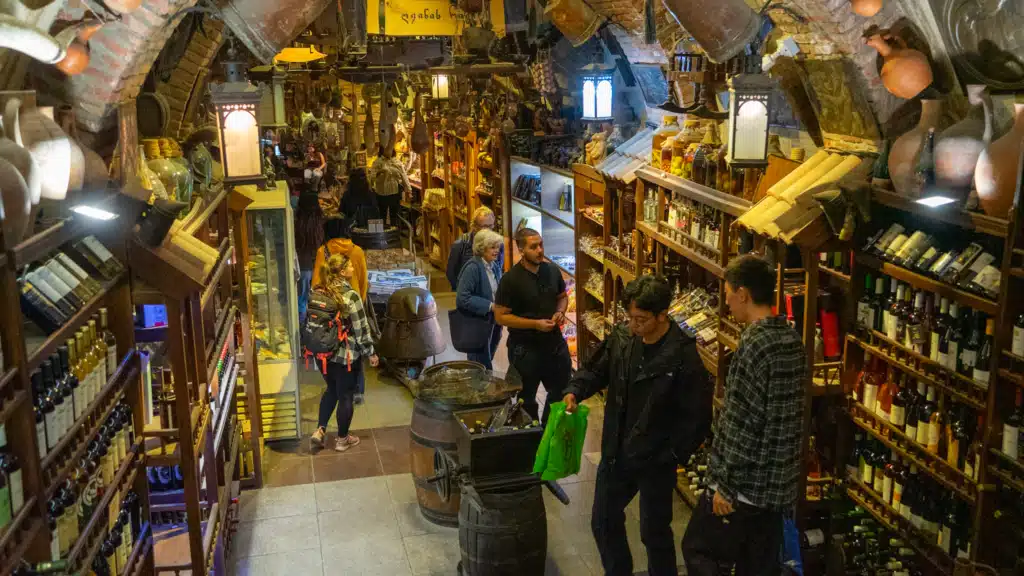
We were in town for Tbilisoba, the city’s annual autumn festival celebrating Tbilisi, the harvest, and Georgian food and wine. The streets fill with food stalls, music, and families, and it’s an easy festival to enjoy without a plan. We joined a wine walk through the festivities, stopping for tastings along the way, and ended the afternoon in a wine cellar for one last tasting before heading out of the city.



Golden Hour: Mtskheta and Jvari Monastery
Mtskheta sits about 30 minutes north of Tbilisi and was the capital of the ancient Kingdom of Iberia. Its historic churches, including Svetitskhoveli Cathedral and Jvari Monastery, are listed together as a UNESCO World Heritage Site. We timed our visit to Jvari for golden hour. The monastery stands on a hilltop above the point where the Aragvi and Mtkvari rivers meet, and late afternoon is when the light falls across the valley and Mtskheta below.


Evening: Dinner and Folk Dancing at Tsiskvili
Back in Tbilisi, we had dinner at Tsiskvili, a riverside restaurant on Akaki Beliashvili Street, with a Georgian folk dance show during the meal. Reserve ahead, especially on weekends, and ask for a table with a view of the stage.
Day 4: Kakheti Wine Harvest in Manavi, Sighnaghi and a Family Marani
Drive Time Tbilisi to Sighnaghi, about 2 hours. Sighnaghi to Telavi, about 1.5 hours
The wine harvest was one of my favorite days of the trip, and it’s the reason I’d plan this route for October.
Morning: Lunch and Qvevri Wine at Giuaani Winery
We drove east from Tbilisi to Giuaani Winery in Manavi for lunch. The winery gave us a demonstration of qvevri winemaking, the Georgian method of fermenting wine in large clay vessels buried in the ground, followed by a tasting. UNESCO recognizes the qvevri method as part of the world’s intangible cultural heritage, and Georgia has been making wine this way for around 8,000 years.


Afternoon: Sighnaghi and the Alazani Valley
This is the stop with the ziplining… although I am not sure if many people will enjoy this.
After lunch, we spent time in Sighnaghi, a hilltop town ringed by 18th-century defensive walls with views across the Alazani Valley toward the Caucasus. It’s small enough to see in an hour or two, which makes it an easy stop on the way to the vineyards.

Late Afternoon: Rtveli at Vakho Oqruashvili Wine Cellar
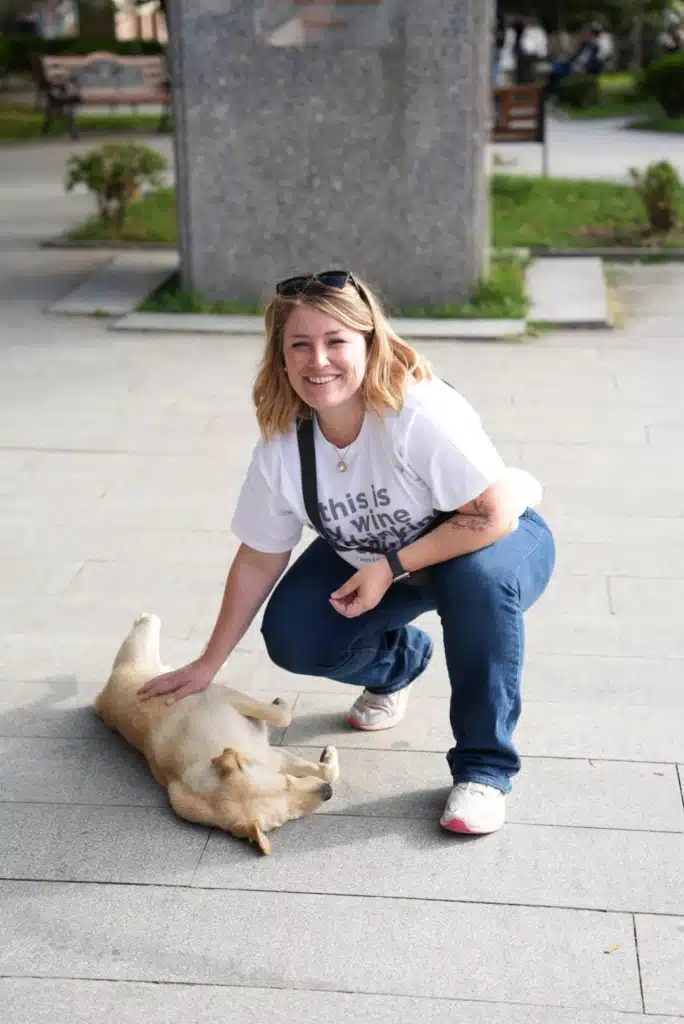
Rtveli is the Georgian grape harvest, and it’s as much a celebration as it is farm work. On the drive to Vakho Oqruashvili Wine Cellar, the first thing that struck me was how lush Kakheti was, followed by the trucks we passed on the road, filled to the brim with grapes.
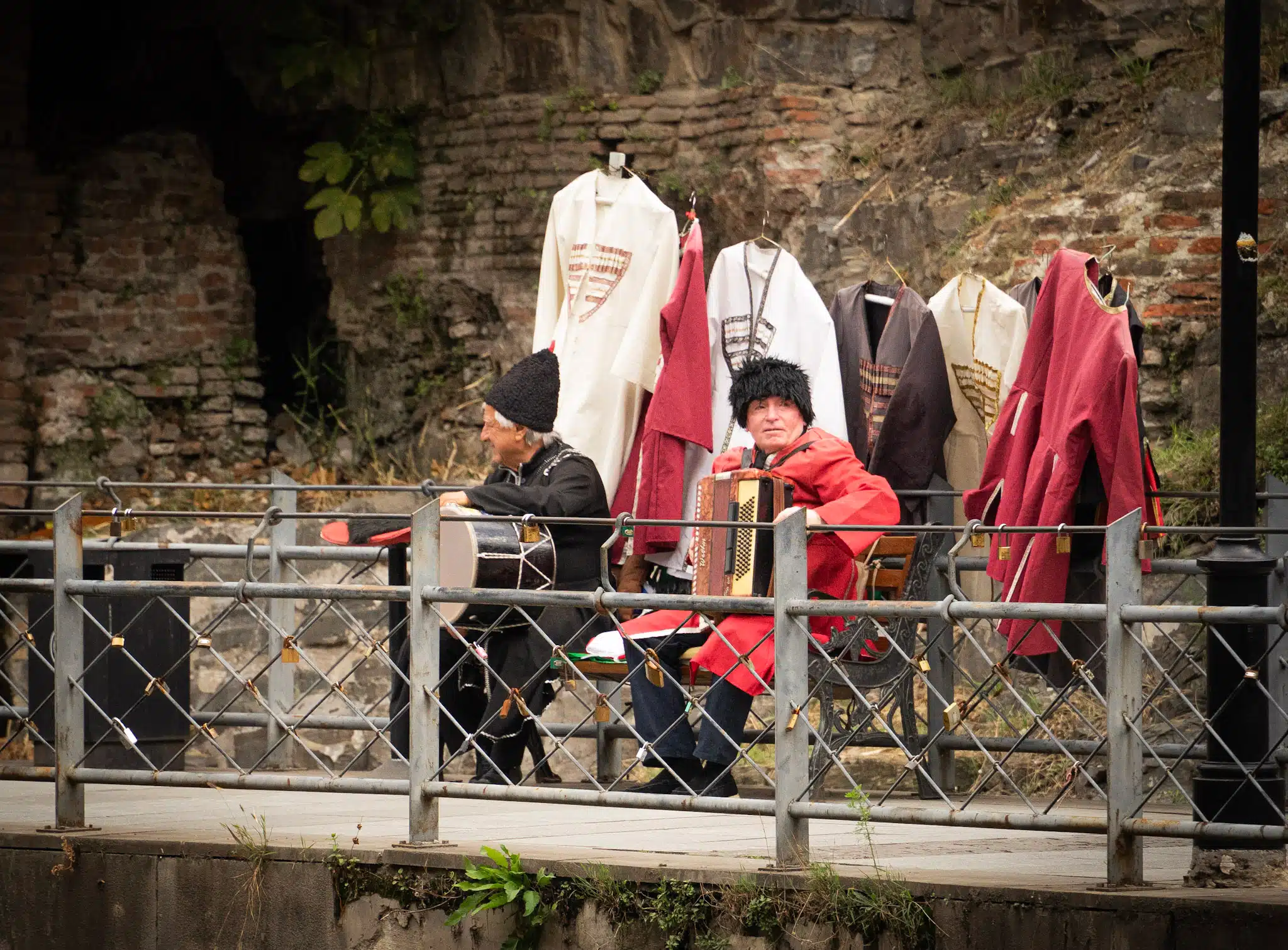
At Vakho’s marani (the Georgian word for a wine cellar), we picked grapes, squashed them with our feet, folded khinkali, drank wine off a roof tile and somehow ended up dancing. Then came our first big supra, the traditional Georgian feast, where Giorgi explained the role of the tamada, the toastmaster who leads the table through a long series of toasts.


Kimberly’s Tip
Vakho Oqruashvili Wine Cellar is a small family operation, and visits are by reservation only. Message them on Instagram at @vakho_oqruashvili_wine_cellar well before harvest season if you want to join in.
Where to Stay in Telavi
We spent the night at the Esquisse Hotel in Telavi, the main town in Kakheti. It puts you in a good position for the next morning’s drive to Alaverdi and Alvani.
Day 5: Alaverdi Monastery and a Wool Workshop in Alvani
Drive Time Alvani to Kutaisi, about 4 to 4.5 hours
Morning: Alaverdi Monastery
Start the day at Alaverdi Monastery, whose 11th-century cathedral is one of Georgia’s tallest medieval churches. It sits in the middle of the Alazani Valley with vineyards around it, and the monks there still make wine.
Afternoon: Tushetian Wool and Felting in Alvani
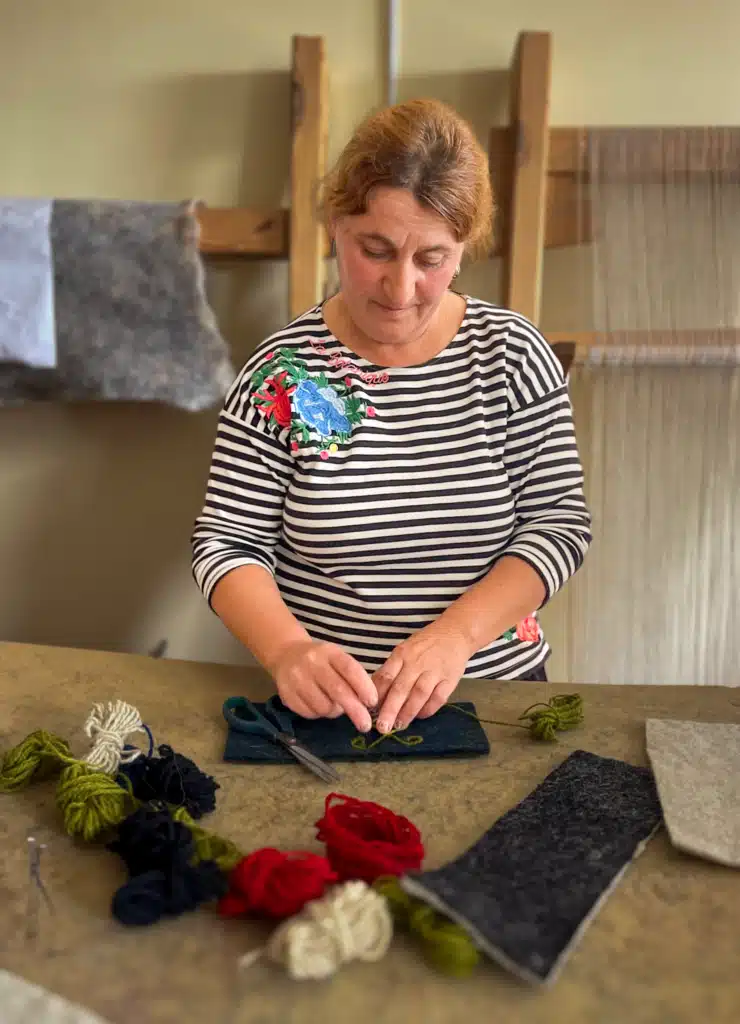
This was one of my favorite days of the entire trip. In Alvani, we visited a Tushetian wool factory, ate a Tushetian lunch with mountain tea and homebrewed beer, and took a felting class. For how to book it and what I bought, see my Tusheti wool factory and felting class guide. The Tushetians are shepherds from the remote Tusheti region in the high Caucasus, and many families spend the winter in Alvani, where the road and the weather are easier.
Wool and felt work are among Georgia’s oldest traditional crafts.



Evening: Drive West to Kutaisi
From Alvani, it’s a long drive west across the country to Kutaisi, so plan to arrive in the evening. We stayed two nights at the Newport Hotel, which made a convenient base for the next day’s stops.
Day 6: Kutaisi, Tskaltubo and Wine in a Cave
Drive Time Kutaisi to Tskaltubo, about 20 minutes
Morning: Kutaisi’s Central Market and the Colchis Fountain
Kutaisi is Georgia’s third-largest city and the center of the Imereti region. Start at the central market for spices, cheese and churchkhela, then walk to the Colchis Fountain, which is decorated with replicas of gold artifacts from the ancient kingdom of Colchis.
Afternoon: The Abandoned Sanatoriums of Tskaltubo
Tskaltubo, about 20 minutes from Kutaisi, was one of the most popular spa towns in the Soviet Union, known for its radon-rich thermal water. Today, many of its grand sanatoriums are abandoned. With our guide, we went inside some of the abandoned buildings and saw that families are still living in parts of them, a reminder that these are homes and not just photo spots.
We also stopped at Bathhouse No. 6, which is still open, and got a short history lesson there. We didn’t soak, because you need a reservation to use the baths, so book ahead if you want to.
For the history, what you can get into and how to book Bathhouse No. 6, check out my full guide to visiting Tskaltubo.

Kimberly’s Tip
I would never explore Tskaltubo’s abandoned buildings alone. There are too many safety factors, from unstable floors to the fact that people still live in some of them. Go with a local guide or a group, and treat the residents’ spaces with respect.
Late Afternoon: Wine Tasting in Tetra Cave
Instead of Prometheus Cave, the region’s best-known cave, we did a wine tasting at nearby Tetra Cave. Both the cave setting and the wine were the draw, and it’s a good alternative to Prometheus if you’d rather pair your cave with a glass of wine.
Evening: Dinner With a View of Gelati Monastery
We ended the day with dinner at Korena’s guesthouse, looking out toward Gelati Monastery, the 12th-century monastery and academy outside Kutaisi that’s listed as a UNESCO World Heritage Site.
This cooking class at Agrohouse was probably one of my favorites because she was so welcoming. We were one of many groups who came through that day, and she told us we were the least demanding and so kind. When we went into the back to wash our hands in the kitchen, it was like she had a whole community of women back there working– they made one of the best tables of food that I have ever had. So thank you to her and her wonderful group of friends.


Day 7: Katskhi Pillar, Chiatura and the Road to Rabati Fortress
Drive Time Kutaisi to Katskhi Pillar, about 1 hour 15 minutes. Chiatura to Akhaltsikhe, about 3 hours 15 minutes
Morning: Katskhi Pillar
Katskhi Pillar is a natural limestone column roughly 40 meters (130 feet) tall, with a small church and hermit’s cell on top. Monks have lived up there on and off for centuries. You can’t climb it, but the view from the base and the monastery beside it are worth the stop.
We climbed to the base of the rock and all I can say about it is this was an imposing place to be. You can’t actually climb to the top of the rock, the monks prefer silence. Instead just marvel at the area and the church there and enjoy it.

Late Morning: Chiatura
Chiatura is a manganese-mining town set in a deep gorge, best known for the cable cars that have carried workers and residents up and down its cliffs since the Soviet era. It’s a short drive from Katskhi, so the two pair easily. We didn’t really do much here, there was an offer to stop but I think most of us wanted to keep rolling along.
Afternoon: Lunch in Makhatauri and the Borjomi Valley
We had lunch at a family winery in Makhatauri, then continued south through the forested Borjomi valley, stopping at a viewpoint along the way. Borjomi is the town behind Georgia’s famous salty mineral water, and the valley is part of one of the largest national parks in Europe, Borjomi-Kharagauli.


Evening: Check In at Rabati Fortress
We spent two nights at Hotel Gino Wellness at Rabati Fortress in Akhaltsikhe, a restored medieval castle complex where a mosque, a church, and the citadel walls sit side by side. Dinner at the Rabati Castle restaurant included pelmeni, the dumplings that came to Georgia from Russia.
I didn’t really enjoy this restaurant, I’ll be frank. Just the way it is.
Day 8: Tenili Cheese in Chobareti and a Family Marani
Morning: Making Tenili in Chobareti
Our day in Chobareti was another favorite moment of the trip. At a local ethnographic house, we learned about tenili, a Meskhetian string cheese pulled by hand into fine threads, and ate it alongside kada, a sweet, buttery Georgian bread. Tenili is a specialty of the Samtskhe-Javakheti region in southern Georgia.
Evening: Davit’s Marani Near Rabati
Back near Akhaltsikhe, we visited Davit’s small family marani. I couldn’t find it online afterward, and many small producers like this don’t have a website, so if you’re traveling with a local guide, ask about family cellars near Akhaltsikhe.
Davit’s cellar is small and cozy, and it turned into one of the most fun nights of the trip. He walked us through how he makes his amber wine (what you might know as orange wine), and then he and our guide, Giorgi, sang for us. Davit even brought out his brandy. The food was wonderful, and the potatoes were the best I’ve ever had.
Day 9: Uplistsikhe, Gori and a Final Supra in Khidistavi
Drive Time Akhaltsikhe to Uplistsikhe, about 3 hours. Uplistsikhe to Tbilisi, about 1.5 hours
Morning: The Cave Town of Uplistsikhe
Uplistsikhe is an ancient rock-cut town near Gori, carved into a sandstone ridge above the Mtkvari River and inhabited for more than 2,000 years. Wear shoes with good grip, because the rock is smooth and uneven in places.

Afternoon: The Khidistavi Dance Troupe
In the village of Khidistavi, we watched a performance by the local school’s traditional dance troupe. It was one of my favorite moments of the trip, and the kind of experience that’s hard to arrange on your own but worth asking a guide about.


Evening: A Final Supra With Polyphonic Singing
Our last harvest experience and supra was near Gori, hosted by a winemaker named Tengo, who took over production from his father and helps run the traditional dance school in Khidistavi. The evening included Georgian polyphonic singing, which UNESCO recognizes as a masterpiece of intangible cultural heritage.
Tengo is an absolute gem of a man; he and his family invited us in for a supra that was fit for royalty. Not only that, but there was also some polyphonic singing during the supra. The amount of effort he put into this was astounding, and it’s something I’ll never forget. Afterward, we drove back to Tbilisi and the Khedi Hotel for our final night.
Day 10: Departure
I spent my last night at the Ibis Tbilisi Airport, and it’s perfect for this. The hotel sits right next to Tbilisi International Airport. I walked out through the parking lot and was at the terminal in about five minutes, with no transfer to book and no early-morning drive across the city.
It works just as well on arrival. If your flight lands late at night or before dawn, check in at the Ibis, get some sleep, and head into Tbilisi in the morning.
If you’d rather spend your last night in the city, book a Welcome Pickups transfer to the airport the night before, especially if your flight leaves early. With a late flight, use the extra time for anything you missed on Day 2.
How to Do This Georgia Itinerary on Your Own
I traveled this route on a group trip, so someone else arranged our transportation, guides, and many of the experiences. If you’re planning it yourself, here’s what I’d change now that I know.
- Spend more time in Kakheti. One night in wine country wasn’t enough. I’d add at least one more so the region doesn’t feel rushed.
- Book a full harvest day with Vakho. Our harvest at Vakho Oqruashvili Wine Cellar was one part of a packed day, and I would have loved a full day there. Visits are by reservation only, so message the cellar on Instagram well before harvest season.
- Give Kutaisi more time. One full day covered Tskaltubo, Tetra Cave, and Gelati, but I’d stay longer next time. With an extra day or two, I’d try more of Kutaisi’s restaurants and spend more time in Tskaltubo’s abandoned spas (with a guide), which felt unlike anywhere else on the trip. Kutaisi also makes a great base for other day trips in western Georgia. And don’t leave without a cocktail at Bar Laboratium. It’s a little hidden, just past the courtyard near the Irish bar, and it poured some of the best cocktails I had in Georgia.
- Build in a down day. Long drives, early starts, and back-to-back supras add up. Plan one day with nothing on the schedule, ideally in Kakheti or Kutaisi.
- Sleep inside a qvevri. Hotel Qvevrebi in Telavi lets you sleep in a room built in the shape of a giant qvevri, the clay vessel Georgians have used to make wine for thousands of years, set among the vineyards of Kakheti. It’s an easy way to add that extra night in wine country.
- Plan your transportation between regions. Our driver was arranged for us, so you’ll need to book a private driver or rent a car for the drives between Tbilisi, Kakheti, Kutaisi, and Akhaltsikhe. In Tbilisi itself, Bolt is all you need.

What This Route Skips: Kazbegi and Svaneti
This go-around, I didn’t make it to Kazbegi or Svaneti, Georgia’s two best-known mountain regions. I’m hoping to get there next year, and when I do, I hope you’ll come back and read all about it! In the meantime, if mountains are high on your list, either one is worth adding to this route.
Kazbegi is the easier add-on. The town of Stepantsminda sits about three hours north of Tbilisi along the Georgian Military Road, and it’s home to Gergeti Trinity Church, the hilltop church with Mount Kazbek rising behind it. Add one or two nights at the start or end of your trip.
Svaneti takes more time. Mestia, its main town, is a long mountain drive from Kutaisi, so it fits best after Day 6. Plan on at least two or three extra nights before you continue south to Rabati.
What to Pack for 10 Days in Georgia
- Comfortable walking shoes: Between cobblestones in Mtskheta and the rock at Uplistsikhe, you’ll want grip. I wear New Balance sneakers for city and village days.
- Sunglasses that stay put: My Goodr sunglasses come on every trip because they don’t slip, even on long days outside.
- A secure crossbody bag: A Baggallini RFID crossbody keeps your phone and cards close in markets and crowds.
- A rain jacket and layers: October brought warm days and rain in Tbilisi and Kutaisi.
- A scarf and a long skirt or loose pants: Women are expected to cover their heads and legs in many Georgian churches and monasteries, and you’ll visit several on this route.
- An eSIM: I used Holafly for the whole trip.
For everything else, from layers to toiletries, use my Europe packing list. Nearly all of it works for Georgia in October.
Georgia Itinerary FAQ
Do you need travel insurance to visit Georgia?
Yes. Since January 1, 2026, Georgia has required foreign visitors to carry travel health insurance covering the length of their stay. I used the Explorer plan from World Nomads for this trip.
Is October a good time to visit Georgia?
In my experience, it’s the best time. You get the Rtveli grape harvest, festivals like Tbilisoba, and cooler weather, with some rain.
How do you get around Tbilisi?
Use Bolt, the ride-hailing app. It’s how I got around the city, and it avoids fare negotiations with taxi drivers.
Does this itinerary include Kazbegi or Svaneti?
No. I didn’t visit either mountain region on this trip. If high-mountain scenery is your priority, you’d need to swap out some of the wine and culture days on this route.
Do you need a guide to visit Tskaltubo?
You can visit the town on your own, but I’d only go inside the abandoned sanatoriums with a local guide or a group, for safety and out of respect for the families who still live there.
Why This 10 Day Georgia Itinerary Is Worth Planning Around the Harvest
This Georgia itinerary covers the east, west, and south of the country in ten days, and the moments I remember most all came from local hosts: the harvest at Vakho’s marani, the felting workshop in Alvani, the tenili in Chobareti, and the dance troupe in Khidistavi. Plan it for October, give yourself time at the harvest, and say yes to the supra.
Keep Planning
More From My Georgia Trip
Save This Itinerary for Your Trip to Georgia
Pin this so you have the full route, drive times, and hotels handy when you’re ready to plan.

Research and Sources
This itinerary is based on my own trip through Georgia in October 2026. Background information comes from the Georgian National Tourism Administration at georgia.travel, including its pages on Rtveli, the Kakheti region and Georgia’s wellness resorts. Details on the 2026 travel insurance requirement come from Interpressnews. Trip details were cross-checked against Laura Ericson’s recap on Type 2 Travel.