Georgian Food: 15 Traditional Dishes to Try (From My Trip Around Georgia)
Last Updated on November 10, 2026 by Kimberly
You guys, I have a confession to make, I absolutely love Georgian Food! I think it may have replaced my love of polish food. So if you’re planning a trip to Georgia and wondering what to eat once you get there? Georgian food would be one of the best reasons to visit, and almost every region puts its own spin on the table, from the cheese breads of the west to the mountain dumplings of the north.
I spent 11 days traveling around Georgia in October, from Tbilisi to the Kakheti wine region, Akhaltsikhe and Kutaisi.
Along the way, I ate at a ton of supras in family wine cellars, folded khinkali during the grape harvest, learned how to make tenili cheese in a village in southern Georgia, and took a cooking class outside Kutaisi.
Below are 15 traditional Georgian dishes and drinks to try: what each one is, the region it comes from, how to order it, and where I had it. If you’re vegetarian, there’s a section for you near the end.
In a Rush?
Where I Stayed in Tbilisi
| Avlabari | Khedi Hotel, Avlabari Check rates and availability |
| More Options | All Tbilisi hotels Browse hotels by neighborhood |
Need data when you land? I used a Holafly eSIM for my whole trip in Georgia.
What Is Georgian Food Like?
Georgian cuisine is built around bread, cheese, walnuts, fresh herbs, and grapes. Walnuts get ground into pastes and sauces, coriander and tarragon show up everywhere, and pomegranate is on so many plates that I was struck by how much of it there is. Meals are shared, and the best way to eat is at a long table with lots of small plates.
The other thing to know is that traditional Georgian food changes from region to region. A khachapuri in Kutaisi isn’t the same as one in Batumi, and the dishes you’ll eat in the mountains are heartier than what you’ll find in the lowlands. That’s why I’ve noted the region for each dish below.
Map of Where I Ate Georgian Food
Here’s every spot from this guide on one map, from the Tbilisi restaurants to Chobareti, Kakheti, and the cooking class outside Kutaisi. Tap a pin to see what I ate there.
15 Traditional Georgian Dishes to Try
To make this list easier to use, I’ve split it into four parts: breads and dumplings, mains and walnut dishes, market finds, and drinks. Use it as a checklist for restaurants in Tbilisi or for the market stalls you’ll pass in Kutaisi.
Georgian Breads and Dumplings
Bread and dough sit at the center of Georgian cooking. These two dishes show up on nearly every menu, from sit-down restaurants in Tbilisi to roadside stops between towns, and they’re the easiest place to start if Georgian food is new to you.
1. Khachapuri (Georgian Cheese Bread)
Khachapuri is the dish most people think of first when they think of Georgian food, and in 2019 Georgia added the tradition of making it to its list of Intangible Cultural Heritage. It’s bread filled with cheese, and nearly every region has its own version.
Imeretian khachapuri, from western Georgia, is the most common: a thin, round bread with salty, squeaky cheese inside. Adjarian khachapuri, from the Black Sea coast, is the boat-shaped one topped with butter and an egg that you stir into the cheese. In southern Georgia, look for the flaky, rolled Meskhetian version.

We ate khachapuri at dinner at Tsiskvili, the riverside restaurant in Tbilisi with the Georgian folk dance show. It’s rich and filling, so if you’re ordering other dishes, share one with the table. It kind of threw me off because of the egg, and I wasn’t sure I would actually enjoy it. But I ended up loving it.
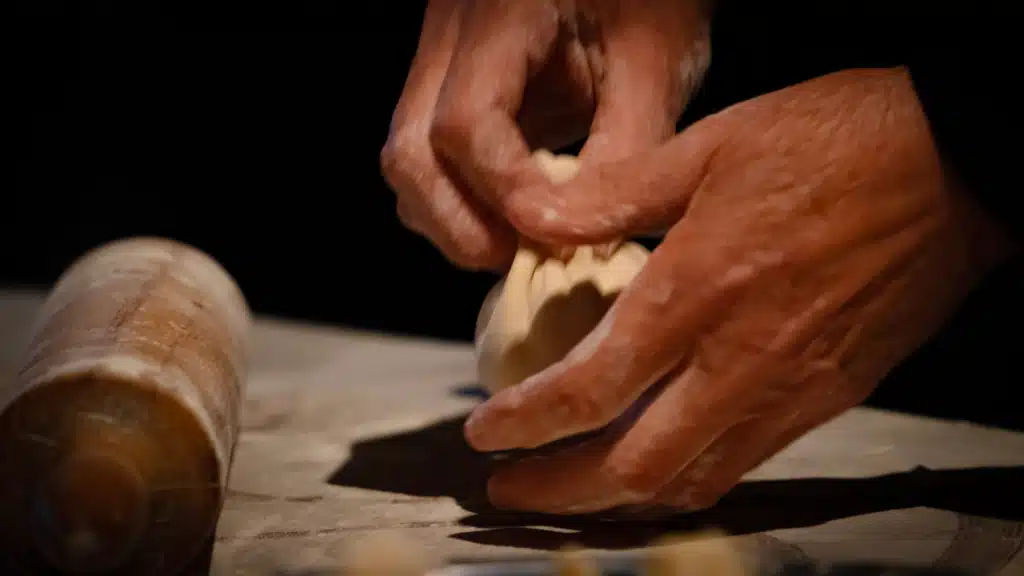
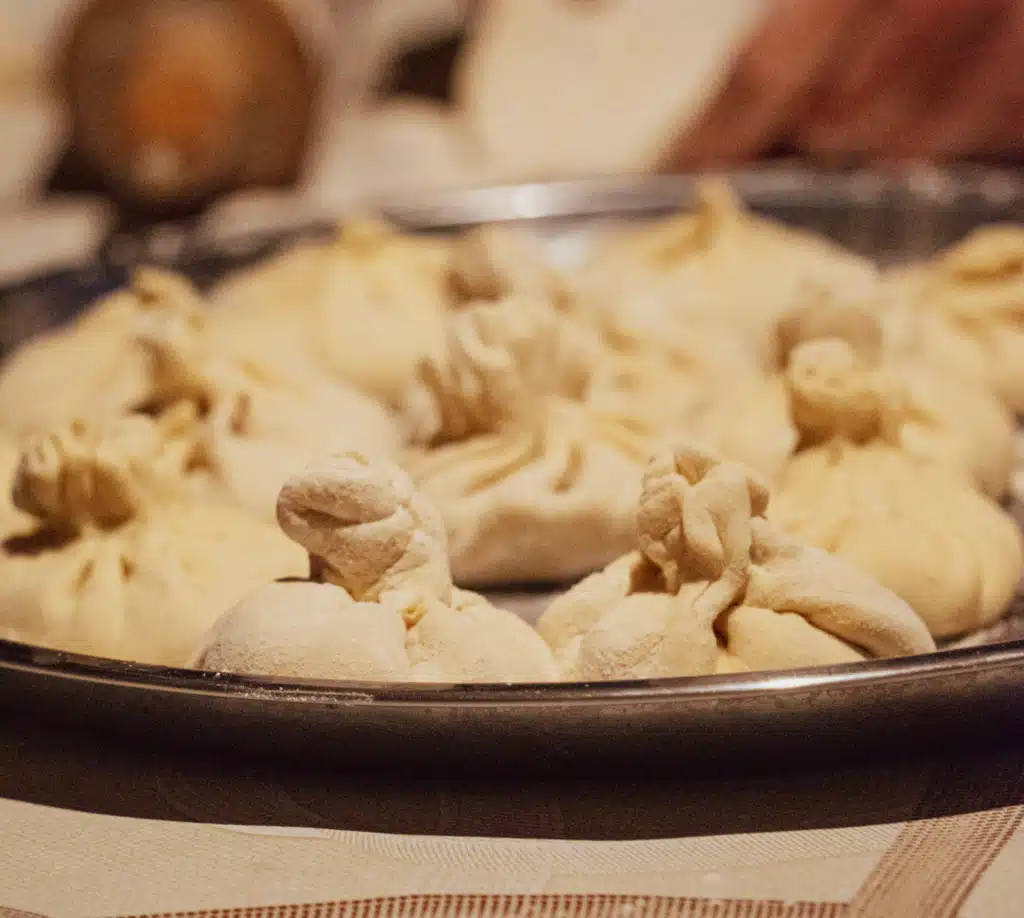
2. Khinkali (Georgian Dumplings)
I thought this was just Pierogi, but fatter and on steroids.
Khinkali are twisted dumplings filled with meat and broth, and they come from the mountains of eastern Georgia, including the historic provinces of Pshavi and Khevsureti.
The original Khevsuruli style is filled with minced meat, onion, chili, and cumin, while the city style, kalakuri, adds fresh herbs. On Orthodox fasting days, you’ll also find versions filled with mushrooms or potatoes.
I had some of the best khinkali I have ever eaten in Tbilisi. We also folded our own at Vakho Oqruashvili Wine Cellar on our grape harvest day in Kakheti. For more on where to eat them, see my guide to the best restaurants in Tbilisi.

Kimberly’s Tip
Eat khinkali with your hands. Hold the dumpling by the knot on top, bite a small hole in the side and sip the broth before you eat the rest. Leave the knot on your plate. It’s how the table keeps count. Oh yeah, add some pepper to the top knot, it adds extra grip!
Georgian Mains, Walnut Dishes and Vegetables
Walnuts appear in more Georgian dishes than almost any other ingredient, ground with garlic, herbs and spices into sauces and pastes. This section covers the mains and vegetable plates that tend to fill the table at a group meal, including several that make Georgia an easy country for vegetarians.
3. Chicken With Makvali (Blackberry Sauce)
Makvali is a Georgian blackberry sauce, and chicken in makvali sauce is listed by Georgia’s tourism board as a dish from Imereti in western Georgia (this was also backed up by our guide, Giorgi) It’s sweet, tart, and a little earthy, and it’s a good one to order if you want something different from the cheese-heavy dishes.
I had chicken with makvali at Balcony No 12 in Tbilisi, with a pitcher of tarkhuna on the side and some Borjomi sparkling water.

Read Next
Not sure which Tbilisi neighborhood to base yourself in? I broke down the best areas for first-timers, plus where I stayed.
See Where to Stay in Tbilisi →4. Shkmeruli (Chicken in Garlic Sauce)
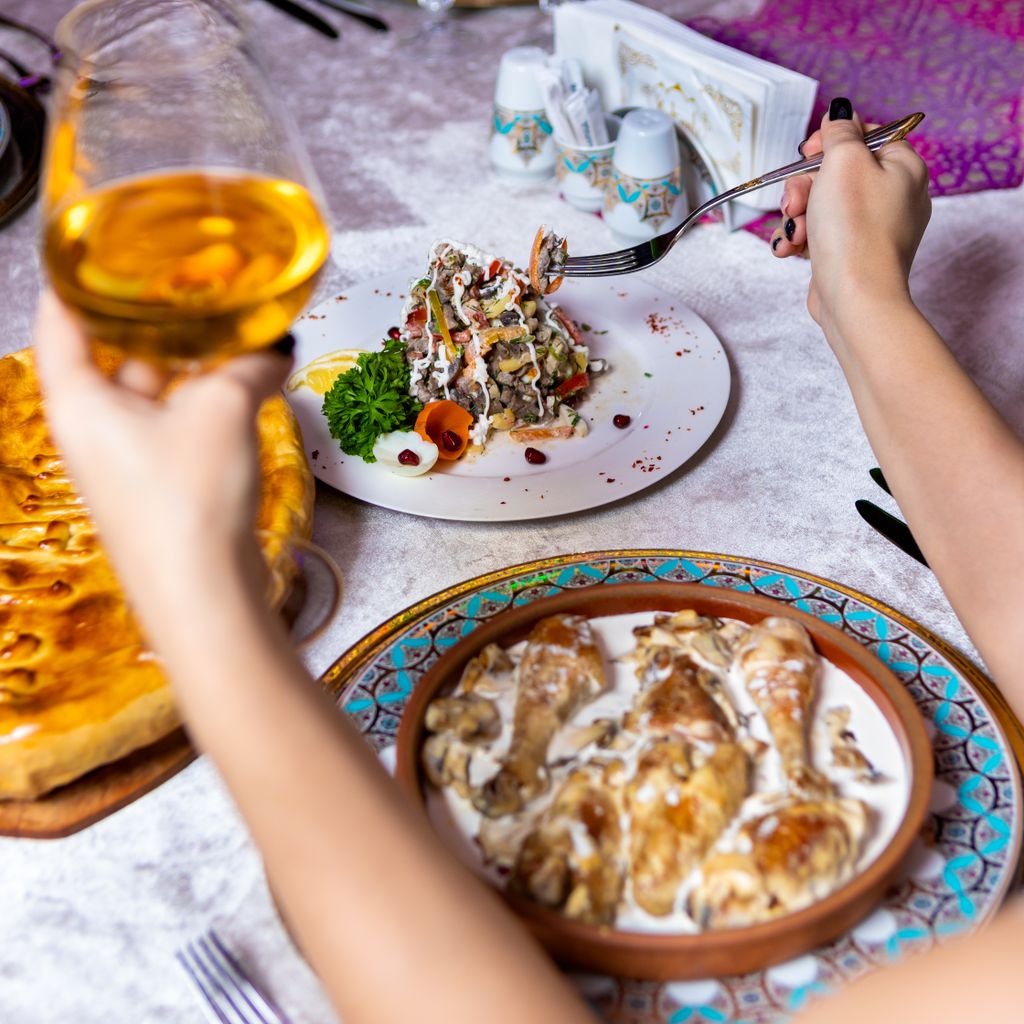
Shkmeruli comes from Shkmeri, a village in the mountains of Racha in northwestern Georgia. The chicken is fried until crispy, then finished in a garlic-and-milk sauce and served in a clay dish called a ketsi. Some villages in Racha skip the milk and use only garlic and water.
I had shkmeruli at Balcony No 12 too. Expect a lot of garlic, so it’s a dish to share. It was so damn delicious. The crispy skin added a layer I cannot describe. It was such a good dish.
5. Pkhali (Vegetable and Walnut Balls)
Pkhali are small balls or spreads made from chopped vegetables or greens, such as spinach, beets, or nettles, mixed with ground walnuts, garlic, and herbs. They’re often topped with pomegranate seeds. They’re eaten all over Georgia, and Imereti alone has about a dozen kinds.
Pkhali was one of the classics I ate on the trip, and it’s one of the easiest ways to eat vegetarian in Georgia.
6. Lobio (Georgian Bean Stew)
This was the dish I couldn’t stop eating if it was on the table. I wanted it all. I had to compete with other travelers at my table, though.
Lobio is a slow-cooked kidney bean stew seasoned with herbs and spices, and it’s often served in a clay pot. It’s a comfort dish you’ll find on menus across the country, and it’s another great vegetarian option.
Don’t ask for a picture because it probably wouldn’t look very appetizing.
Planning Your Georgia Trip?
Start with these guides from my October trip.
7. Badrijani Nigvzit (Eggplant Rolls With Walnuts)
Badrijani nigvzit are thin slices of fried eggplant rolled around a garlicky walnut paste. Georgia’s tourism board calls eggplant with walnuts a supra delicacy, and it’s made year-round, so you can order it in any season. I had the opportunity to make this at an Agrohouse outside of Kakheti and it was incredibly easy. This is a recipe I would love to make at home!

8. Mtsvadi (Georgian Grilled Meat)
Mtsvadi is the grilled meat of Georgian food, usually pork, beef, or lamb cooked on skewers. You’ll find it all over the country, but Kakheti’s mtsvadi is especially famous, so order it in the wine region if you can. Order it with tkemali, a sour plum sauce made in late summer. I had mtsvadi on the trip, too. We saw this everywhere during Tiblisoba in Tbilisi!
This one is so obvious I don’t really need to show you a picture of grilled meat!
Georgian Market Finds: Cheese and Sweets
Some of the food worth trying in Georgia doesn’t come from a restaurant at all. Cheese, sweet bread, churchkhela and tklapi are sold at markets and street stalls across the country, and churchkhela in particular is easy to pack for the trip home.
9. Tenili Cheese
Tenili is a Georgian string cheese from Meskheti, in the Samtskhe-Javakheti region of southern Georgia. The cheese is pulled in warm whey until it forms fine threads, washed in cold saltwater, then packed with cream into a clay pot and aged for about two months. The tradition is on Georgia’s list of Intangible Cultural Heritage.
Our day in Chobareti, a village in southern Georgia, was one of my favorite moments of the trip. At a local ethnographic house, we learned about tenili and ate it alongside kada. You can also find tenili at markets around Georgia.

10. Kada (Georgian Sweet Bread)
Kada is a sweet, buttery Georgian bread, and in Chobareti we ate it with tenili. In Georgia’s mountain regions you’ll also find a savory version, khortsshebuiani kada, a holiday pastry stuffed with meat, cheese, and alpine leek.
I loved this so much and I couldn’t stop eating it while we were in Southern Georgia, I was trying to figure out a way to make this at home, but I am afraid I don’t tossing skills the women had!


Read Next
Want to eat your way through Georgia? My 10 day itinerary covers the harvest supra in Kakheti, the tenili day in Chobareti and the Kutaisi market.
See My 10 Day Georgia Itinerary →11. Churchkhela (Walnut and Grape Candy)
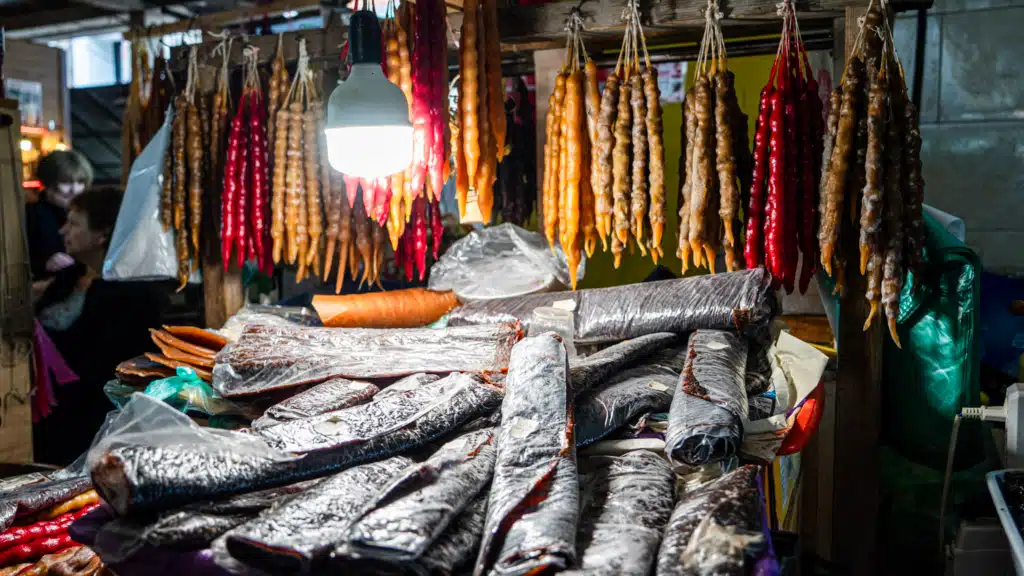
Churchkhela is the Georgian food you’ll see in markets all over the country. Walnut halves are strung on a thread and dipped again and again in tatara, grape juice thickened with wheat flour, then hung to dry. The Kakhetian version with walnuts is the most popular, and it’s traditionally made after Rtveli, the grape harvest. In western Georgia, a similar version made with hazelnuts and corn flour is called janjukha.
I had churchkhela on a meat-and-cheese board at Balcony No 12, and you can buy it at the Meidan Bazaar, the underground market in Tbilisi’s Old Town.

Kimberly’s Tip
Churchkhela keeps well, so it’s an easy gift to bring home. Pick some up at the Meidan Bazaar before you leave Tbilisi.
12. Tklapi (Georgian Fruit Leather)
Tklapi is Georgian fruit leather, and it has been part of Georgian cooking for centuries. Fruit is boiled, mashed into a thick purée, spread thin on a cloth-covered board and dried in the sun until it can be rolled up like a sheet.
There are two main kinds. Sour tklapi is usually made from cherry plums, the same fruit behind tkemali sauce, and Georgian cooks use it to add tang to soups and stews like kharcho. Sweet tklapi is made from apricots or peaches, and you’ll also see versions made from figs, mulberries, cherries, pears and apples. Newer flavors, like kiwi, have started showing up too.
You’ll find several variations at food markets and stalls in Tbilisi, Kutaisi and almost anywhere you travel in Georgia, often hanging right next to the churchkhela. I bought some at the market in Kutaisi, and I also had it on the meat-and-cheese board at Balcony No 12.
Why try it? It’s an easy way to taste Georgian fruit without sitting down to a full meal; it shows you how Georgians cook with sour flavors, and it packs flat, so it’s a simple souvenir to bring home. Buy one sweet and one sour sheet and taste them side by side.
What to Drink in Georgia
Georgia has one of the oldest winemaking traditions in the world, and drinks are treated as part of the meal rather than an afterthought. This section covers the soda, brandy, wine, and herbal tea worth ordering.
13. Tarkhuna (Georgian Tarragon Soda)
Tarkhuna is a bright green soda flavored with tarragon. It was invented in 1887 by Mitrofan Lagidze, a pharmacist in Kutaisi, so if you’re visiting western Georgia, you’re in the city where it started. I had a pitcher of it at Balcony No 12. It has a very interesting taste and I think you’ll love it, and it’s worth a try!

Read Next
Staying in Kutaisi to try tarkhuna where it started? Tskaltubo and its abandoned Soviet sanatoriums are an easy trip from the city.
Plan Your Visit to Tskaltubo →14. Chacha (Georgian Grape Brandy)
Chacha is a clear brandy made from grape pomace, the skins and seeds left over after winemaking. In 2011 it became Georgia’s first registered geographical indication. Commercial chacha is usually around 40 percent alcohol, but homemade versions can be much stronger.

Kimberly’s Tip
If someone pours you homemade chacha at a supra, sip it slowly. You don’t have to finish every glass, and it’s fine to switch to wine or water.
15. Qvevri Wine and Amber Wine
Georgia has been making wine for about 8,000 years, and the traditional method uses a qvevri, a large clay vessel buried in the ground. UNESCO added the qvevri winemaking method to its Intangible Cultural Heritage list in 2013. Amber wine, also called orange wine, is white wine made with the grape skins left in, which gives it its color.
We had lunch and a qvevri wine demonstration at Giuaani Winery in Kakheti, and at Davit’s small family marani near Akhaltsikhe, he walked us through how he makes amber wine. For the full harvest day, see my 10 day Georgia itinerary.

Bonus: Immortelle Tea (Eternal Flower)
Immortelle, often called the eternal flower, is Helichrysum arenarium, a small yellow wildflower in the daisy family. It gets its name because the flowers keep their color and shape long after they’re dried. Foragers pick the flower heads at the height of summer in mountain areas, including Samtskhe-Javakheti in southern Georgia, and steep the dried blooms as an herbal tea.
Don’t mix it up with Helichrysum italicum, its Mediterranean relative (sometimes called the curry plant), which is grown mostly for essential oil rather than tea.
The tea was phenomenal. If you spot the dried yellow flowers at a market or spice stall, ask the vendor how they like to brew it.

Vegetarian Georgian Food
Georgia is easier for vegetarians than you might expect, because so many dishes are built on walnuts, beans, vegetables, and cheese. Look for pkhali, lobio, badrijani nigvzit, and any kind of khachapuri. On Orthodox fasting days, many restaurants also serve khinkali filled with mushrooms or potatoes, so ask if they have them.
How to Eat Like a Local: The Georgian Supra
A supra is a traditional Georgian feast: a long table covered in shared dishes, wine that keeps coming and a tamada, or toastmaster, who leads the table through a long series of toasts. Our first big supra was at Vakho’s marani on our harvest day in Kakheti, where our guide, Giorgi, explained the tamada’s role.
If you want to try a lot of these dishes in one sitting, a cooking class or a home-hosted meal is the way to do it. Ours was at Agro House Korena, a guesthouse in Gelati outside Kutaisi. The host was so welcoming, and she and a whole community of women in her kitchen made one of the best tables of food I have ever had.

Kimberly’s Tip
If you’re traveling solo, a cooking class or a group supra is the easiest way to taste a full Georgian spread without ordering ten plates for one.
Read Next
Want to know where to eat all of this in Tbilisi? I rated every restaurant and wine bar I tried.
See the Best Restaurants in Tbilisi →Georgian Food FAQ
What is the national dish of Georgia?
Khachapuri and khinkali are the two dishes most often called Georgia’s national dish. The tradition of making khachapuri was added to Georgia’s Intangible Cultural Heritage list in 2019.
Is Georgian food spicy?
Most Georgian food is more herby and garlicky than hot. The spicy one to watch for is ajika, a chili paste from Samegrelo and Abkhazia in western Georgia.
Is Georgian food good for vegetarians?
Yes. Pkhali, lobio, badrijani nigvzit and khachapuri are all vegetarian, and mushroom or potato khinkali are common on fasting days.
What do people drink with Georgian food?
Wine is the classic pairing, especially qvevri and amber wine. You’ll also see chacha, tarkhuna and Borjomi, Georgia’s famous salty mineral water.
Where can I try Georgian food in Tbilisi?
Tbilisi has everything from mountain khinkali to modern Georgian cooking. My favorite meals were at Sofiko and Khedi, and I’ve rated the rest in my guide to the best restaurants in Tbilisi. Between meals, do what I did and spend an afternoon at the Tbilisi sulfur baths.
Georgian Food Is a Reason to Plan the Trip
Georgian food is one of the best reasons to visit Georgia. Eat by region as you travel, try at least one supra, and save room for churchkhela. For where to stay and how to plan the rest of your trip, start with my 10 day Georgia itinerary and my guide to where to stay in Tbilisi.
Keep Planning
More From My Georgia Trip
Hungry for More? Food Guides From My Travels
Save This Guide to Pinterest

Research and Sources
- My own trip around Georgia in October 2026, including Tbilisi, Kakheti, Chobareti, Akhaltsikhe and Kutaisi
- Georgia National Tourism Administration: Must-Try Georgian Dishes, Shkmeruli, Tenili Cheese, Churchkhela and Kada
- UNESCO: Ancient Traditional Georgian Winemaking Method Using the Qvevri
- Agenda.ge: Khachapuri Granted Cultural Heritage Status
- Georgia.to: Tklapi
- Biogroup Georgia: Helichrysum Immortelle: Benefits, Uses and Sourcing