Tbilisi Sulfur Baths: What It’s Really Like (+ Tips for Going Solo)
Last Updated on November 10, 2026 by Kimberly
I went to the Orbeliani Baths, the blue-tiled bathhouse in Tbilisi’s Abanotubani district, on an October group trip to Georgia with Type 2 Travel, with five other people, four women and two men. That’s not how most of you will go. (If you want the whole route, here’s my 10 day Georgia itinerary.)
Most of you will be standing outside that building on your own, wondering what you’ll have to take off and whether a stranger is about to scrub you. You’ll probably feel dread about the whole ordeal, but you’ll know that if you don’t experience it, you’ll regret it.
I had the same questions before I went, so this post answers them: what the Tbilisi sulfur bath custom is, what my two hours there looked like minute by minute, and whether it’s worth a slot in your itinerary if you’re traveling solo.
Short version: yes, go. But I want you to know a few things first, including one honest comparison nobody else seems to make.
In a Rush?
How I’d Book the Tbilisi Sulfur Baths
Evenings and weekends at Orbeliani fill up days ahead. Pick your lane and book before you land.
The blue-tiled one. Private rooms only, from about 120 GEL an hour for two, kisa scrub 30 GEL extra
Book a room on their website
A host, hotel pickup and two or three other travelers in the room, about $95. The easy answer to “I’m alone and don’t want to be”
Check dates on GetYourGuide
Both put you within a 15-minute walk of the baths. Khedi Hotel in Avlabari was my pick on this trip
Check rates and availability
The baths, the grape harvest, the supras and the wine, all booked for you. This is the trip that took me there
See the Georgia trip details
What are the Tbilisi sulfur baths?
Tbilisi’s sulfur baths are natural hot springs people have built over and bathed in for at least 1,500 years, and they’re why the city exists. Tbilisi takes its name from the Georgian word tbili, meaning warm, and the legend of its founding is a king, a falcon, a pheasant, and a hot spring. Big shout-out to Giorgi, our guide on our group trip, for filling us in on the history. The full story is further down, because it’s a good one, but the short version is that the water has been rising out of the rock here since before anyone wrote it down, and the bathhouses you’ll walk into today do roughly what they did in the 1600s.
The Georgian National Tourism Administration puts it plainly on its own site: seeing these historic baths is not enough; you really must experience them for yourself.
A Short History of the Tbilisi Sulfur Baths
The springs come first, the city second. Hot, sulfur-rich water rises naturally through the rock under what is now the Old Town, and it has never stopped. According to Georgian legend, King Vakhtang Gorgasali was hunting in the forest here in the 5th century when his falcon dove after a pheasant and both birds fell into a hot spring. When his men found them cooked, the king ordered the forest cleared and a settlement built on the spot. His son Dachi moved the capital here from Mtskheta, and Tbilisi has been the capital ever since. Whether or not you believe the pheasant, the geology holds up, and so does the name: tbili means warm.
Bathing became the thing Tbilisi was known for. The city sat on the Silk Road between Persia and the Black Sea, and traders, soldiers and pilgrims passing through all used the same water. By the 13th century, there are records of more than sixty bathhouses in the city. Today, about seven remain, all clustered in Abanotubani.
Destroyed and Rebuilt
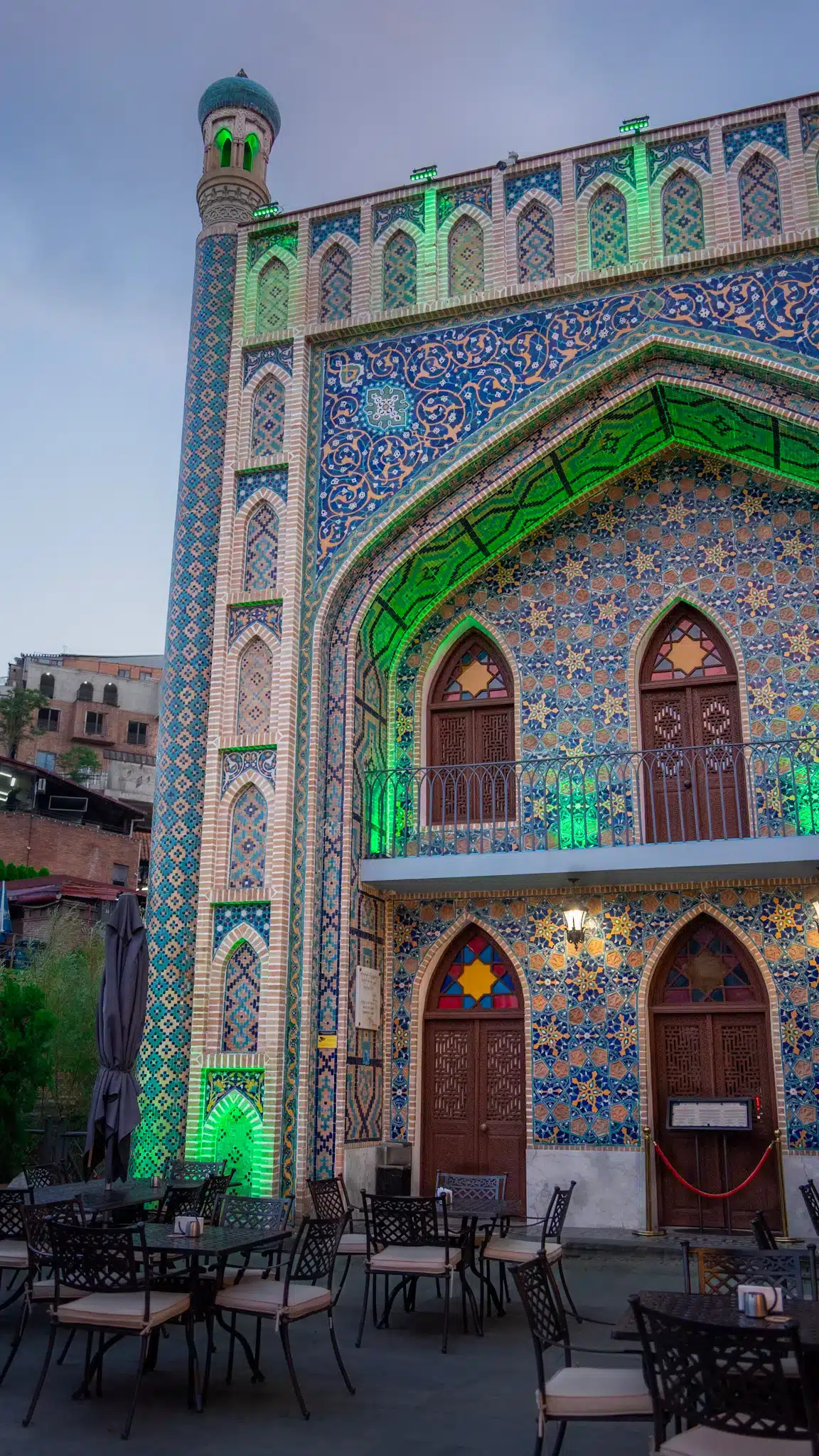
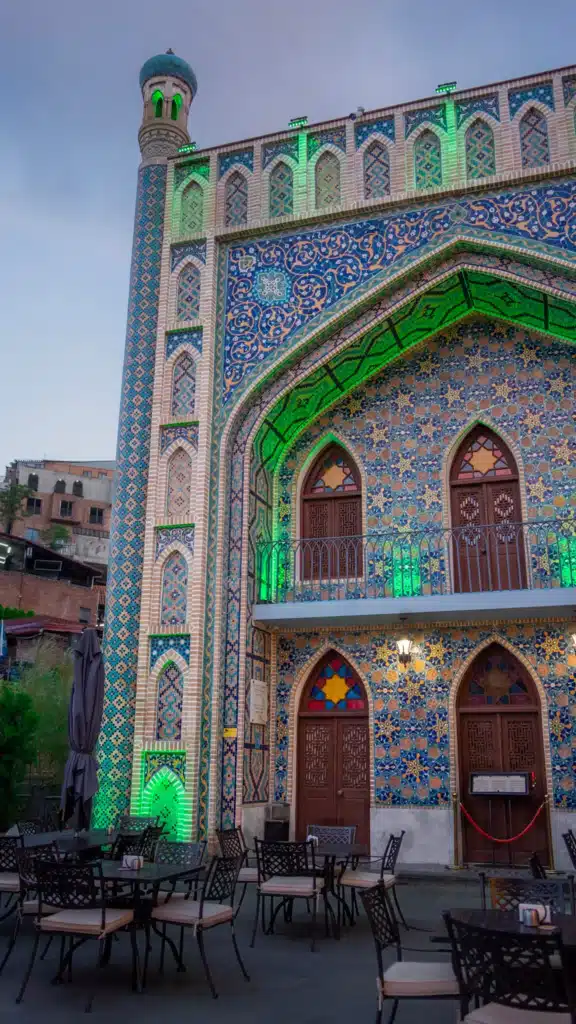
The buildings you see now are not the originals. In 1795, the Persian ruler Agha Mohammad Khan sacked Tbilisi and burned it, bathhouses included, and everything in Abanotubani was rebuilt afterward. That’s why the architecture looks the way it does: the pointed arches, the domed roofs sunk into the ground, and the blue-and-turquoise tilework on Orbeliani are Persian in style, and the only working mosque in Tbilisi sits about 200 meters from the baths. The Chreli-Abano building itself dates back to the 17th century in its bones, with most of the other bathhouses on Abano Street rebuilt in the 19th. This corner of the city has always been a mix of Georgian, Persian, Armenian, Azerbaijani, and Jewish neighbors who all bathed in the same water.
For centuries the baths were where the city’s social life happened. People spent whole afternoons here, hosted dinner parties in the bath rooms, closed business deals, and, so the story goes, mothers brought prospective daughters-in-law to the women’s halls to inspect them before a wedding was agreed. When the Russian poet Alexander Pushkin visited in 1829 he wrote that he had never seen anything more luxurious than the Tbilisi baths, in Russia or in Turkey. Alexandre Dumas and Anton Chekhov came through later and said much the same.
The Baths Through the Soviet Years
The baths kept their place through the Soviet decades for a plainer reason: when the electricity and hot water failed at home, which was often, the springs still ran hot. Older Tbilisi residents still come weekly, and if you use the public women’s hall you’ll be sharing it with women who’ve been coming since long before anyone photographed the facade.
So when you sit in that pool, you’re not doing a spa treatment. You’re doing the thing the city was built around, in a building rebuilt on the ruins of the one before it, with water that predates all of them.
Where are the sulfur baths in Tbilisi? Abanotubani, the bath district
Abanotubani sits at the foot of Narikala Fortress on the south edge of the Old Town. What I learned was that the name means “bath district,” and the low brick domes rising out of the ground are the roofs of the bath chambers themselves, sunk into the earth to sit atop the springs. The Abanotubani sulfur baths are all within a two-minute walk of each other, so you can look at the facades before you commit to one.
The water is naturally hot and sulfur-rich. It comes straight from the source into the pools at around 38 to 40 degrees Celsius (100 to 104 Fahrenheit), or hot-tub hot. And it smells exactly like you think it does. I grew up visiting the sulfur springs in Wyoming, and this was the same smell, like a struck match. You stop noticing it after ten minutes.
What makes a Georgian bath different from a spa day at home is the kisa (sometimes spelled kisi) scrub, where an attendant called a mekise exfoliates your whole body with a coarse mitt, then covers you in soap lather. More on exactly what that involves below.

Why go to the sulfur baths in Tbilisi?
Three practical reasons.
- It’s the one thing in Tbilisi tied to the city’s existence, so skipping it is a little like skipping the canals in Venice.
- It’s an inexpensive, bookable, two-hour reset after a long flight or a day of walking the Old Town’s hills.
- For women who are nervous about public bathhouses in Turkey, Hungary, or even Morocco, Tbilisi is a gentler entry point. You can rent a fully private room, control who is in it, and still get the traditional scrub.
Orbeliani Baths (Chreli-Abano)
Orbeliani Baths is the blue-and-turquoise-tiled bathhouse with a Persian-style facade at 2 Abano Street. It’s the one in every photo of Abanotubani, and its official name is Chreli-Abano, which means “colorful bath.”
The noble Orbeliani family historically owned it, and the name has stuck. Locals and Google Maps use both names, so if you search for “Orbeliani Baths Tbilisi” and get Chreli-Abano results, you’re in the right place.
This matters for solo travelers: the Orbeliani bathhouse offers private rooms only. There is no communal hall. Every booking is for 1 to 6 people, by the hour, and you can book online through their website.

At a Glance
Orbeliani Baths (Chreli-Abano)
2 Abano Street, Abanotubani, Old Town Tbilisi
| Type | Private rooms only, 1 to 6 people, booked by the hour |
| Price | From about 120 GEL per hour for two, suites from 200 GEL |
| Kisa scrub | About 30 GEL, paid in cash to the attendant |
| How long | Book 2 hours if you want the scrub |
| Solo friendly | Yes. First-timers book a small private room; public women’s halls are at Bathhouse No. 5 next door |
Book direct with Orbeliani, from 120 GEL per hour Small-group bath with a host, from $95 with pickup
What happens when you arrive at the sulfur baths
Our group had an evening reservation that our trip host, Laura of Type 2 Travel, had booked and paid for in advance. Here’s how it went from the door:
- Check in at the front desk. We gave our name, the staff spoke English, and that was it. If you’ve booked online, bring the confirmation on your phone.
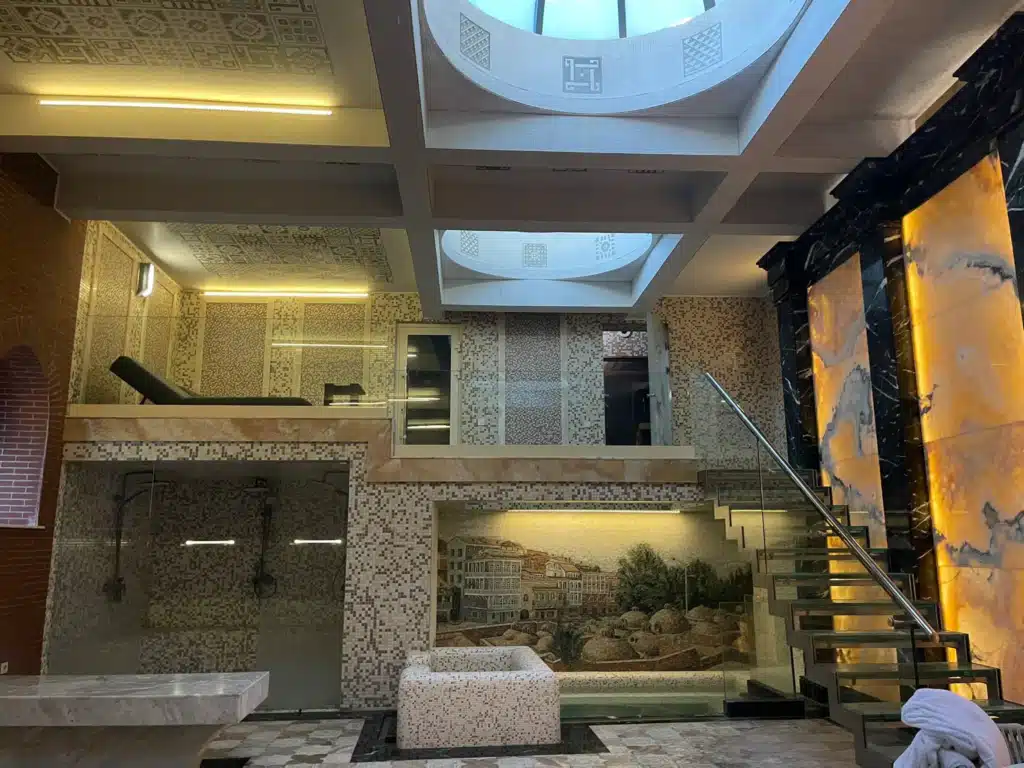
- They led us upstairs to our room. Ours was a suite. Outside the door was a small mini-bar counter where you can order drinks and snacks to the room. We ordered rosé and Georgian sparkling wine, which felt right for a wine country.
- Change in private. The suite had private changing rooms and two bathrooms, so nobody is undressing in front of anyone. Robes were supplied. There was a hair dryer in the bathroom, which I didn’t know about, so I brought my own.
- Soak first. The attendant asks you to sit in the sulfur pool for about 15 minutes before any treatment. The pool fit all six of us. This is also where you find out what too hot really is. I took breaks.
- Cold plunge when you need it. Our suite had a cold plunge pool, sulfur showers, a dry sauna, and a wet sauna. Rotating between the hot pool and the cold plunge is the whole point, and it’s what stops you from overheating.
- The scrub, if you booked it. See the next section.
- Rinse, dress, leave. The sulfur showers run cold. They’ll tell you when your time is nearly up.
The kisa scrub, step by step
We all booked the kisa scrub and the soap massage, which are two add-ons that happen back to back. If you’ve read my Morocco hammam post, kisa is the Georgian cousin of the kessa glove: same coarse mitt, same job, different pronunciation depending on which side of the Black Sea you’re on. A woman came to our room to do ours. During the scrub, you’ll be asked to:
- Take your top off. Swimsuits stay on in the pools, but for the scrub, we were told to take our tops off. In our mixed group, the two men faced the other wall, and nobody was fazed. In a room of just women, or on your own, this is a non-issue (in my opinion, Laura has some wonderful and understanding folks on her tours)
- Lie on the stone slab. The scrub happens in the room on a warm stone platform, not in a separate treatment area.
- Get scrubbed with the kisa glove. It’s a coarse mitt, and she does not go easy. It isn’t painful but it is firm, and you will see grey rolls of dead skin come off you. Ours took about 10 minutes.
- Get rinsed, then soaped. After the scrub, she rinses you, covers you in a cloud of soap bubbles for the massage, then rinses again.
- Head to the cold sulfur shower. She sends you to the shower to finish. Cold. You’ll gasp. Then you feel incredible. This is where I put on my swimsuit top and return to the sulfur pool with the group. You can then decide your adventure.. hot sauna, cold sauna?
The soap massage at the Tbilisi baths
The massage is quick, five minutes at most, and it’s more of a soapy rubdown than a spa massage. Book it anyway; it’s what makes the scrub feel finished. Our attendant was sweet, efficient, and clearly did this all day. If you’re worried about the intimacy, this is the part I’d tell you not to worry about. It’s clinical in a good way.
Kimberly’s Tip
Take every piece of jewelry off before you leave your hotel and put it somewhere you’ll find it again. Sulfur water tarnishes silver, you have to remove it for the scrub anyway, and a wet changing room is the easiest place in Georgia to lose a ring.
Where to stay: Old Town Tbilisi / Abanotubani
The baths sit at the bottom of the Old Town, so anywhere in the Old Town or across the river in Avlabari puts you within a 10- to 15-minute walk. I stayed in both areas on this trip and wrote them up in my guide to where to stay in Tbilisi. If you want a proper bed and a good breakfast to come back to after the baths, Khedi Hotel in Avlabari was my favorite.
Find a Stay in Old Tbilisi
Compare hotels and apartments within walking distance of the baths. Old Town for atmosphere, Avlabari for quieter nights and the metro.
Search Tbilisi stays on Hotels.comMy Orbeliani Baths experience, and how it compares to a Moroccan hammam
I want to say this plainly because nobody else seems to: if you’ve done a good hammam in Morocco, the Georgian sulfur bath will let you down slightly. Not a lot. Slightly.
My reference point is Les Bains du Lotus in Marrakech, which I did on a girls’ trip earlier this year after a first attempt in Fes that nearly put me off hammams for good.

Tbilisi Sulfur Bath vs. Moroccan Hammam
The Marrakech one was a full ritual: steam room to open your pores, black soap left to sit, the kessa glove scrub, a rinse, then a proper massage and hair wash, with tea and snacks after.
From start to finish, it was well over an hour of someone else taking care of you, and the scrub alone was close to 30 minutes.
The Georgian version is the same idea compressed. You soak yourself in the sulfur pool for 15 minutes, the mekise arrives, the kisa scrub is about 10 minutes, the soap massage is quick, you’re sent to the cold shower, and then you’re back to self-service in the pool with your wine. There’s no steam room sequence, no black soap, no hair wash. It’s a treatment inside a bath booking, rather than a bath built around a treatment.
While I hate to compare, I feel as though it’s a great way for my readers to understand.
Which one you’ll prefer depends on what you’re after. If you want to be looked after for an hour, Marrakech wins, and it isn’t close.
If you want to sit in naturally hot mineral water with friends, drink Georgian sparkling wine, and get an efficient scrub in the middle, Tbilisi is the better evening.
I loved the hammam more. I’d still book the Georgian baths again tomorrow, and I’d happily do both on the same trip if geography allowed.
What Surprised Me About Tbilisi
What I didn’t expect was how easy Tbilisi was. In Fes I was motioned through doors with no explanation and soap in my eyes. In Tbilisi there was none of that.
The staff spoke English, the room was ours, and the attendant explained what she wanted before she did it. I walked in a little insecure, about my body, about the stranger-scrubbing-me part, about doing something this physical in front of people I’d met days earlier.
Fifteen minutes in the hot pool and a glass of sparkling wine later, none of that mattered. By the end, it was just six people laughing in a cold plunge pool. It was fun to do with friends, and it’s the kind of thing that makes a group gel, which is exactly why Laura builds it into the first days of her Georgia trip.
The two hours flew. We dressed, walked out into Old Town, and went straight to dinner and the Tbilisoba festival that weekend, scrubbed raw and more relaxed than I’d been the entire trip.
Tbilisi Sulfur Bath vs Moroccan Hammam
| Orbeliani, Tbilisi | Les Bains du Lotus, Marrakech | |
| Setting | Private room, hot sulfur pool, cold plunge, saunas | Steam room, no pools, then massage room |
| Scrub | Kisa mitt, about 10 minutes, firm | Black soap then kessa glove, about 30 minutes |
| Massage | Short soap massage on the slab | Full massage plus hair wash |
| Time | Book 2 hours, mostly self-guided | About 90 minutes, fully guided |
| Cost | From about $45 per hour for the room, plus $11 scrub | About $66 per person |
If you’ve never done either, read the hammam post first. Everything I wish I’d known before Fes applies in Tbilisi too, especially the part about not shaving the day before.
How much do the Tbilisi sulfur baths cost?
Private rooms at Orbeliani are priced per room, per hour, so the maths gets better the more people you bring. The small rooms for two run around 120 GEL an hour, the three-person rooms around 160 GEL, and the big suites like ours with the cold plunge and saunas start around 200 GEL an hour.
Add roughly 30 GEL each for the Kisa scrub and the soap massage, and have that part in cash, because the attendant is paid directly afterward. Drinks from the mini-bar are extra.
At October 2026 rates, that is roughly $45 to $75 an hour for the room, so a solo two-hour Tbilisi sulfur bath with a scrub in a small room lands around $100 to $120, and a two-hour suite split six ways was under $30 each for the room.
Going solo: private room or public bath?
After doing this, I’d say the baths are completely manageable alone, and I would go back by myself next time I’m in Tbilisi. It’s a great way to come down off a flight.
If going alone still feels like a stretch, this is what a small group trip is good for. I’d never have ordered a scrub in a room with strangers on my own first try, and with the Type 2 Travel group it was the easiest thing we did all week.
Three Ways to Do the Baths as a Solo Woman
You have three ways in as a solo woman, and which one I’d recommend depends on whether you’ve done a bathhouse before.
If this is your first bathhouse anywhere: book a small private room at Orbeliani. Orbeliani is private rooms only, so you get a locked door, your own sulfur pool, a shower, and the famous building, for roughly 120 GEL an hour. Add the kisa scrub and the attendant comes to you. Nobody else is in the room. You control the temperature, the swimsuit question, and the pace. This is the lowest-stress way to try the custom, and it’s what I’d point a nervous first-timer to every time.
If you’d rather not handle the booking yourself, the Luxury Sulfur Bath Ritual on GetYourGuide adds a hotel pickup, an English-speaking host, and a glass of Georgian wine or tea to a private room for a small fee on top of the room price. Read the reviews first: one traveler reported the pickup was a regular taxi and the travel time was counted inside the session. The Private Sulfur Bath, Wine and Spa experience is the same idea from a different operator if the first one is full.
If You’d Rather Not Be Alone in the Room
If being in a room alone is what puts you off, book the small-group version. The Royal Sulfur Bath and Sauna experience version puts you in a private room with a host and two or three other travelers for about $95, pickup included, adults only. It’s the only sulfur bath listing I found that’s built around a small group rather than a couple, which makes it the easiest answer to “I’m alone, and I don’t want to be.” A reviewer said 90 minutes covered the bath and sauna with time to spare.
If you’ve done a hammam or an onsen and want the local version: go to the public women’s hall at a neighboring bathhouse. Orbeliani doesn’t have one. Walk 50 meters down Abano Street to Bathhouse No. 5 or the Royal Baths, pay 5 to 10 GEL at the door, and you’re in a women-only hall with Tbilisi grandmothers who’ve been coming weekly for fifty years.
What to Know About the Public Baths
People bathe nude in the public baths; you can still order a kisa scrub, and it costs about a tenth of a private room. This is the version I’d do myself on a solo return, and it feels closest to what the baths have been for 1,500 years.
If you’re comparing the best sulfur baths in Tbilisi, Gulo’s Thermal Spa is the other name that comes up constantly; it’s private rooms only like Orbeliani, slightly cheaper, and I haven’t been.
Either way, nothing about it felt unsafe or uncomfortable. The staff are matter-of-fact, the attendants are professional, and the whole city treats this as normal, because it is.
My Top Pick for Solo Travelers
Royal Sulfur Bath & Sauna, Small Group
Abanotubani, Old Town Tbilisi, with hotel pickup
| Price | About $95 per person |
| Duration | 1 to 2 hours |
| Includes | Private bath room, sauna, English-speaking host, hotel pickup. Kisa scrub is extra |
| Best for | Solo women who want company in the room, first-timers, anyone nervous about going it alone |
Check dates and book on GetYourGuide
Tips for booking the Tbilisi sulfur baths
First off, I have to say joining a group trip like Type2Travels helped me ease into the Sulfur bath outing, so look into her group trips; then, if you can’t make it and want to plan your own solo trip to Georgia, you’ll want to follow these tips.
- Reserve ahead. Orbeliani books out, especially evenings and weekends. Book online a few days before, ask your hotel to call, or let a hosted experience handle it for you.
- Book two hours, not one. One hour with a scrub feels rushed. We had two, and it was right.
- Bring: a swimsuit if you want one (optional in a private room), a hair tie, a change of clothes, and cash for the scrub. Towels, a wrap, and slippers were provided, and there was a hair dryer.
- Leave at the hotel: all jewelry. Sulfur water tarnishes silver fast, and you’ll be taking it off for the scrub anyway.
- Don’t shave the day before. Freshly shaved skin plus a kisa mitt is a bad combination. Same rule as the hammam.
- Drink water. Hot room, wine, and sulfur steam add up quickly. Order a bottle with your rosé.
- Best for: friends and couples who want a suite, nervous first-timers who want a private room, experienced bathhouse-goers who want the public women’s hall, and anyone who needs a cheap reset after a flight. Kids are fine in a private room.
- Timing: evening is lovely because you walk straight out to dinner in the Old Town. Mornings are quieter if you’re nervous.
- Afterward: eat. My guide to the best restaurants in Tbilisi has Old Town picks within walking distance of the baths. Your skin and your appetite will both be wide open.
Tbilisi sulfur baths FAQ
Is Tbilisi safe for solo female travelers?
Yes, and the baths are a good example of why. I spent three nights alone in the Old Town before the group arrived and never felt uncomfortable walking Abanotubani in the evening. The bathhouse staff are matter-of-fact with women on their own, the private rooms lock, and the public women’s hall is women-only. For more on getting around alone, I’ll have a blog post coming soon.
Do you wear a swimsuit in the Tbilisi sulfur baths?
In a private room it’s your choice. We kept swimsuits on in the pools and took tops off for the scrub. In the public halls, people bathe nude.
Can you visit the Tbilisi sulfur baths alone?
Yes. Book a small private room at Orbeliani, join a small-group hosted session, or use the public women’s hall at Bathhouse No. 5. All three are normal and safe.
How long should I book?
Two hours if you want the scrub and massage. One hour is enough for a soak only.
Is the kisa scrub included in the price?
No. It’s about 30 GEL extra, paid in cash to the attendant after the treatment.
What’s the difference between Orbeliani Baths and Chreli-Abano?
Nothing. Chreli-Abano is the official name; Orbeliani is the historic family name. Same blue-tiled building at 2 Abano Street, and the one most people mean when they search for the Tbilisi sulfur baths.
Are the Tbilisi sulfur baths worth it?
Yes, especially as a first-evening reset. If you’ve done a full Moroccan hammam, expect something shorter and more self-guided, and still worth doing.
For the full trip, check out my 11 Days in Georgia itinerary, link and What to Expect in Georgia in October Coming SOON!
Keep Planning
More From My Georgia Trip
Save This Guide for Your Trip to Tbilisi
Pin this so you have the prices, booking tips and what to expect handy before your visit.