What Is the Alta Via 1? Here’s Everything You Need to Know
Last Updated on September 29, 2026 by Kimberly
You’re probably here trying to figure out how to book the Alta Via 1, or if you can hike the Alta Via 1 solo. Either way, the Alta Via 1 is the most famous long-distance hike in the Italian Dolomites, roughly 120 kilometers of mountain trail where you walk hut to hut for about a week, sleeping and eating in rifugios (mountain huts) instead of carrying a tent (you actually can’t wild camp in the Dolomites!)
That’s the short version. But “what is the Alta Via 1?” is usually code for a longer question: is the Alta Via 1 actually doable for me, and is it worth a week of my limited vacation days? I’ve been there, staring at a map from a kitchen table in Vicenza, Italy. Trying to figure out if I was about to bite off more than I could chew. So here’s an honest answer in blog form to get you set up for the Alta Via 1
When I set out to do the Alta Via 1 and 2 while living in Italy, little did I know It would lead to a lot of wonderful encounters and learning about such a beautiful area!
This Post Pairs Well With:
Bookatrekking Review: My Honest Opinion After 4 Hut-to-Huts
In a Rush? My Top 3 Picks to plan your trip to the Dolomites
| Book it stress-free Self-guided AV1 with huts + transfers handled by Bookatrekking |
Check dates |
| Get there Compare flights into Venice or Innsbruck |
Find flights |
| Sleep before & after Pre/post-trek hotels in Cortina or Belluno |
See stays |
So, what exactly is the Alta Via 1?
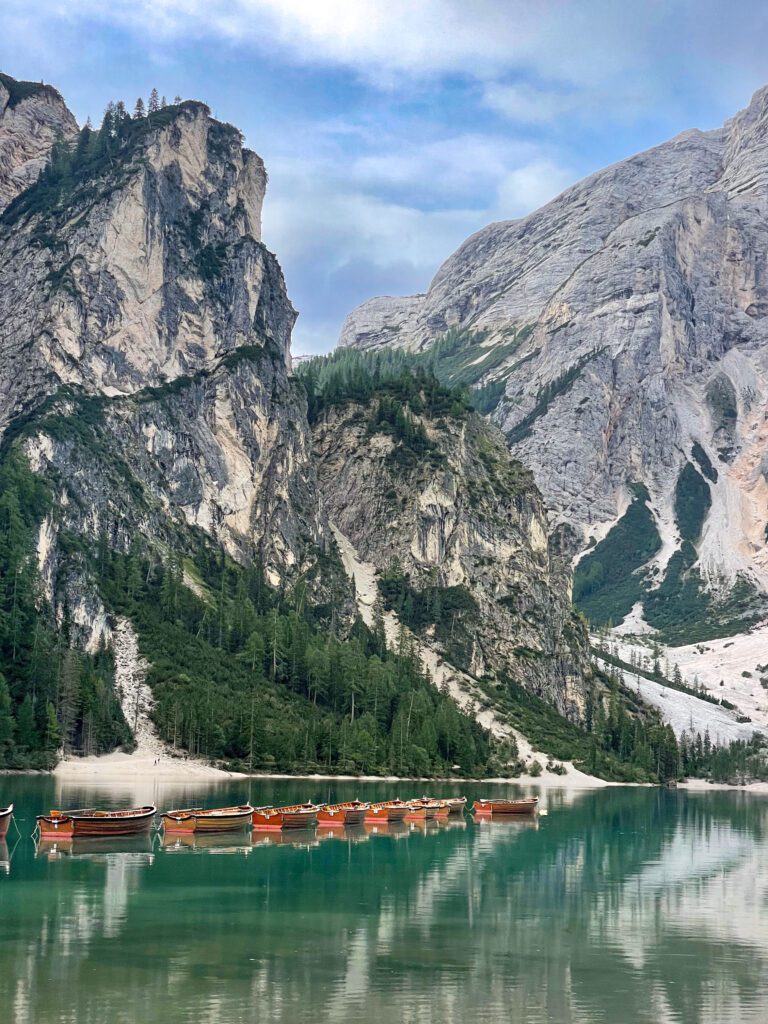
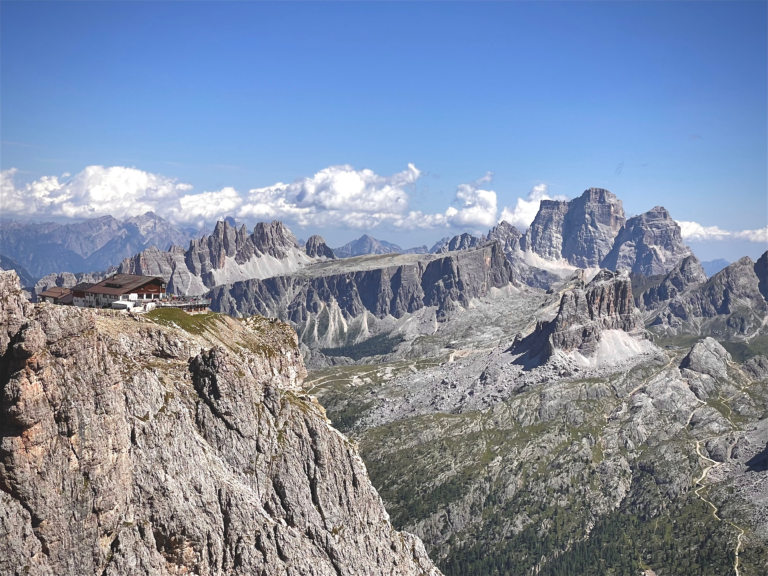
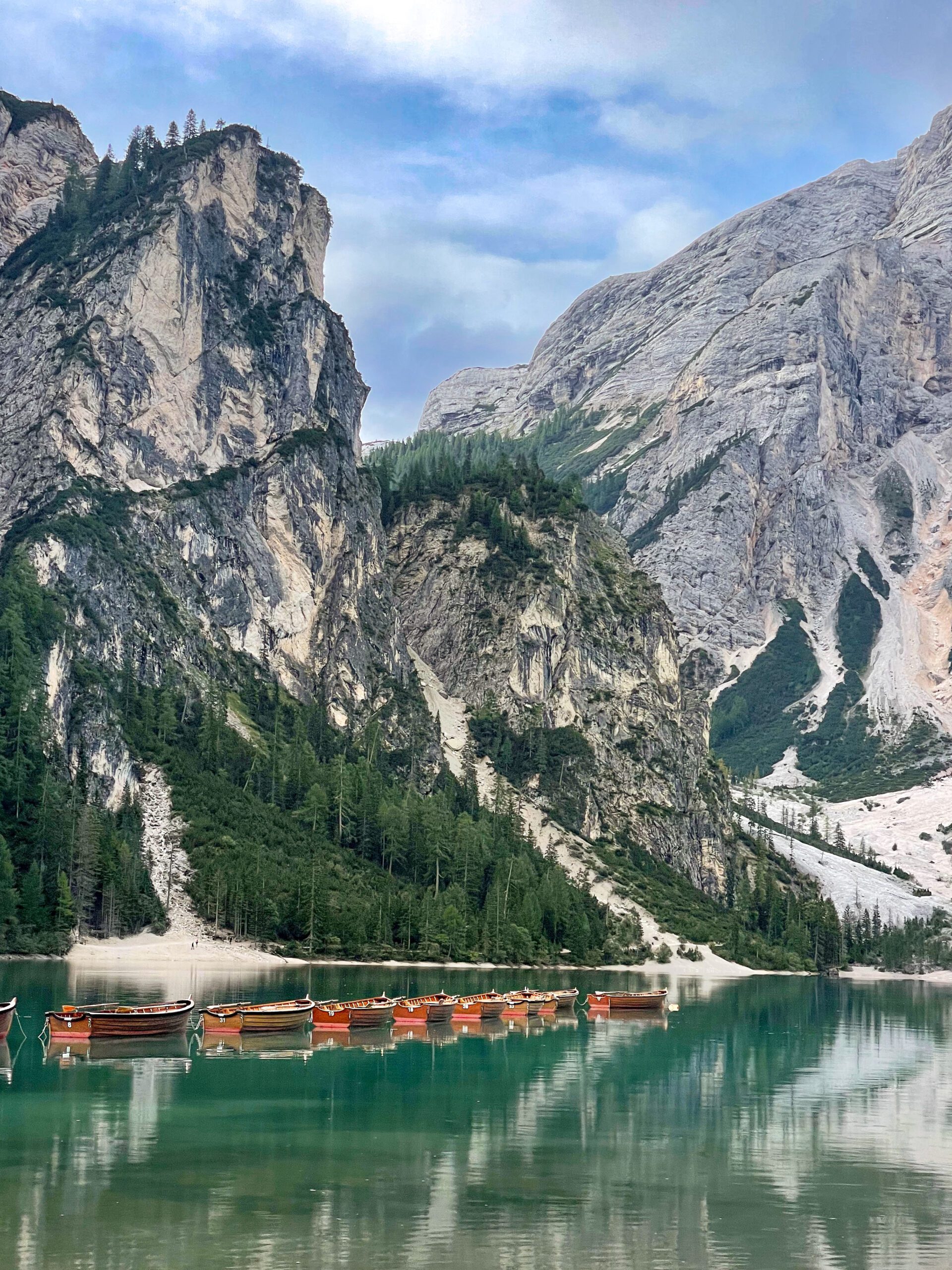
“Alta Via” just means “High Route” in Italian. There are several numbered high routes through the Dolomites, and the Alta Via 1, also called the Dolomite High Route 1 , is the original headliner. It runs north to south through the eastern Dolomites, starting at the impossibly turquoise Lago di Braies, which makes a perfect place to stay BEFORE your hike, and finishing roughly a week later down near Belluno.
You don’t camp (it’s not allowed in the Dolomites), don’t carry a week of food (just snacks!). You walk each day to the next staffed mountain hut, where dinner and a bunk are waiting. That single fact is what makes the AV1 the gateway trek it’s become; it’s a multi-day mountain adventure that doesn’t require you to be a backpacking masochist.
ALTA VIA 1 AT A GLANCE
| Distance | ~120 km (75 miles) |
| Typical length | 8–11 days (most do ~10) |
| Start / Finish | Lago di Braies → La Pissa (bus to Belluno) |
| Highest point | Rifugio Lagazuoi, 2,752 m |
| Total ascent | ~6,600–7,300 m |
| Difficulty | Moderate — no technical climbing |
| Season | Late June to mid-September |
| Where you sleep | Staffed rifugios, half board |
Is the Alta Via 1 hard? AN Honest Answer
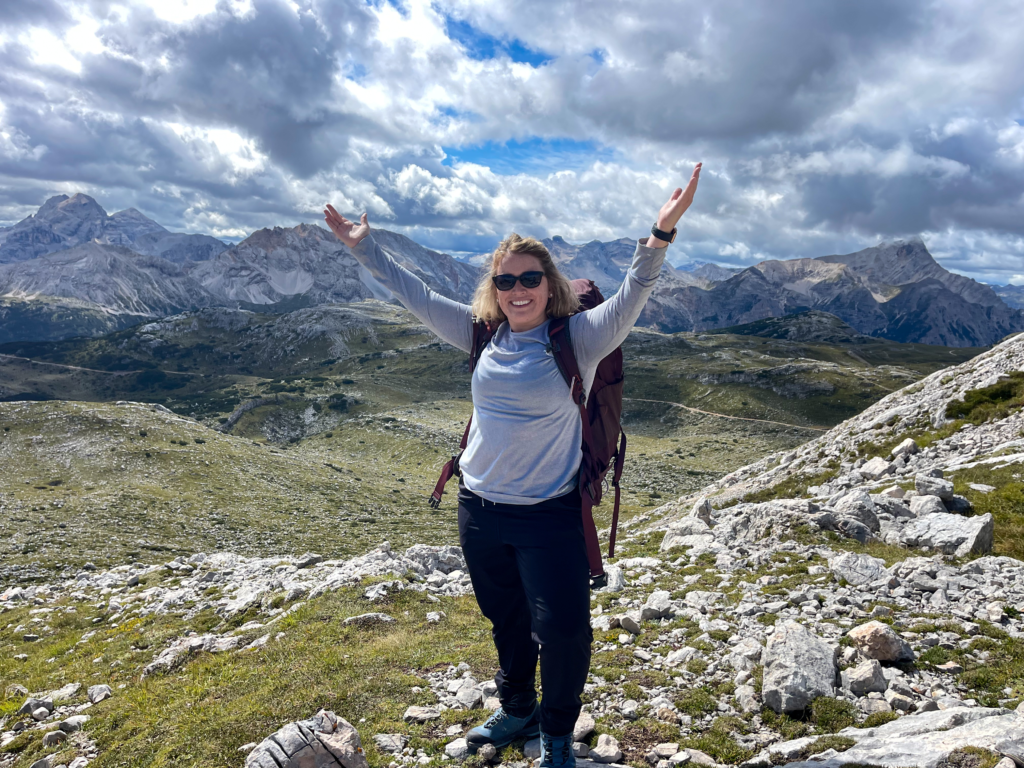
Here’s the thing nobody tells you cleanly: the AV1 is rated moderate, and that rating is fair,but “moderate” hides a lot. There’s no roped climbing, no glacier travel, and the most exposed sections have fixed cables you can clip into if you want.
What gets people is the repetition. You’re climbing and descending 600–1,000 meters a day, day after day, with a pack on your back, often for 5–7 hours. It’s not one hard day. It’s seven medium-hard days back-to-back, and your knees will have opinions about the descents.
If you can comfortably hike a full day with elevation and then get up and do it again tomorrow, you can do the Alta Via 1. If your idea of a hike is a flat two-hour loop, give yourself a few months of training first. I say that with love.
The hardest part of all this is basically booking the Alta Via 1!
✍️ HERE ARE MY THOUGHTS: Parts of the Alta Via 1 are hard, there’s no doubt about it. Especially that last bit of descent, your knees are gonna hurt! You’ll want to train for the Alta Via 1 and focus on Core, Balance and the WHOLE shebang! While I don’t have a training plan I can refer you to the experts: check out Movingmountainsmeg for training plans. I am currently using one of her plans and I love it!
How long does the Alta Via 1 take?
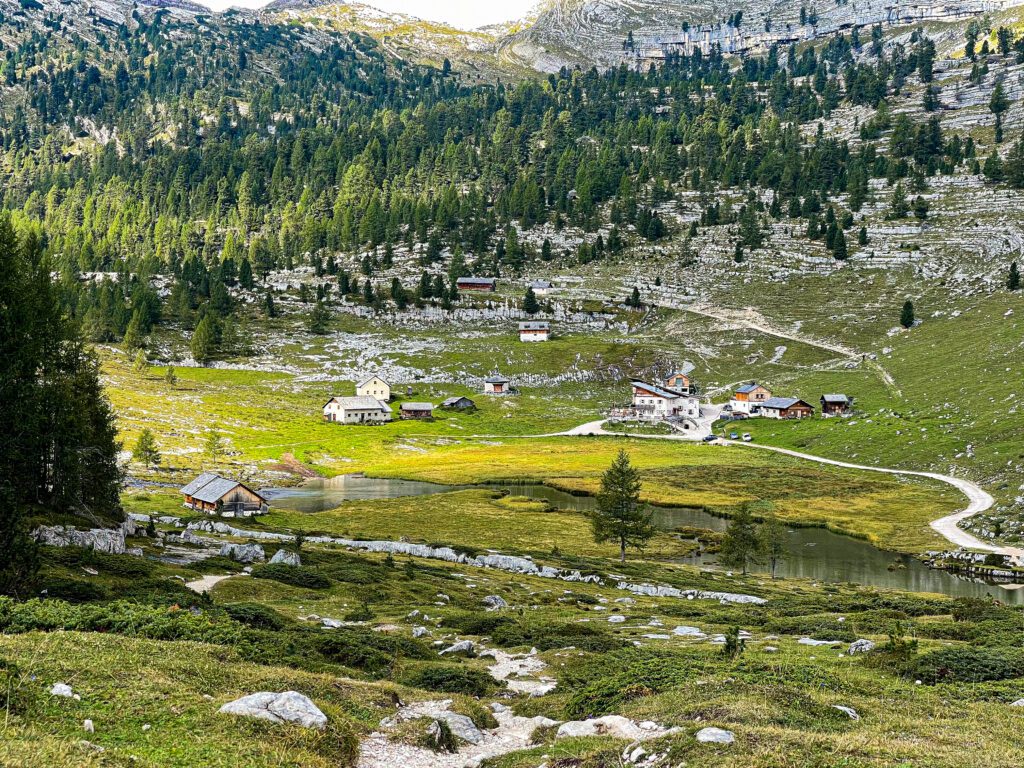
The classic full route is most often done in 10 days, but it’s genuinely flexible.
Fast, fit hikers compress it into 7. Others stretch it to 11 or 12 with a rest day built in. And this is the part I wish someone had told me sooner: You don’t have to do the whole thing, for instance if you only have four days, you can do what I did Alta Via 1 in Four Days
The AV1 splits neatly into a northern half and a southern half, so if you’ve only got four or five days, you can hike a section and still come home with the real experience.
I did the Alta Via 1 North in one complete section, then, because of how popular it’s become, I couldn’t make reservations for the southern half. I decided because I was close enough to do day hikes into the rifugios.
Short on time and trying to decide which half? I broke that down in my Alta Via 1 short write-up. I then did the southern half on day hikes while I was in Italy. Due to increased popularity, the Alta Via 1 has been incredibly hard to book. So I said Fuck it, let’s do day hikes from one point to the next!
⏳ BOOK EARLY — this is the part people get wrong
BOOK ALL OF YOUR HUT TO HUT’S 6-9 MONTHS IN ADVANCE! The popular huts sell out within weeks. If you want August or a specific itinerary, treat January like a deadline, not a suggestion.
Where you sleep: the rifugios (and the booking scramble)
The rifugios are half the reason to do this trek. They range from rustic stone huts with shared bunkrooms and a single cold-ish shower to surprisingly comfortable lodges with private rooms and three-course dinners.
You’ll eat dinner communally, swap trail notes with strangers in four languages, and fall asleep early because there’s nothing else to do — which, after a 1,000-meter day, is exactly what you want. I have a whole guide on what to expect at a rifugio in the Dolomites
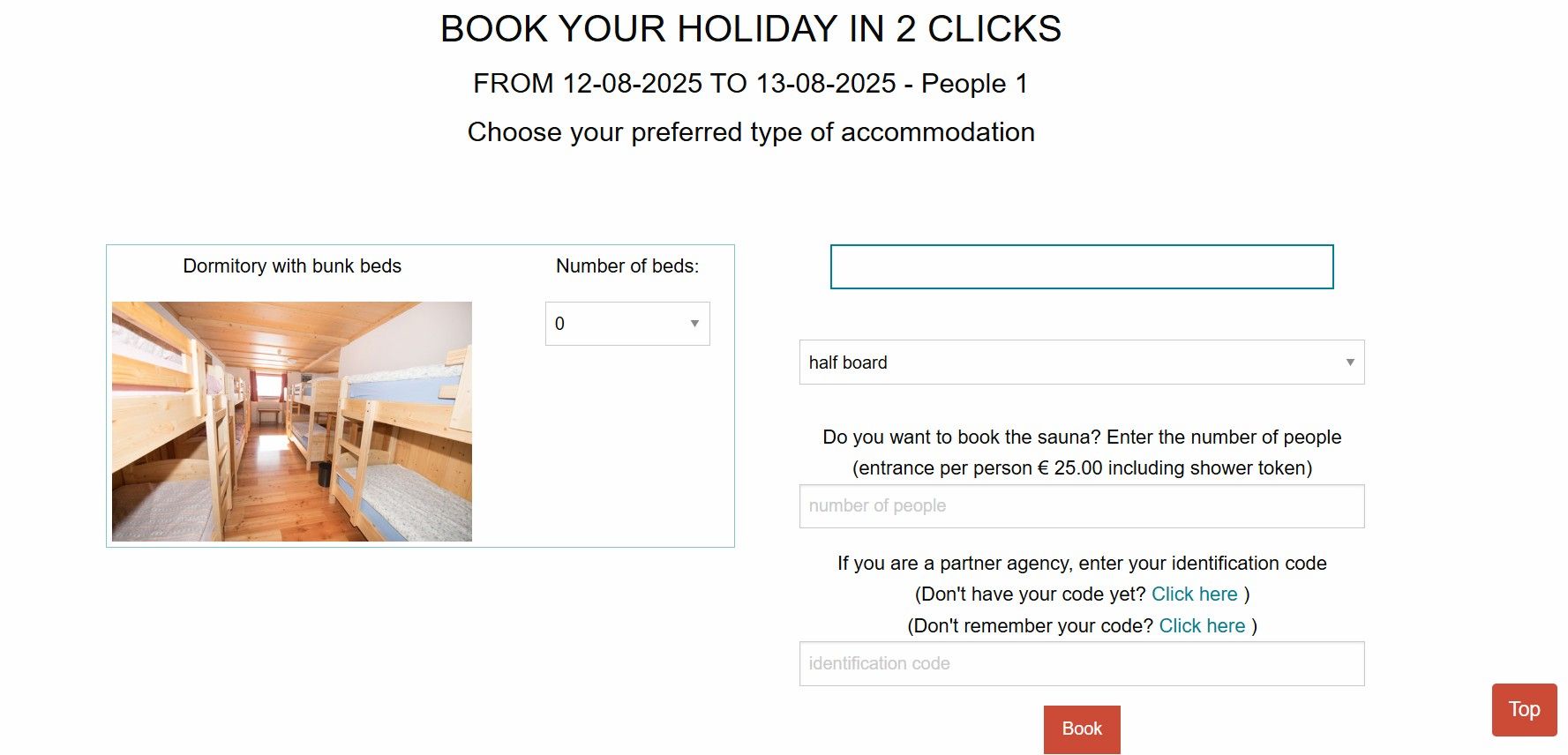
Now the unglamorous truth: booking is the hardest part of the whole trip. There’s no central reservation system.
You contact each hut separately; most open bookings around 6-9 months for the coming summer, and the popular ones sell out within weeks. Many are still cash-only or have spotty card-machine coverage, so you’ll need to carry euros.
That’s why a lot of people ,including plenty of solo female travelers, I’ve sent this way — go self-guided: you still hike alone at your own pace, but a company books all the huts and handles the logistics. I dig into the full DIY vs. booked decision and the step-by-step booking process for how to book the Alta Via 1 rifugios.
Your interactive Map for planning your Hut to Hut!
THE ALTA VIA 1 HUT TO HUT MAP
Tap any pin for the rifugio’s elevation and a direct link to book it. The dashed line runs north → south, the way most people walk it — from Lago di Braies down to the La Pissa bus stop near Belluno.
Pin locations are approximate, for planning only — always navigate with a proper map/GPS on trail. Booking links go to each rifugio’s official site; huts are reserved directly, one by one.
What it costs
The AV1 isn’t a budget backpacking trip, but it’s far from a luxury holiday either. Your biggest line item is the rifugios, booked on a half-board basis (dinner, bed, and breakfast). On top of that, budget for lunches bought at the huts, the odd beer that tastes like the best beer of your life, transport to the trailhead, and a night or two in town before and after.
If you book a self-guided package that wraps the huts, route notes, and transfers into one price, 2026 self-guided itineraries start around £990 / roughly €1,150, depending on length and season, before flights.
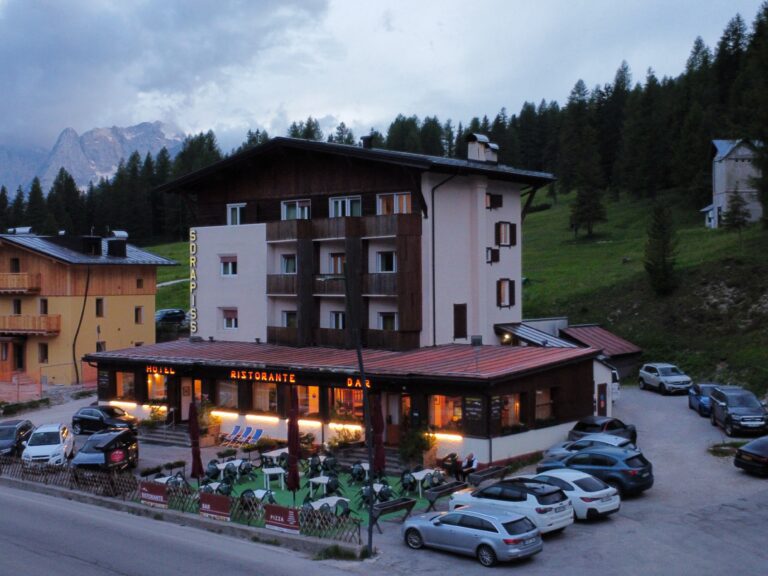
✍️ HOW MUCH I PAID FOR THE AV1 NORTH: To do the AV1 North, it cost about $700 through Bookatrekking. To ease the start time, I stayed at Hotel Trenker just outside of Lago di Braies. Literally 8 minutes away from the start point. You can read about my Hotel choice through this blog post here: Where to Stay Before and After the Alta Via 1
When to hike the Alta Via 1
The window is narrow and non-negotiable: rifugios are generally open from late June to mid-September, and outside that, the huts are shut, and high passes can hold snow. Within the season, each month has a personality:
When to hike: the AV1 month by month
| Month | Daytime (on trail) | Nights | Rain & storms | Crowds | My take |
|---|---|---|---|---|---|
| Late June | 8–16°C 46–61°F |
0–6°C 32–43°F |
Frequent; one of the wettest stretches. Afternoon thunderstorms build early. | Quieter | Wildflowers and the longest days — but expect lingering snow on high passes and check that your huts have actually opened. |
| July | 10–18°C 50–64°F |
3–7°C 37–45°F |
Warm but stormy afternoons are the norm. Start early, be off high passes by early afternoon. | Busy | Everything fully open and running. Classic AV1 conditions — just respect the daily storm clock. |
| August | 10–18°C 50–64°F |
3–7°C 37–45°F |
Statistically the most rain-days of the season; still plenty of bluebird mornings. Afternoon storms common. | Peak | Peak crowds and peak Italian-holiday energy around mid-month (Ferragosto). Book very, very early. |
| September | 6–14°C 43–57°F |
-1–4°C 30–39°F |
Drier and more settled, clearer skies, fewer storms. A high dusting of snow is possible late in the month. | Quieter | My pick: crisp air, thin crowds, fewest storms. Just pack for frosty nights and check each hut’s closing date — many shut mid-to-late September. |
Temps are typical ranges at hut elevations (~2,000–2,500 m), adjusted from Cortina d’Ampezzo climate data. Valley sections run warmer; high passes are colder and windier. Mountain weather changes fast — always check the forecast and ask the hut warden before setting off.
If you’re still deciding which month suits you, I go deeper in when to hike the Dolomites: a month-by-month guide.
Who the Alta Via 1 is (and isn’t) for
It’s for you if you’re reasonably fit, you love mountains more than you love comfort, and the idea of unplugging for a week with no decisions beyond “which peak am I looking at” sounds like heaven. It’s a brilliant first long-distance hut trek, and one of the best solo trips I’ve ever taken. You’re alone on the trail but rarely lonely at dinner.
It’s probably not for you if you need a private bathroom every night, you can’t be flexible about the weather, or you’re hoping to wing the booking two weeks out in July. (You won’t get beds.)
A little bit of my backstory: I was actually finishing up Iron Transplant before I did the Alta Via 1 and 2. So I was a little rusty, and it was really hard. So I really do recommend a combination of strength training and cardio!
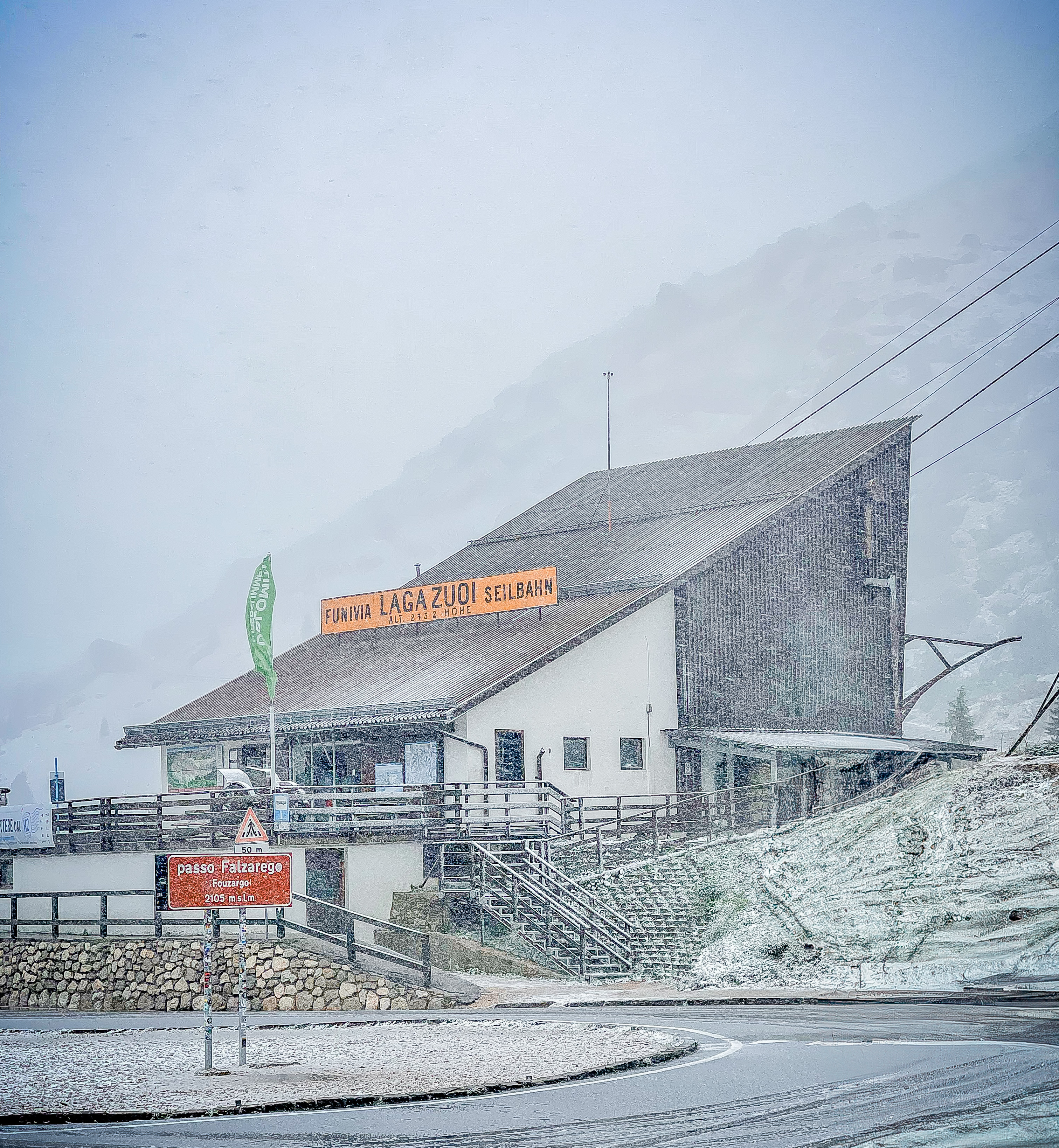
WHAT SURPRISED ME: How the weather can change on a dime in the Dolomites! On one of my days it snowed! It was only the end of August! That tells you the weather can absolutely change on a dime! Need a good weather app? Here are a few good apps for your travels in the Dolomites
Alta Via 1 vs Alta Via 2: which one?
Short answer: Start with the Alta Via 1. It’s the more approachable of the two, with moderate elevation, no real technical sections except for a few ladders, and that gateway-trek friendliness.
The Alta Via 2 is longer (~160 km), higher, and includes genuinely exposed via ferrata sections that demand a head for heights and proper gear. It’s a different beast that I got a taste of during my Palaronda Trek. I compare them properly in Alta Via 1 vs Alta Via 2: how to choose (coming Soon!)
Can you do the Alta Via 1 Solo?
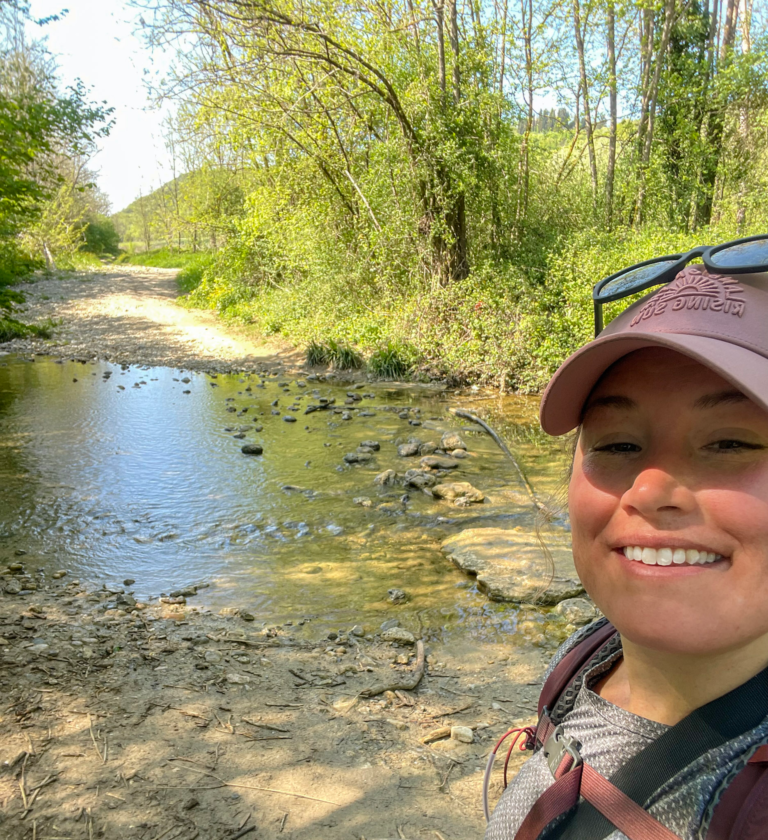
You’re reading a blog of a woman who did it herself.
I really think you need to be prepared for this one, and also be prepared not to run into people for a while, and if you are alright with that, then you’ll be okay.
When I say come prepared, what I mean is, train for it, pack for it, and outfit yourself properly! Know your emergency numbers in the Dolomites (112!) and always tell people where you are going!
Little rule of thumb, don’t tell anyone you don’t feel comfortable with knowing that you are solo hiking.
FAQ: Quick questions about the Alta Via 1
No mountaineering experience is required, but you do need real hiking fitness, the ability to do 5–7 hours with elevation, multiple days in a row. It’s a moderate trek, not a technical one. I do, however, wish that I had trained more before heading out!
Absolutely, and it’s one of my favorite solo recommendations. The trail is well-marked and busy enough that you’re never truly isolated, and rifugio dinners make it easy to meet people.
No. You sleep in staffed rifugios every night on a half-board basis. Wild camping is discouraged in the nature parks in the Dolomites.
The Alta Via 1 is Calling You
The Alta Via 1 was the trek that made me fall for the Dolomites, and it’s still the one I send people to first. If you’ve got a week and a decent pair of legs, you can do this. The hardest part really is the booking and maybe the courage to get out there and hike the Alta Via 1 Solo!