Kakheti Wine Tour: What Rtveli, Georgia’s Wine Harvest, Is Really Like
Last Updated on November 11, 2026 by Kimberly
The first thing I noticed when we drove into Kakheti wasn’t a vineyard. It was the trucks. They lined the road, one after another, filled to the brim with grapes, all waiting their turn at the wineries. It was early October; I was on a Kakheti wine tour, and the whole region was in the middle of Rtveli, Georgia’s grape harvest.
I spent that day on a Kakheti wine tour that turned into much more than a tasting. We had lunch at a winery, walked around Sighnaghi, picked grapes, stomped them with our feet, made khinkali, and sat down to our first real Georgian supra. I was surprised by how much we fit into one day.
If you’re wondering whether a Kakheti wine tour during Rtveli is worth planning your trip around, here’s what the day actually looks like, what Rtveli is, when it happens, and how to do it yourself.
I did this day as part of an 11-day group trip with Laura Ericson of Type 2 Travel, and you can see the rest of the route in my 10-day Georgia itinerary.
In a Rush?
Where to Stay for a Kakheti Wine Tour
| Esquisse Hotel Telavi, where I stayed the night of the harvest | Check rates → |
| Hotels in Telavi and Sighnaghi Check availability near the wineries | See hotels → |
What Is Rtveli?

Rtveli is the grape harvest in Georgia, and it’s more than farm work. According to Georgia’s national tourism board, extended families gather early in the morning to pick grapes together, press them the same day and finish with a supra, the traditional Georgian feast. Songs, folk dances and religious traditions are all part of it.
The grapes are traditionally pressed by foot, which keeps the stems from breaking and making the wine bitter. The juice then goes into a qvevri, a large egg-shaped clay vessel that’s sealed and buried in the ground. This qvevri method was added to UNESCO’s Intangible Cultural Heritage list in 2013, and it’s a big part of why Georgian wine tastes like nothing else.
When Is Rtveli in Georgia?
Rtveli runs from September to December, depending on when the grapes ripen in each region. It starts in Kakheti with the Rkatsiteli harvest and ends in western Georgia, in Guria and Ajara. Kakheti, in the east, is the country’s main wine region, and it’s where most visitors go to see the harvest.
I was there in the first week of October, and the harvest was in full swing. That’s one reason I think October is the best time to visit Georgia: you get the harvest, cooler weather, and a calendar full of festivals.
Kimberly’s Tip
Harvest timing changes every year with the weather. If seeing Rtveli is the reason for your trip, plan for late September or early October and confirm with your winery before you book flights.
The Kakheti Winery Where I Did My Harvest Day
My harvest day was at the Vakho Oqruashvili Wine Cellar, a small family winery in the village of Velistsikhe in Kakheti. Vakho’s family has been making wine for a long time, and you feel it in how naturally everything runs. According to the tourism board’s listing, visitors can learn about qvevri winemaking, taste wine straight from the qvevri and join master classes on the harvest, churchkhela, khinkali and khachapuri.
Visits are by reservation only, so this isn’t a place you can drop into. Message ahead through their Instagram, @vakho_oqruashvili_wine_cellar or on Facebook!

What a Kakheti Wine Tour During Rtveli Looks Like, Step by Step
Here’s how my harvest day unfolded, in order, so you know what to expect.
Lunch at Giuaani Winery in Manavi
We drove from Tbilisi to Giuaani Winery in the village of Manavi for lunch, which was a good way to ease into Kakheti. Manavi is only about 45 minutes from Tbilisi, so it’s an easy first stop on any Kakheti wine tour.
Giuaani is a family winery. According to Georgian Wine UK, the family has farmed vineyards in Manavi since the 1800s, and the modern winery opened in the 2010s. They make wine both ways, in traditional qvevri and in European-style oak barrels, from Georgian grapes like Saperavi, Rkatsiteli, Mtsvane, Kisi and Khikhvi. There’s also a restaurant and a small hotel on the estate if you want to stay the night.
Lunch came out in courses, with a tasting alongside it, and the amber wine was the one I’d order again. Our guide, Giorgi, walked us through the bottles as we went.


An Afternoon in Sighnaghi
After lunch, we spent the afternoon in Sighnaghi, a hilltop town about an hour and 40 minutes from Tbilisi and one of the most popular stops on any Kakheti wine tour.
Before we got into the center, we stopped at the Sighnaghi zipline on the edge of town. It’s about 400 meters (1,300 feet) long and takes under a minute, with the valley spread out below you. It’s a bit rough around the edges, but oh so fun. If you’ve been drinking at lunch, it might be a little too much fun.
Sighnaghi is known for two things. The first is its fortress wall. According to Georgia’s tourism board, King Erekle II built it in 1762, and it stretches about 4 kilometers (2.5 miles) with 23 towers and six gates. The second is its nickname, the City of Love. Couples can get married at the town’s House of Rituals, which registers marriages around the clock.
We walked the fortress walls, and the views are worth every step. You look straight out over the Alazani Valley, where much of Kakheti’s wine is grown, to the Greater Caucasus mountains beyond. The streets are cobblestone and hilly, so wear good shoes. Afterward, we stopped for Turkish coffee in town, and I made friends with a stray dog, which happens to me in every country.
If you have extra time, Bodbe Monastery, dedicated to Saint Nino, is just outside town.

The Grape Trucks on the Road
On the drive to Vakho’s, we passed truck after truck filled with grapes, lined up along the road. It was the moment it clicked for me that the harvest isn’t a show for tourists. It’s the busiest, most important time of the year for the whole region.
Picking Grapes
At Vakho’s, we went straight out to the vineyard and picked grapes for a good thirty minutes. You grab a pair of clippers and a bucket from the car waiting for you, then work your way down the row. Fill the bucket, move on to the next vine, repeat. It isn’t strenuous, and Vakho walked around the whole time, talking and laughing with all of us.
Out in the rows, he also poured us his homemade grape chacha with some bread. And the views are stunning. The vineyards run out across the valley with the Caucasus mountains on the horizon, and it’s hard to stay focused on your bucket.
I’d done a grape harvest once before, at Anna Francesca Vineyards in Italy in 2024, and it was a blast. This was along the same lines. I love hands-on experiences like this because they teach you more about where you are and what people there actually do, and picking grapes in Kakheti did exactly that. Quite honestly, I also really love learning about wine in general because It’s something my father used to be into.
Stomping Grapes With Our Feet
Then came the part everyone waits for: stomping grapes in a traditional wooden press, holding onto a bar for balance. I’ll be honest with you, the grapes we stomped were for fun. Vakho doesn’t use them for his wine. I liked that he was upfront about it, and it didn’t take away from the experience at all.

Making Khinkali
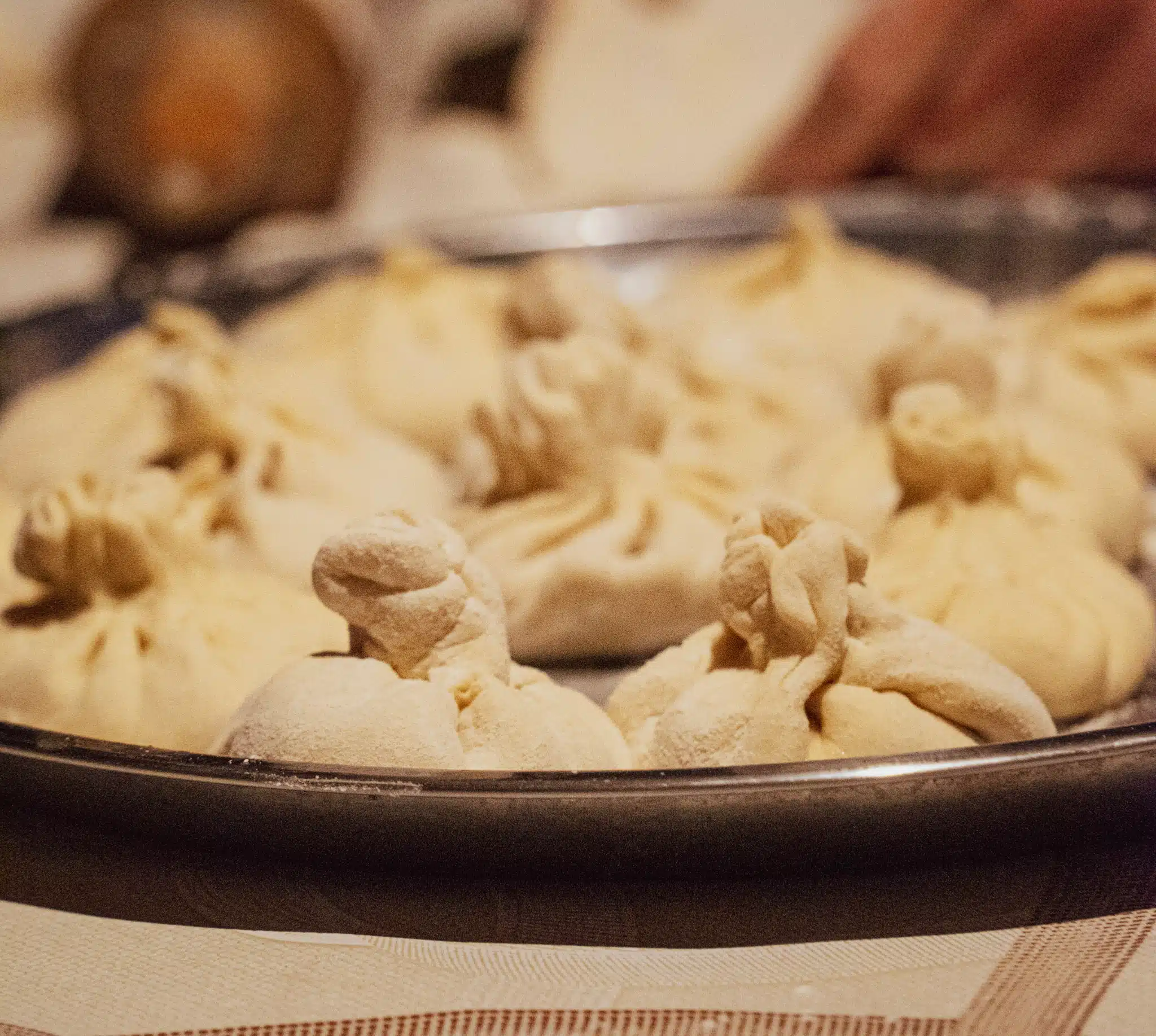
Next we moved to the kitchen to make khinkali, the pleated soup dumplings you’ll eat all over Georgia. Pleating them is harder than it looks. If you want to know what else to eat while you’re there, see my guide to traditional Georgian food.
Our First Supra
The day ended with our first big supra. Our guide, Giorgi, explained the role of the tamada, the toastmaster who leads the table through a series of toasts, and why you don’t just sip whenever you feel like it at a Georgian feast. Somewhere in the day I also drank wine poured off a roof tile, and by the end of the night we were dancing.
That chacha from the vineyard, by the way, is the strong Georgian grape brandy, and it shows up again at the supra. Pace yourself with it.

What Happens to the Grapes After the Harvest
After pressing, and long after your Kakheti wine tour is over, the juice goes into the qvevri with the skins, stems, and seeds. The qvevri is sealed and left in the ground, and the wine ferments for about five to six months before it’s ready to drink. That long contact with the skins is what gives Georgian amber, or orange, wine its color and texture.
Winemakers taste the new wine in spring, which is when the qvevri get opened. If you want to see the other end of the process, Tbilisi holds its New Wine Festival in spring, usually in May, where winemakers from around the country pour their new vintages.
More Harvest Moments Beyond Kakheti
Kakheti gets the attention. However, some of my favorite wine moments of the trip happened at smaller family producers in other parts of Georgia.
Near Rabati Fortress in Akhaltsikhe, we spent an evening at Davit’s small marani, a cozy home wine cellar. The food was excellent (the best potatoes I’ve ever had), Davit and Giorgi sang for the group, and Davit brought out his brandy and walked us through how he makes his amber wine.
Near Gori, our last harvest experience and supra was hosted by Tengo, who took over the winemaking from his father and helps run the traditional dance school in Khidistavi. That evening came with polyphonic singing, which you have to hear in person. Both stops are part of my 10-day Georgia itinerary.
How to Plan Your Own Kakheti Wine Tour
Getting There From Tbilisi
Kakheti is about a two-hour drive from Tbilisi. You can join a group day tour, hire a driver or book a private transfer with GetTransfer. Flights into Tbilisi often land at odd hours, so book your airport pickup ahead with Welcome Pickups. For getting around Tbilisi itself, I used Bolt.
Book Your Winery Ahead
During Rtveli, small family wineries get busy, and many, like Vakho’s, only take visitors by reservation. Message them a few weeks out, ask whether you can join the harvest itself, and confirm the date closer to your trip, since it depends on when the grapes are ready.
If you’d rather have everything arranged for you, from the drivers to the winery visits, a group trip like the one I joined with Type 2 Travel takes care of it. Head to their website and join the waitlist for their next Georgia trip.
If a group trip isn’t in your budget, Eat This! Food & Wine Tours runs one- to three-day food and wine trips into Kakheti from Tbilisi that you can book on your own.
Where to Stay
Stay at least one night in Kakheti so you’re not driving back to Tbilisi after a supra. We stayed in Telavi the night of the harvest. If you’re starting or ending in Tbilisi, see my guide to where to stay in Tbilisi.
What to Bring
- Clothes you don’t mind staining. Grape juice gets everywhere, especially if you stomp.
- Comfortable shoes for walking the rows of vines.
- A jacket. October days in Kakheti were in the high 60s to 70s°F for me, and evenings cool off.
- Data. I used Holafly the whole trip, with a few dead zones in the countryside.
- Travel insurance. Georgia requires it for visitors, so sort it out before you go. My World Nomads review covers what I look for.
Kimberly’s Tip
Pace yourself. Between the tasting at lunch, wine at the supra and homemade chacha, it adds up fast. Eat everything they put in front of you, and drink water between toasts.
Is a Kakheti Wine Tour During Rtveli Worth It?
Yes. A regular wine tasting shows you the finished product. Rtveli shows you the work, the families and the traditions behind it, and then sits you down at the table with them. What stayed with me was how much we packed into one day and how many people were out working the harvest, from the trucks on the road to the families in the vineyards.
If you can time your trip to Georgia for late September or October, plan at least one day in Kakheti around the harvest. It was one of my favorite days of the whole trip.

Kakheti Wine Tour FAQ
What is Rtveli?
Rtveli is the grape harvest in Georgia. Families pick grapes together, press them the same day, traditionally by foot, and celebrate with a supra, the traditional Georgian feast.
When is the grape harvest in Georgia?
Rtveli runs from September to December, depending on the region and the weather. It starts in Kakheti with the Rkatsiteli harvest, usually from mid-September into October.
Can tourists take part in Rtveli?
Yes. Many family wineries in Kakheti welcome visitors to pick grapes, press them and join a supra, but most require a reservation, so book ahead.
How far is Kakheti from Tbilisi?
About two hours by car. You can do a Kakheti wine tour from Tbilisi as a day trip, but staying a night in Telavi or Sighnaghi makes the day much more relaxed.
What grapes grow in Kakheti?
Kakheti is best known for Rkatsiteli, a white grape, and Saperavi, a red grape, though the region grows many local varieties.
What is qvevri wine?
Qvevri wine is fermented and aged in large clay vessels buried in the ground. The method is thousands of years old and is on UNESCO’s Intangible Cultural Heritage list.