Osaka Ramen Cooking Class: Making Ramen in a Real Ramen Shop
Last Updated on September 29, 2026 by Kimberly
I knew when I traveled to Japan that I wanted to learn how to make Ramen. Taking an Osaka ramen cooking class seemed like the perfect opportunity to do just that. Sure, we could do this while living in South Korea, but there’s something about ramen in Japan that just made sense. I knew I needed to experience a cooking class in Japan that would teach me something for years to come.
So after booking flights to Osaka and figuring out what we wanted to do, I landed on a particular Osaka Ramen Cooking class. I truly believe one of the best ways to understand a place is to learn how to cook something. Not just go to a place and eat, but actually learn from a chef who does this every day.
That’s how we landed on this particular Ramen Class with Chef Shuji. I didn’t know how fun it would be, or that we would learn something that would help us make our own ramen at home (and guys, aside from the Ramen in Düsseldorf, this homemade ramen has been the best!)
Here is what you need to know about an Osaka ramen class to decide whether it is worth your time, including the one thing most listings do not tell you upfront.
OTHER COOKING EXPERIENCES I’VE WRITTEN ABOUT:
At a Glance
Osaka Ramen Cooking Class
Menya Shu, Tennoji Ward
| Length | 1 hour |
| Cost | $42.54 on Viator, $45.60 on Klook |
| Group size | Up to 4, private |
| Noodles | Not made from scratch, and neither are Shu’s |
| Kids | Age 7 and up |
What Happens in An Osaka Ramen Cooking Class
A little history for you before we get into the nuts and bolts of it all. Did you know that Ramen is not originally Japanese?
The famous noodle soup came from China and evolved into something that stands entirely on its own. I also learned in my research that there are regional styles, much like sommeliers argue about wine.
According to JNTO, there are four main types of Ramen, where three types refer to seasoning: Miso, Shio, and Shoyu, and the fourth is tonkotsu- a pork broth. So as you can see, there’s a wide variety (I am a big fan of the tonkotsu, myself!)
Then, of course, there is the history of ramen: a staple during World War II, Japan recorded its worst rice harvest, and America sent in Flour. The short of it, this flour was diverted to the black market and Voila! Ramen was made. Find out more about ramen history here.
A ramen class breaks the bowl into its parts, and understanding those parts is really the point!
- The broth is what makes a bowl good or bad. Tonkotsu, shoyu, shio, miso, chicken, clam.
- The tare, the seasoning base that goes in the bottom of the bowl before anything else.
- The noodles, which I would soon learn are made with alkaline water and are a specialty product.
- The toppings: chashu, egg, and aromatics
Classes differ mostly in how many of those four you make yourself, and you’ll want to check that before your booking!
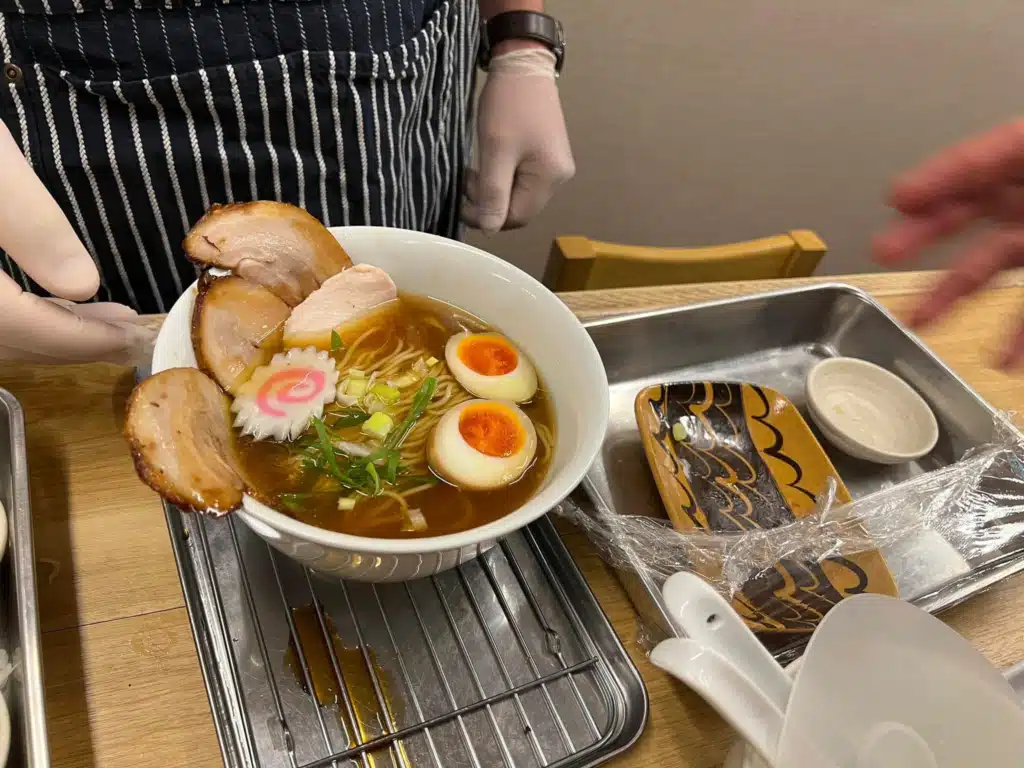
Do You Make the Noodles From Scratch?
This is the single biggest difference between Osaka ramen classes, and you’ll need to really figure out if you have the time to do something like this.
Short classes: You cook the broth from scratch and assemble the bowl. You’ll spend an hour and a half; it’s usually $39 to $45
With Chef Shu, we had the shorter version. I didn’t mind this at all. The reason? I just wanted to learn from him. I wanted to get his take on how to make this at home in a Western kitchen; what tricks could I borrow for a successful cooking experience at home? I knew I wouldn’t be making ramen noodles at home. I could easily buy these from one of many asian food stores near me.
I learned I had the right Idea, because proper ramen noodles need alkaline water, resting time, and proper technique. I mean, I can’t even make Pierogi right. LOL
So you’ll make the broth, learn the process, and the layering. Which I was perfectly fine with!
FULL DISCLOSURE: In Shu’s class you do not make the noodles and there is a specific reason for that. The menu on his wall says every noodle in the shop is custom-ordered from a noodle maker in Kyoto. So he sources the noodles and puts effort into the broth.
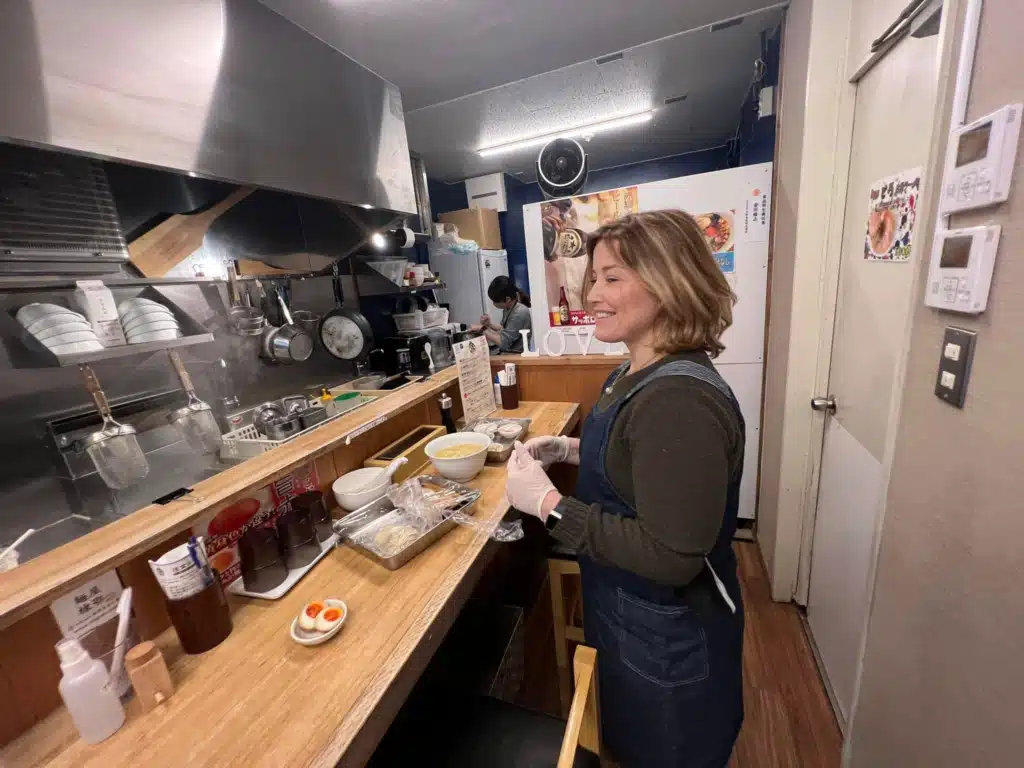
Why Take a Ramen Class in Osaka
Simply put, Osaka is foodie heaven! (Well, all of Japan is!) The food here felt approachable; you could find great places to eat on every corner. Making ramen just added to that vibe!
A ramen class in Osaka is where you can get conversation from a chef and others who want to learn about methods. You’re in a small room with a professional who will answer questions for an hour. You can’t get that from standing in line.
Chef Shu’s Class in Tennoji
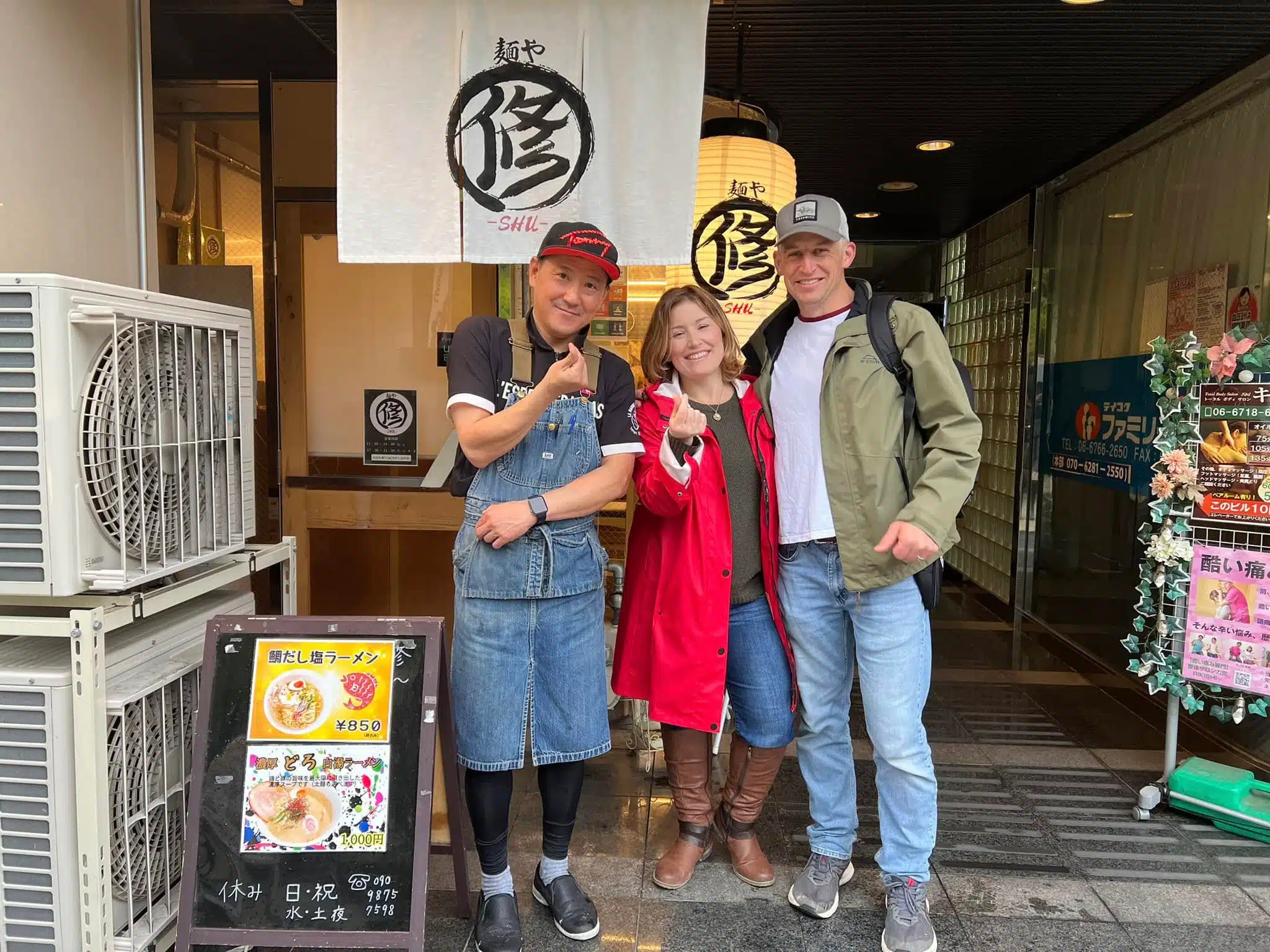
The class runs at Menya Shu (麺や修)
The best part is, you aren’t in Dotonbori or Namba with the crowds, and when we went, in April, it was raining. So doing this class made perfect sense (I mean ramen anytime makes sense but wow, what a comfort food to have on a rainy day!)
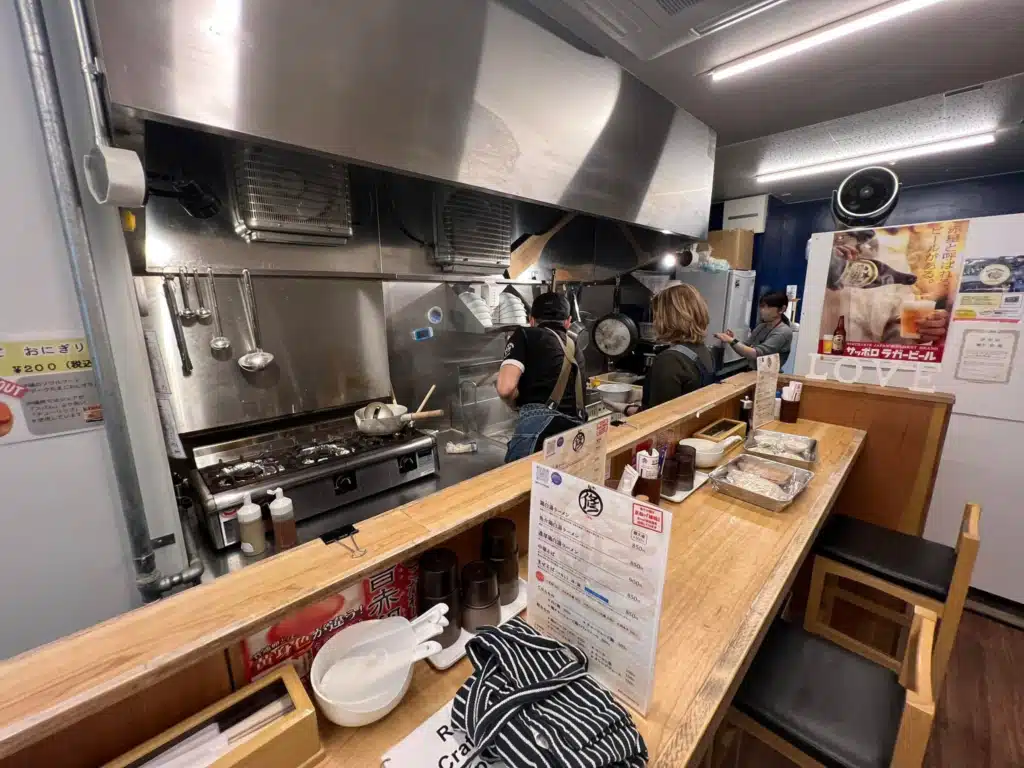
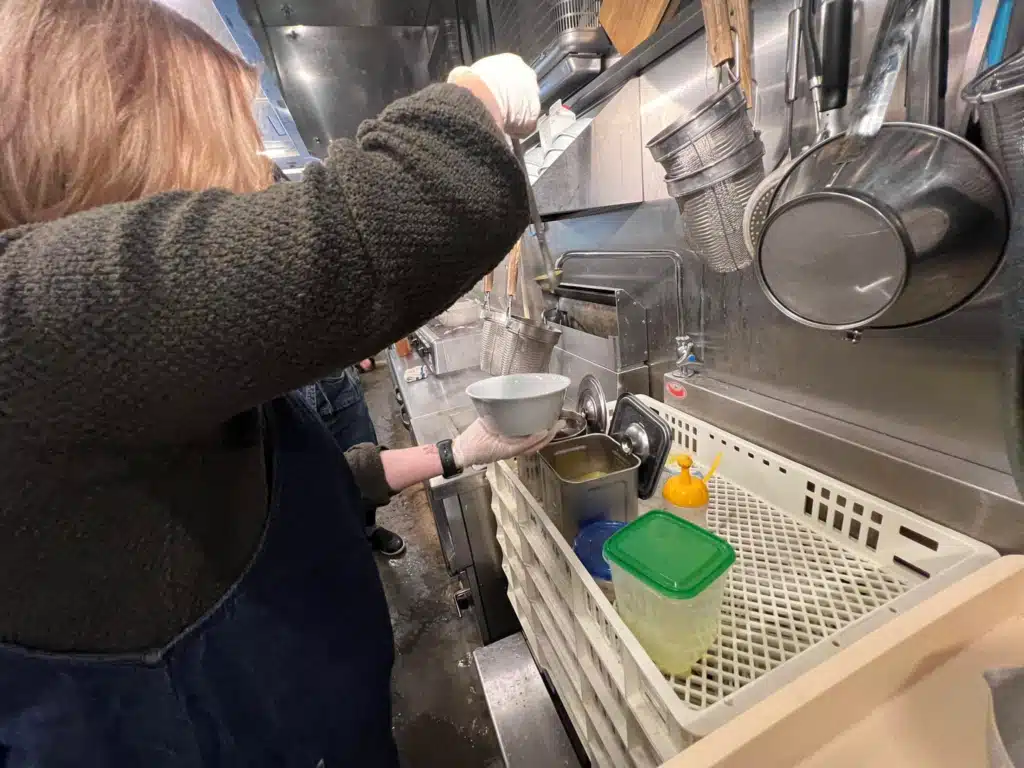
The shop is small. One wooden counter, six or seven seats, and a narrow galley kitchen behind it with gas burners, noodle baskets, and the stockpots all within arm’s reach. No separate teaching kitchen; you cook in his kitchen!
His own menu is chicken paitan-led: chicken paitan at ¥850, a seafood chicken paitan at ¥850, a richer version at ¥900, chuka soba at ¥850, and mazesoba at ¥850.
Before we arrived
Chef Shu contacted me before the cooking class and made sure I understood where he was located and to let him know if we had any issues getting there. I loved how thoughtful he was even before we got there.
Later, he would tell us, “People get lost! Time is precious, so it matters to me!”
We took the train to Tennoji from Namba, which, honestly, wasn’t that long. Using Google Maps to navigate to his shop made it easy.
What happens when you arrive
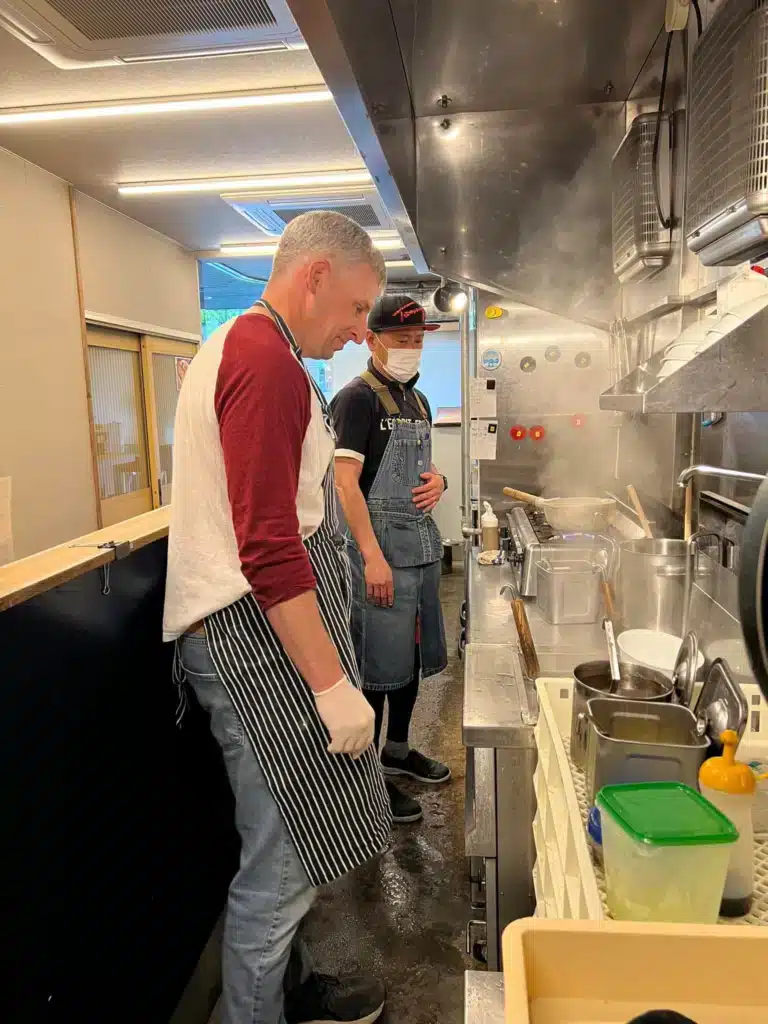
My husband and I were doing this together, so we had to take turns. I recorded and took pictures of him doing his thing. Yes! We were the only two in this class, which was actually quite nice!
You’ll be given aprons and disposable gloves; food safety first. Many of the tools were wrapped and very sanitary.
You’ll get about 15 minutes on the ingredients and the tools, then 30-40 minutes of hands-on cooking (think chopping techniques and context behind the ingredient)
Shu guides you the whole entire way. Then you’ll sit down and eat what you made with your host.
ONE RULE: Arrive more than 15 mintues late and you cannot join. It’s a one-hour class, a working restaurant.
What You’ll Do
During the class, you will:
- Learn the tools and ingredients, with Shu walking you through what each one is for.
- Choose your ramen style from four options, including soy sauce, chicken, and clam broths.
- Cook the broth, which determines whether the bowl is any good.
- Build the bowl in order: tare first, then broth.
- Prepare and arrange the toppings: chashu, narutomaki, scallions, and a seasoned egg if you want one.
- Boil the noodles to the right point, which is less obvious than it sounds.
- Eat what you made, at the counter, with everyone else.
- Take the recipe home so you can attempt it in your own kitchen.
My Ramen Class Experience
We showed up cold, wet, and hungry. We had spent the morning walking around Osaka Castle in the rain.
Funny story, since I had a Korean number, he thought we were Koreans! LOL
Our booking had come through with Korean phone numbers, because we were living in South Korea at the time, and my name is Kim. Between the numbers and the Kim, he had decided a Korean guest was on the way. We turned up and were, obviously, not that. His face was priceless!
It turned out fine, because Shu has his own history with Korea and loves the place. He speaks Korean. So we spent part of the hour talking about Seoul instead of ramen.
He also told us why he teaches. He and his wife both love ramen. It is one of his favorite things to eat, and at some point they decided they wanted to show people how to make it. That is the whole reason the class exists!
The hardest part for me was the noodles. Not the broth, not the toppings. Getting the noodles right. I get anxious in kitchens, and standing at a professional line with a basket of noodles in boiling water and a chef watching is exactly the situation my brain does not enjoy. Isaac had no problem at all, which was annoying.
Shu was patient as ever with us and I really appreciate the fact that he was willing to be so patient with me.
I made the shoyu. Clear brown broth, chashu, narutomaki, scallions, thin straight noodles. Mine came without egg. Isaac went all in on toppings!
It was incredible. Soothing is the word, and given the rain and the walking and the hunger, it landed exactly where it needed to.
What I didn’t expect
The thing I did not expect: we make ramen at home now. Regularly. It’s not as good as Shu’s, obviously.
But the class did what a good class is supposed to do: show you that you can actually pull this off in your own kitchen. That’s why I wrote this review, and I want you to end up in Shu’s Kitchen at a Ramen Making Experience in Osaka!
The other reason is smaller, but it matters just as much. This is one man’s shop with a counter and a handful of seats, run with his wife. Booking the class puts money directly in their pocket.
We learned from Shu, and Shu learned from us. That is what an hour in a small shop gets you.
Who This Ramen cooking Class Is Best For
Families. This would be genuinely fun with kids. It is short, it is hands-on, everyone gets their own bowl, and there is no long stretch of standing around listening. Check the Klook listing for age requirements here
Solo travelers, especially solo women. Shu and his wife run this with real hospitality, and I would send a solo traveler here without hesitating.
It is a small group at a counter with a family who want you to enjoy yourself. If you are traveling alone and want one thing on your Osaka itinerary that puts you around people, this is a good pick.
Couples. We did it as two, and it worked. You each make your own bowl, so nobody is watching the other person cook.
Anyone who actually wants to cook it again. That is the real dividing line. If you want an experience, any class will do. If you want to go home and make ramen, this one shows you how.
Skip it if you specifically want to make noodles by hand, for the reason above.
How Much It Costs and where to book
The one-hour class runs roughly $45 per person depending on the platform and the season. Longer Osaka classes that include noodle-making and gyoza run $80 to $105, and specialty versions with sake pairings go above $115.
Money-saving tip: the one-hour class is the best value per hour of any ramen class in Osaka, and it does not eat a third of your sightseeing day to get there.
Where to book, and why the platform matters
Same class, same operator, different fine print. I booked through Viator for our trip to Japan, you can also book through Klook as well.
- Klook lists it as Professional Ramen Cooking Class in Osaka. Over a thousand booked, 4.9 out of 5. This is the one I use for Asia.
- Viator carries it under a different name, Ramen Craftsman Experience in Osaka, which is why it is hard to find if you search the Klook title.
Book with the cancellation terms that suit your trip.
Good to Know Before You Book
Menya Shu (麺や修), Tennoji Ward, Osaka · Google Maps
Shop hours
- Monday, Tuesday, Thursday, Friday: 11:00 to 14:00 and 17:30 to 20:00
- Wednesday and Saturday: lunch only
- Sunday: closed
- Class slots run around a working restaurant, so a Sunday in Osaka rules this out, and Wednesday and Saturday evenings are unlikely. Plan it into a weekday if you can.
- It is one hour. Most Osaka ramen classes run around three. If your Osaka time is tight, that difference is why you should book this one.
- Aprons and gloves are provided. Wear what you like, within reason.
- Arrive on time. If you are more than 15 minutes late, you cannot join.
- Dietary needs. Ramen broth is very often pork- or fish-based, so this is not a small question.