How to Visit One of Venice’s Most Beautiful Hidden Gardens (Redentore Garden Guide)

Looking for unique experiences in Venice that go beyond the usual sights? A visit to Redentore Garden in Venice offers a fresh perspective on the city’s charm.
One of the most effective ways to explore a quieter, less busy side of the city is by visiting its hidden gardens—spaces that most travelers never see.
After spending time navigating the crowds around St. Mark’s Basilica and the Grand Canal, I started looking for something slower and less crowded. That’s how I found the Redentore Garden in Venice on the island of Giudecca.
It ended up being one of the most relaxing and memorable experiences of my trip.
In this guide, I’ll walk you through exactly how to visit Redentore Garden, what to expect, and why it’s worth adding to your Venice itinerary, plus a few other gardens in Venice if you want to explore more.
Why Visit a Hidden Garden in Venice?
Most visitors focus on Venice’s major landmarks, which often means dealing with large crowds and a fast-paced itinerary.
I followed a similar approach at first, but quickly found myself looking for something quieter, much like when I discovered I could row voga alla veneta in Venice, I knew I wanted to see the Redentore Garden.
Adding the Redentore Gardens to your Venice Itinerary changes the pace completely. Instead of moving between crowded attractions and going to other Islands around Venice, you’re able to slow down, explore at your own pace, and experience a different side of the city (I talk about this in my Favorite Food Tours in Venice Post)
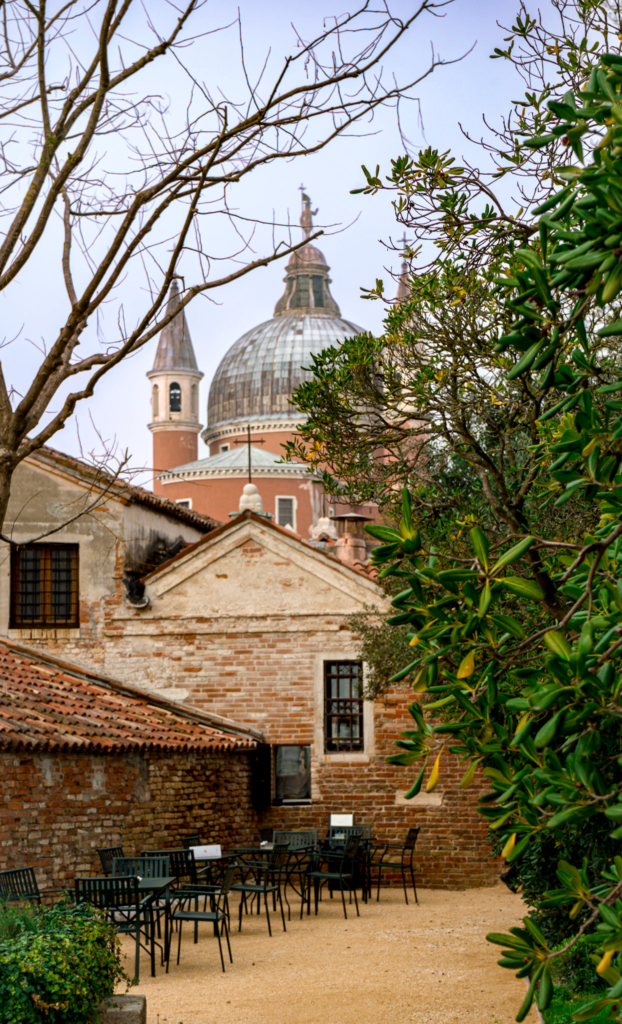
What Makes Gardens in Venice Unique
Gardens in Venice are relatively rare and often hidden within historic spaces.
Many are:
Part of convents or religious complexes
Located behind walls or enclosed courtyards
Designed for practical use, not just visual appeal
That combination of history and function makes them feel very different from traditional city parks.

My Experience Visiting Redentore Garden
I visited Redentore Garden with my husband and my mother-in-law, and the shift from the rest of Venice was immediate. As soon as I stepped inside, the noise dropped off, and the pace changed—it felt noticeably quieter and more contained compared to the crowded areas we had come from.
I visited in November, expecting the garden to feel fairly minimal, but that wasn’t the case. Believe it or not, visiting Venice in November is fairly wonderful. A bit cold and wet, but other than that, incredible.
There were still flowers in bloom, well-maintained planting areas, and greenery throughout the space. What stood out most was the smell, something you don’t usually associate with Venice. The scent of soil and plants was noticeable as we walked through, which made the environment feel completely different from the surrounding streets.
The garden doesn’t follow a strict route, which makes it easy to explore at your own pace. As we walked through, we naturally separated and spent time in different areas without really planning to. At one point, I found myself completely alone in a part of the garden, which is a rare experience in Venice, and made the visit feel even more distinct.
What made the experience stand out most, though, was my mother-in-law’s reaction. She loves gardening, and I could see her slowing down to look closely at different plants and layouts, noticing details I might have otherwise missed. It created a different kind of shared experience—one that didn’t revolve around moving quickly or trying to see everything.

The History Behind the Garden
The garden, known as Hortus Redemptoris, had been a part of the larger Redentore complex on Giudecca, which dates back to the late 16th century. The complex was built following the devastating plague of 1575–1577, one of the most significant outbreaks in Venice’s history. In response, the city commissioned the Church of the Redentore as a votive offering, designed by the renowned Renaissance architect Andrea Palladio (who is also very well known in Vicenza — psst, here’s a post about things to do in Vicenza!).
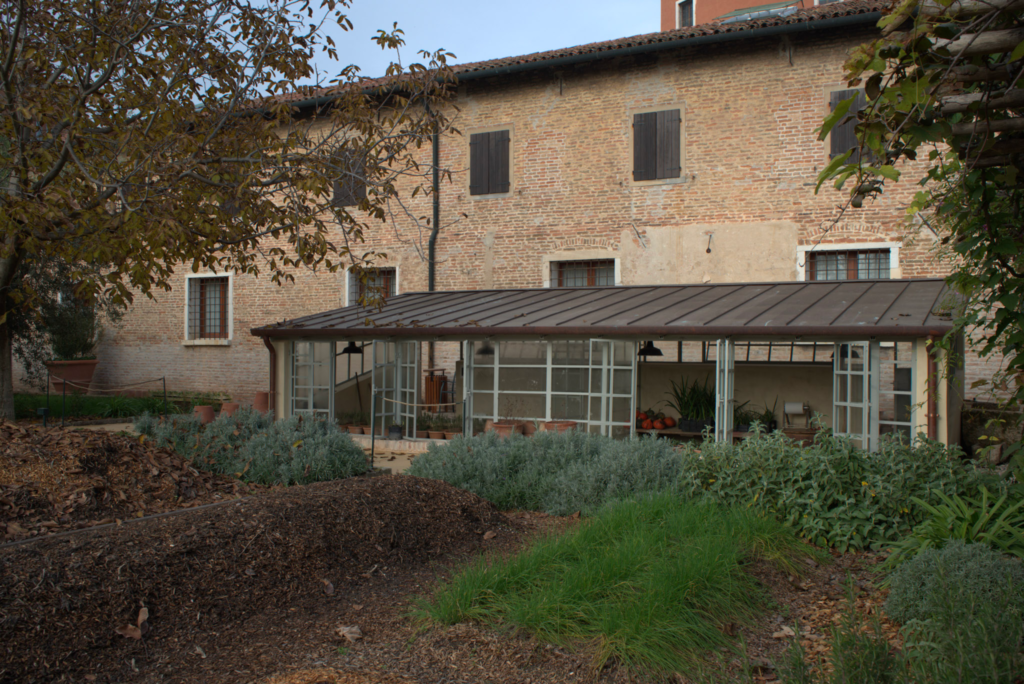
Alongside the church, a convent was established for Capuchin friars, and the garden became a functional part of daily life within it. For centuries, it was not intended for visitors. Instead, it served as a working monastic garden for growing food, cultivating medicinal herbs, and producing flowers for religious purposes. This practical use is still reflected in the layout today, particularly in the presence of a traditional “garden of simples,” where herbs like chamomile, valerian, and mallow were grown for natural remedies.
The garden remained closed to the public until recently. After suffering damage over time, including significant flooding during the 2019 Acqua Granda, it underwent a major restoration project led by the Venice Gardens Foundation and reopened in 2021.
The goal of the restoration was not to redesign the space, but to return it to its original function. This included restoring historic pathways, reintroducing traditional plants, and rebuilding key structures such as the greenhouse and workshop areas.
Sustainable systems were also added, including rainwater collection and on-site composting, allowing the garden to function much as it would have historically, self-sufficient and closely tied to the rhythms of the land.

What you’ll see during Your Visit
Redentore Garden is home to more than 2,500 plants, making it one of the most botanically diverse gardens in Venice.
As I walked through the space, I noticed how structured everything felt—plants were intentionally grouped rather than randomly arranged.
You’ll find:
- Cypress trees and olive trees
- Fruit trees, including fig, almond, pomegranate, persimmon, and black cherry
- Medicinal plants like chamomile, valerian, verbena, and mallow
- Mediterranean herbs such as lavender, sage, rosemary, and helichrysum
- Flowers grown for the church, including roses, lilies, zinnias, and dahlias
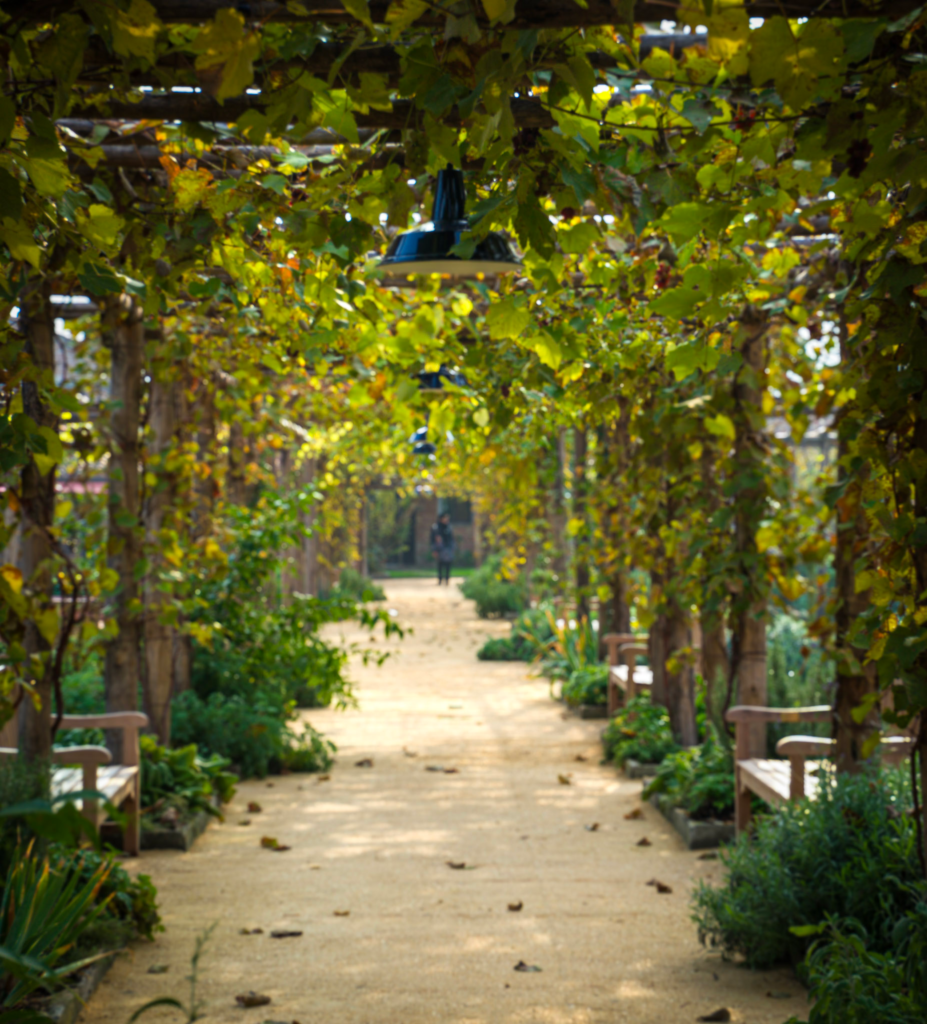
There are also smaller details that stand out when you slow down, like violets, strawberries, and climbing plants woven into pergolas.
At the center of the garden, there’s a water basin with lotus flowers and water lilies, which acts as a focal point without feeling overly designed.
How the Garden Is Designed (And Why It Feels Different)
The garden follows paths that are arranged in a structured grid.
As I walked through it, I noticed how this design naturally guides movement without the need for signage.
A long pergola runs through part of the garden, covered in:
- Wisteria
- Climbing roses
- Bignonias
This creates shaded walkways and adds variation to the space.
Unlike decorative gardens, this one is built around:
- Food production
- Biodiversity
- Sustainability
The garden still produces vegetables, honey, and olive oil, and includes composting systems and water management features.
What Else Can You See Inside the Redentore Complex
Beyond the garden itself, Hortus Redemptoris has been carefully restored and includes several historical spaces.
These include:
- A carpentry workshop
- Oil and honey production areas
- A wool workshop
- Spaces once used to produce mistrà liqueur
Today, many of these have been converted into exhibition spaces.
There is also:
- A meditation chapel
- A café overlooking the lagoon, with some ingredients sourced from the garden
How to Visit Redentore Garden or Hortus Redemptoris,
Tickets
€12 standard
€6 reduced
Free for certain groups (children under 5, clergy, etc.)
Opening Hours
The garden is open Thursday to Saturday, with seasonal hours:
Winter: 10:00 AM – 4:30 PM
Spring/Fall: 10:00 AM – 5:30 PM
Summer: 10:00 AM – 7:30 PM
Closed Sunday–Wednesday and on select holidays.
How to Get to Redentore Garden in Venice
Getting to Redentore Garden is straightforward, even if you’re staying in central Venice.
The easiest way is to take the vaporetto (water bus) to Giudecca and get off at the Redentore stop. From there, it’s just a short walk to the garden entrance.
When we took this route, the shift was noticeable almost immediately. The ride itself only takes a few minutes, but arriving on Giudecca feels very different from the main areas around St. Mark’s. It’s quieter, less crowded, and much more residential.
If you’re coming from:
- St. Mark’s / San Zaccaria → take Line 2 (direct and quick)
- Zattere → take Line 2 or Line 4.1
- Piazzale Roma / Train Station → take Line 2 (longer route, but no transfers)
I found Line 2 to be the most convenient overall.
One thing to keep in mind is that vaporetto schedules can vary slightly depending on the season, so it’s worth checking times in advance—especially if you’re planning to visit later in the day.
The Café at Redentore Garden (Worth Stopping For)
One thing I didn’t expect was how good the café would be.
At the end of the garden, facing the lagoon, there’s a small Caffè Illy that’s open on the same days as the garden (Thursday to Saturday).
The setting alone makes it worth stopping. It’s quiet, surrounded by the garden, and feels completely removed from the busier parts of the city.
What stood out most to me was the food. A lot of the ingredients come directly from the garden, so the menu changes depending on what’s available.
The menu leans toward simplicity but thoughtfulness, with a focus on seasonal ingredients and herbs grown on-site. It feels intentional without being overly formal.
The staff was also genuinely kind and welcoming, which added to the overall experience.
Given the location, the quality of the food, and the setting, I found it to be very good value for Venice—especially compared to more tourist-heavy areas.
How Much Time to Spend at the Garden
Plan for 1–2 hours to explore at a comfortable pace.
Venice Garden Tours (How to See More Hidden Gardens)
If visiting Redentore Garden makes you want to see more spaces like this, a guided Venice garden tour is one of the best ways to do it.
One thing I realized after my visit is how many gardens in Venice are completely hidden from view. A lot of them sit behind walls, inside convents, or within private properties, and you simply wouldn’t know they exist unless you had access.
That’s where garden tours come in. Instead of trying to find these places on your own, you’re able to visit multiple gardens in one experience, often with access that isn’t available to the general public.
Most Venice garden tours include a mix of private courtyards, convent gardens, and historic green spaces that aren’t normally open. They also tend to include context about the history and purpose of each space, adding another layer to the experience.
For me, visiting Redentore shifted how I saw Venice. It made me realize that some of the most interesting parts of the city aren’t the ones you see immediately—they’re the ones tucked away behind walls.
If you’re interested in architecture, history, or simply slowing down your itinerary, a garden tour is a natural next step.
Other Gardens in Venice to Visit
- Giardini della Biennale- Large, open, and less crowded.
- Giardini Reali- Central but quieter early in the day.
- Papadopoli Gardens – Easy to access near transport hubs.
Is Redentore Garden Worth Visiting?
Redentore Garden is worth visiting if you’re looking to experience a quieter side of Venice without leaving the city entirely.
It’s not a major landmark, and it doesn’t have the same “must-see” status as places like St. Mark’s or the Doge’s Palace. But that’s exactly what makes it valuable. The experience is slower, less crowded, and feels more connected to the city’s history and daily life.
I wouldn’t prioritize it if you’re in Venice for a very short time and trying to fit in all the main sights. But if you have a bit more flexibility in your itinerary, or you’re looking to balance busy areas with something calmer, it’s a worthwhile addition.
For me, it ended up being one of the most relaxing parts of the trip—and a completely different way to experience Venice.
FAQs About Visiting Redentore Garden
You can often buy tickets on-site, but booking in advance is recommended during peak travel seasons to guarantee entry.
Take the vaporetto to Giudecca and get off at the Redentore stop. From there, it’s a short walk to the garden entrance.
Yes, but it is only open Thursday through Saturday, with seasonal hours that change throughout the year.
Most visitors spend 1–2 hours, depending on how slowly they explore.