
From Volcanic Soil to Sweet Wine:Menti Wines is A Winery Near Vicenza Worth Visiting
If you’re searching for a winery near Vicenza that focuses on sustainability, biodynamic farming, and traditional winemaking, Menti Wines in Gambellara should be at the top of your list.
Located in the volcanic hills of eastern Veneto, Menti is just 25–30 minutes from Vicenza, 15 minutes from Soave, about 30 minutes from Verona, and a little over an hour from Venice. If you’re already planning a day in Soave or exploring the Prosecco Hills, adding a stop here makes for a rewarding half-day wine tasting experience in northern Italy.
This isn’t a commercial bus-stop winery. It’s a family-run estate rooted in tradition, environmental stewardship, and a patient approach to winemaking that you can feel the moment you arrive.
If you’re building out a northern Italy itinerary — whether it’s your first time in Verona, you want to explore Vicenza beyond the city center, you’re spending a day in Soave, or planning an e-bike ride through the Prosecco Hills — Menti fits seamlessly into the mix.
I completely fell in love with Menti the moment Stefano began talking about his mission — to let the land lead. In this blog post, I walk you through my visit so maybe you’ll plan a visit here and fall in love with Menti Vineyards as I did.
Menti Wines At a Glance
Location: Gambellara, 25–30 minutes from Vicenza
Specialty: Biodynamic Garganega wines + traditional sweet wine
Historic Feature: 1700s grape drying tower (picaio method)
Farming Style: Biodynamic + organic certified
Best Time to Visit: October–December to see the drying tower in use
Reservations: Required via the official website
Good For: Half-day trip from Vicenza or Verona
Menti Wines caters to all types of travelers; it’s a solo female traveler-friendly experience!
Where Is Menti Wines Located?
Menti Wines is located in Gambellara, a small wine-producing village between Vicenza and Verona, at the southwestern edge of the Lessinia hills.
This landscape is defined by ancient volcanic activity. Rolling hills, mineral-rich soil, and steady breezes make it ideal for viticulture. Because it sits close to the A4 highway, it’s an easy detour if you’re driving between Verona and Vicenza — or a quiet countryside escape from Venice.
Unlike larger commercial wine regions, Gambellara feels calm, local, and deeply rooted in tradition.
The Origins of Gambellara: Why This Region Matters
One of the reasons I love living in Italy is that every region is deeply rooted in what it produces. In Veneto alone, you can trace entire communities through what grows there — from grappa distilleries just outside Bassano del Grappa to the cheese aging in Asiago. Places likeTrattoria Al Angelo reflect that same philosophy: simple ingredients, regional identity, and a respect for tradition that mirrors what you see at Menti.
Gambellara is no different.
s shaped this area for centuries. Long before modern wineries and wine routes, people were already growing grapes on these hills. For generations, these volcanic hills have been dedicated to growing Garganega, a grape that thrives in mineral-rich soil and has shaped the identity of the region.
Gambellara has long been known for both dry white wines and dessert wines made from dried grapes. The town even maintains its own wine route through the hills.
Menti isn’t trying to reinvent anything here. It’s simply continuing what this region has always done — just in a more intentional way.
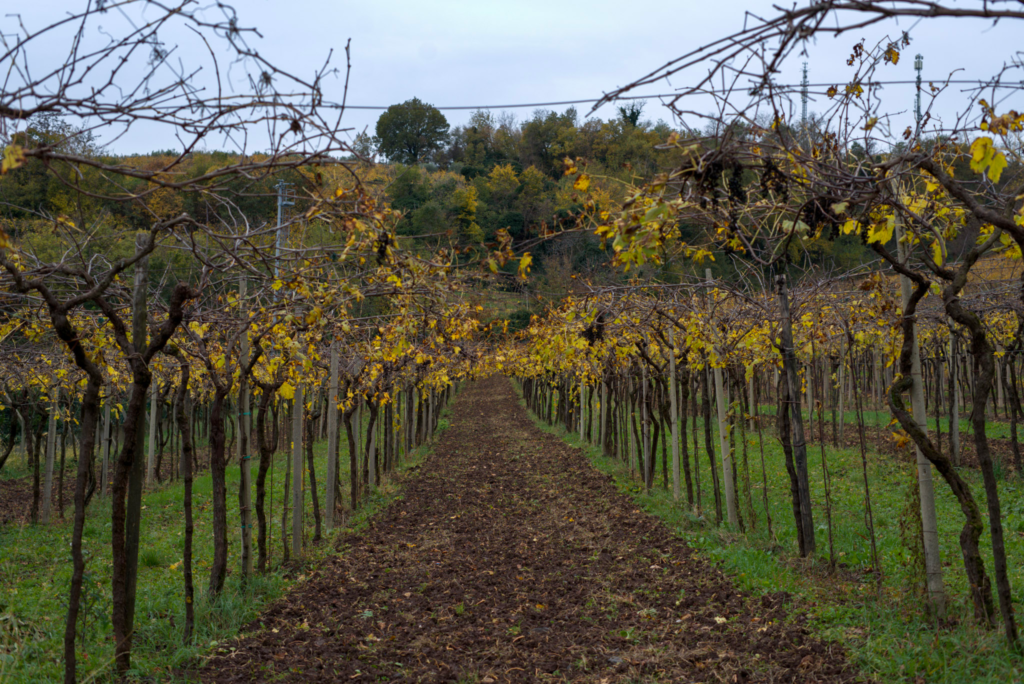
Instead of low-trained vines close to the ground, many here are raised in pergola style, lifting the grape clusters higher into circulating air. It protects the fruit from excessive heat radiating off the rock. It allows wind to move freely after rain. It reduces humidity, which in this region is far more dangerous than insects.
“The main problem is when it is too wet,” he told us. “Humidity stays. Then fungi.”
Everything about the vineyard felt designed around airflow and balance — not yield.
A Brief History of Menti Wines in Gambellara
The Menti story begins in the late 1800s, when Giovanni Menti moved to Gambellara and began farming land inherited through his wife’s family. He cultivated olives, fruit trees, vegetables, and Garganega grapes — a variety uniquely suited to the region’s dark volcanic soil.
That agricultural knowledge passed through generations, eventually to today’s winemaker, Stefano Menti. More than a century later, the winery remains family-owned and deeply tied to the land.
But what makes Menti special isn’t just longevity. It’s the decision to return to low-intervention farming rather than follow industrial trends.
Wine has shaped this area for centuries. Long before modern wineries and wine routes, people were already growing grapes on these hills. For generations, these volcanic hills have been dedicated to growing Garganega, a grape that thrives in mineral-rich soil and has shaped the identity of the region.
Gambellara has long been known for both dry white wines and dessert wines made from dried grapes. The town even maintains its own wine route through the hills.
Menti isn’t trying to reinvent anything here. It’s simply continuing what this region has always done — just in a more intentional way.
Instead of low-trained vines close to the ground, many here are raised in pergola style, lifting the grape clusters higher into circulating air. It protects the fruit from excessive heat radiating off the rock. It allows wind to move freely after rain. It reduces humidity, which in this region is far more dangerous than insects.
“The main problem is when it is too wet,” he told us. “Humidity stays. Then fungi.”
Everything about the vineyard felt designed around airflow and balance — not yield.
A Brief History of Menti Wines in Gambellara
The Menti story begins in the late 1800s, when Giovanni Menti moved to Gambellara and began farming land inherited through his wife’s family. He cultivated olives, fruit trees, vegetables, and Garganega grapes — a variety uniquely suited to the region’s dark volcanic soil.
That agricultural knowledge passed through generations, eventually to today’s winemaker, Stefano Menti. More than a century later, the winery remains family-owned and deeply tied to the land.
But what makes Menti special isn’t just longevity. It’s the decision to return to low-intervention farming rather than follow industrial trends.
The Afternoon That Changed the Tone
I didn’t expect to spend the afternoon talking about volcanic rock, 90-year-old vines, and bottle weight.
But that’s exactly what happened at Menti.
We arrived on a chilly day in November, and it had just rained. I was afraid we wouldn’t be able to get a full tour of the place. Rows stretched neatly across the slopes, the winery tucked quietly into the landscape. Stefano greeted us and welcomed us into his home and invited.
We sat around the kitchen table talking about our time in Italy, and he talked about his family and his recent travels. Then, with a cheerful smile, “andiamo!” (let’s go) and we walked outside to the vineyard (I WAS ECSTATIC!)
And then something moved under the vines.
“Sheep,” Stefano smiled, almost amused at our surprise. “They are working.”
Not grazing. Working.
My husband noticed that electric net outlines the vineyard rows, mostly to keep wandering dogs from startling the flock. Inside that boundary, the sheep move slowly beneath the pergola-trained vines, eating the grass that would otherwise need mowing and fertilizing the soil as they go.
“The sheep save us time,” he said. “And they fertilize. The grass becomes manure.”
That was the moment the visit shifted for me. This wasn’t going to be a tasting-room performance. It was going to be about systems.
Old Vines, Slow Decisions
At one point Stefano mentioned something that lingered with me long after we left.
“In Italy, the average vineyard is seven years old.”
Seven.
In many parts of the industry, vines are planted, pushed hard for a few seasons, and replaced when productivity drops. It’s efficient. Profitable. Standard.
At Menti, the youngest vineyard dates to the 1980s. The oldest vines were planted in the 1930s. Some individual plants are over 90 years old and still producing fruit.
“If you prune well,” he said, “the vine is like a tree. It wants to grow.” Care equals longevity.
Harvest: 40 Hours vs 72 Tons
During harvest, everything is picked by hand.
He told us about a day when four and a half people worked nine hours and harvested around 2.5 tons of grapes. In the same time frame, a neighboring vineyard using mechanical harvesters gathered 72 tons.
The number felt almost abstract. But then he explained the difference.
When harvesting by hand, you see each bunch. You cut away what isn’t perfect. You leave damaged fruit behind. You decide, cluster by cluster, what becomes wine.
“With machines,” he said lightly, “you harvest EVERYTHING.” I won’t forget that. It wasn’t judgment. It was simply a reflection on scale. Speed changes what ends up in the tank (I’ll let you think about that!)
Down in the Cellar
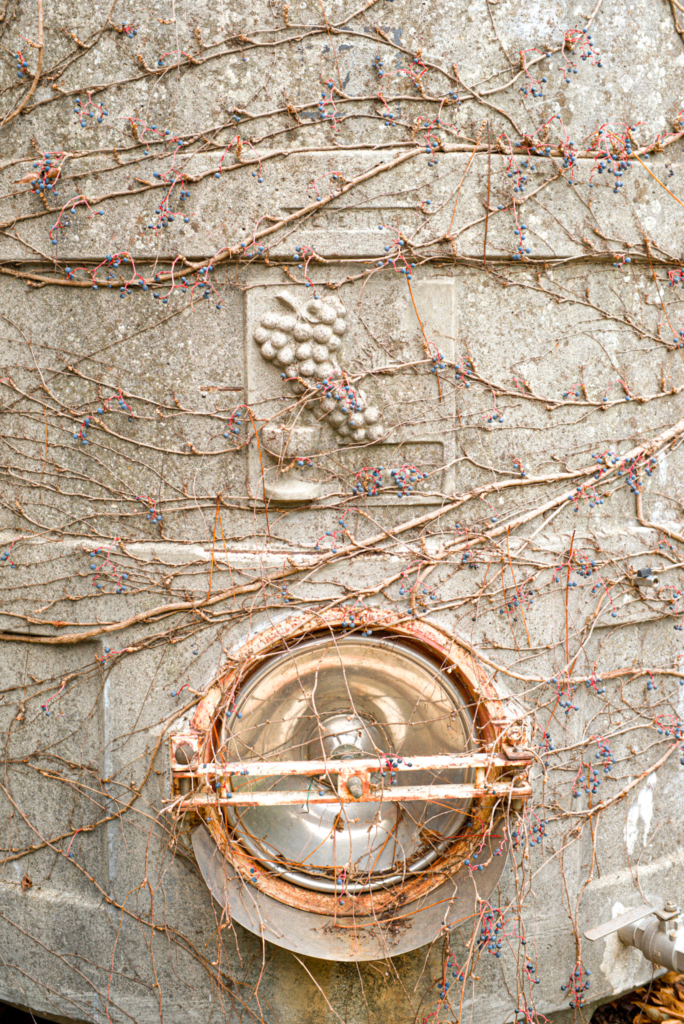
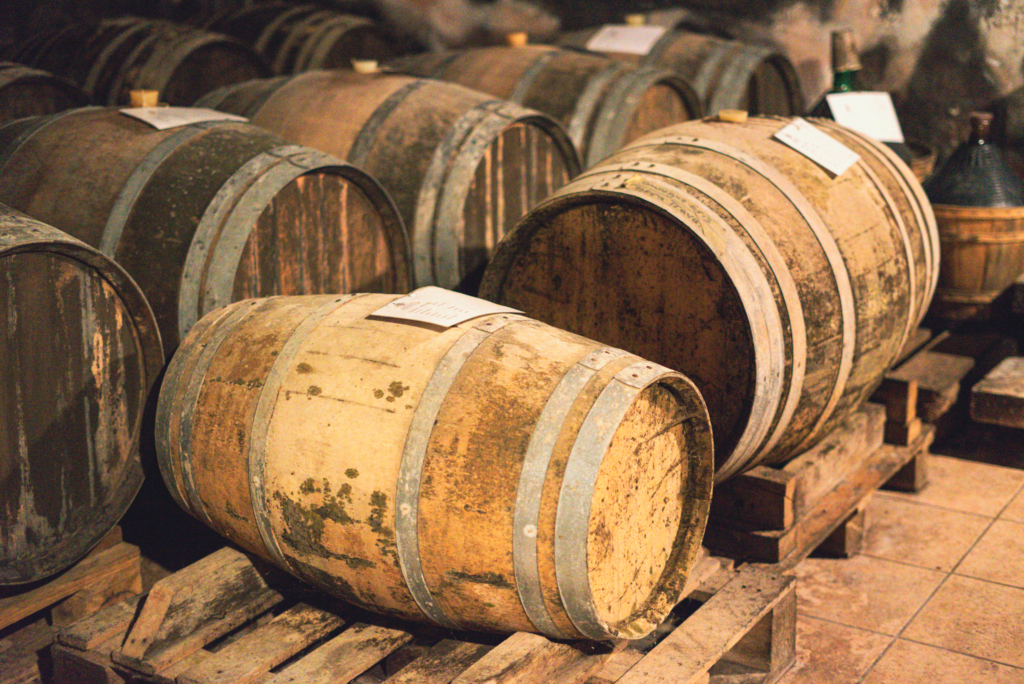
The cellar itself didn’t try to impress. Concrete tanks built in the late 1970s line one wall, once considered outdated, now appreciated again for their gentle stability. Old French and Slavonian oak barrels sit quietly in the corner, some decades old.
I asked Stefano why he chose Old French and Slavonian Oak. “We don’t want strong oak,” Stefano explained. “We want the wine to breathe.”
I learned that instead of chasing bold wood flavors, the goal here is micro-oxygenation, slow evolution without domination. The thick stone walls regulate temperature naturally. The winter cold never fully penetrates. Summer heat never overwhelms (and it gets quite hot in Veneto)
The 1700s Drying Tower and the Traditional Picaio Method
We walked around to the front of the building and climbed the stairs.
And there really aren’t words for the first time you see the grapes hanging in the tower.
I had seen photos online. I had read about it. I thought I knew what to expect.
In person? It was stunning.
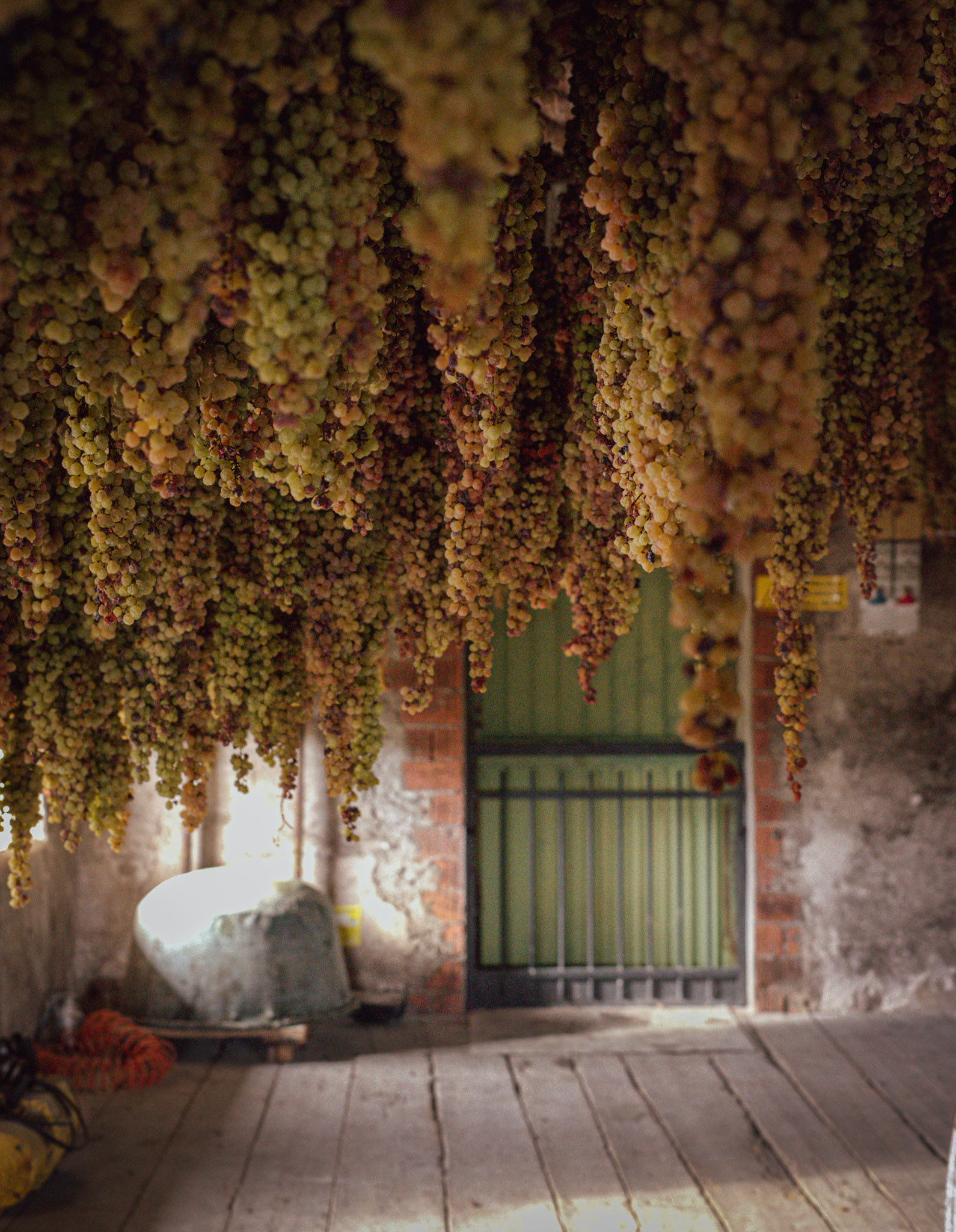
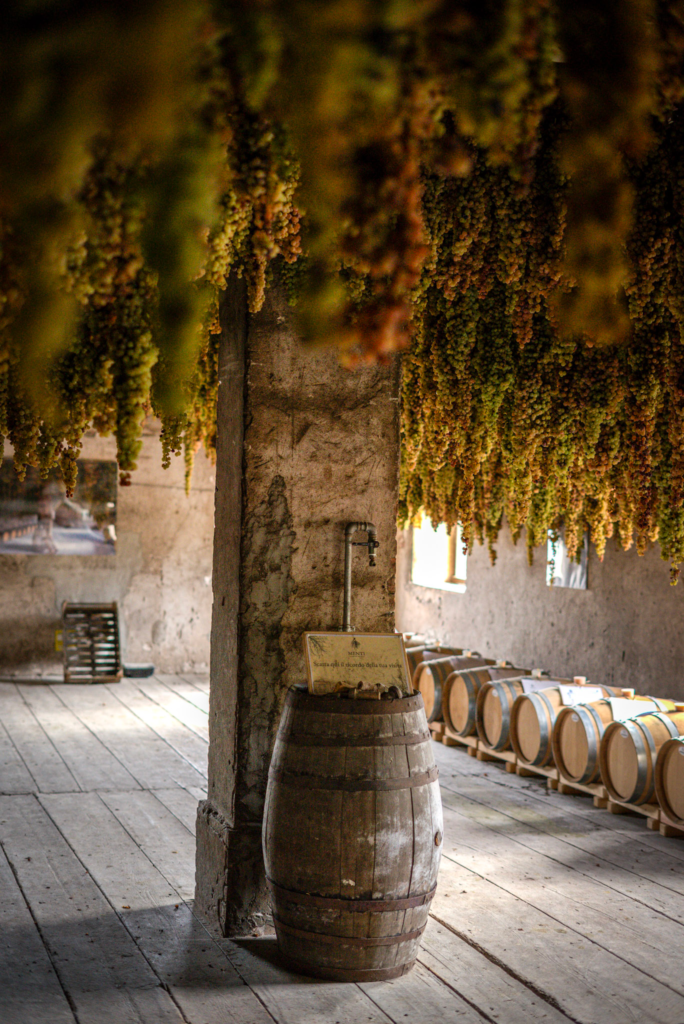
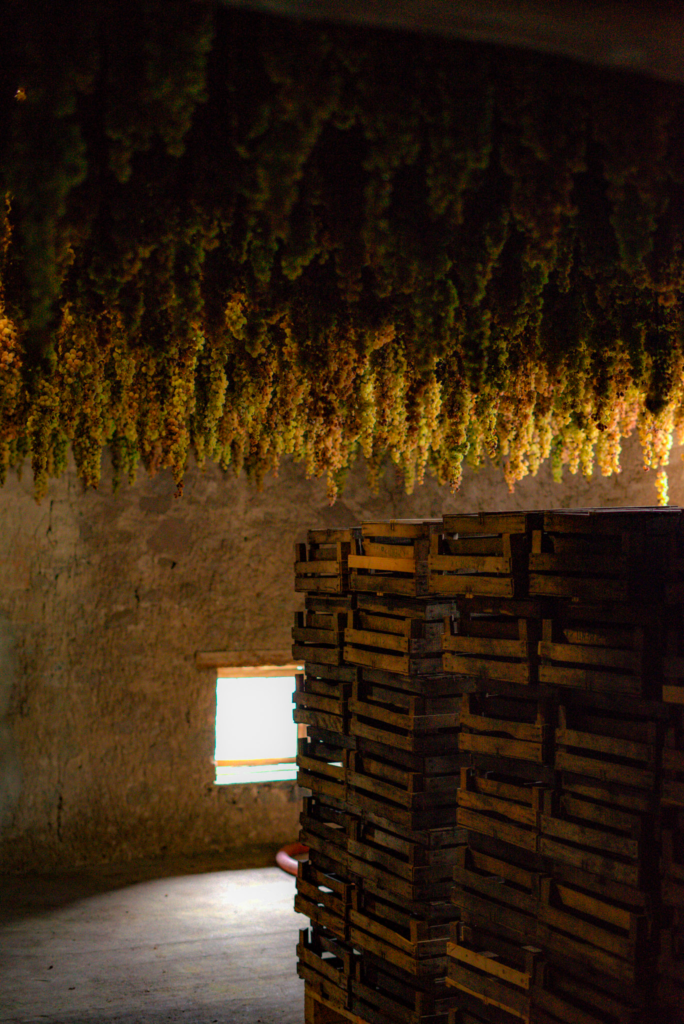
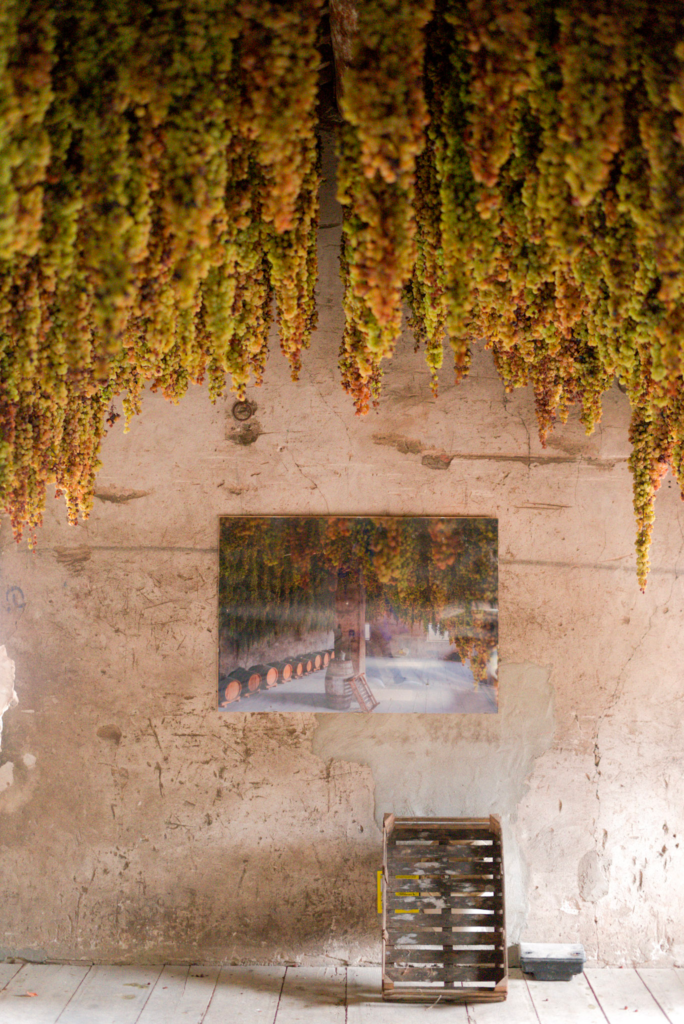
Two full floors of grape clusters hanging from wooden beams. Rows and rows of them. Light filtering in through small windows. The air thick with the scent of fruit slowly concentrating — honeyed, slightly fermented, almost jam-like.
Stefano began explaining the traditional picaio method, and both my husband and I found ourselves listening intently.
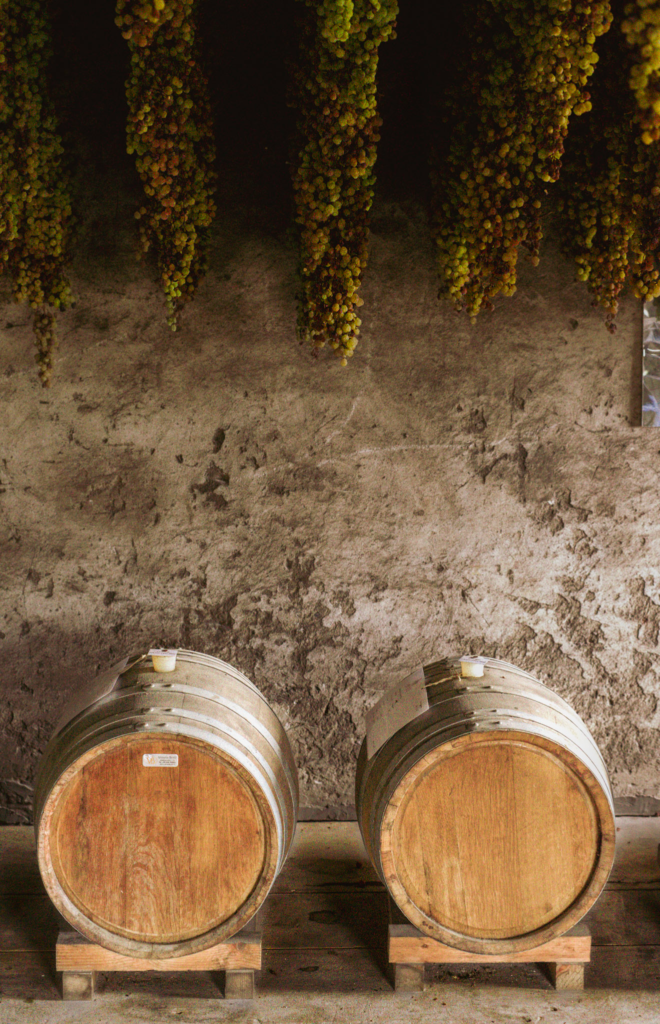
Each year, at the end of August and into early September, the grapes destined for their sweet wine are harvested by hand and placed in wooden crates. Then they’re carried upstairs and hung from the ceiling beams in this tower, where they remain for nearly six months.
No machinery. No artificial climate control.
Just air.
The breezes that move through the hills of Gambellara circulate naturally through the tower, keeping the grapes ventilated as they slowly dehydrate. Over time, the fruit loses nearly seventy percent of its original weight. Water evaporates. Sugars concentrate. Aromas deepen.
By the time the grapes are pressed, what remains is intensely rich juice — thick, golden, concentrated.
Fermentation happens slowly with native yeasts in concrete tanks before the wine moves into old French oak barrels to age for at least a year. The result is an amber-colored sweet wine layered with notes of honey, ripe peach, toasted almond, candied fruit, and dried herbs.
Sweet, yes. But balanced. Structured. Almost meditative.
Standing there, surrounded by hundreds of clusters quietly transforming overhead, I realized something simple but profound:
This wine exists because someone chose patience.
In a world that constantly pushes for speed and scale, six months of hanging grapes feels almost radical.
A full Range Wine Tasting Experience at Menti
After we finished in the drying tower, we crossed over to the tasting room.
The space itself feels intentional without being formal. Dim lighting, a long wooden table, comfortable seating — relaxed, but focused. It’s the kind of room where conversation happens naturally. If you’re visiting with a group, I can easily imagine strangers becoming friends over shared glasses and shared curiosity.
By the time we sat down, the wines didn’t feel like products anymore. They felt like the natural outcome of everything we had just seen.
The Garganega was mineral and clean, almost crystalline. Not sharp ,alive. You could taste the volcanic soil in its tension and brightness (I feel so smart for drawing that comparison)
The sparkling wine, refermented naturally in bottle, carried texture without heaviness. The bubbles felt so light.
Then came the orange wine — white grapes fermented on their skins. In the glass it was amber-toned, structured, quietly confident. It felt rounder on the palate, almost velvety.
“It seems sweeter,” Stefano smiled. “But it is not.”
He was right. It wasn’t sweet. It just had depth.
And then the sweet wine — the one born upstairs in the drying tower. Made from grapes that had hung for months using the traditional picaio method. Concentrated but balanced. Honeyed but never sticky.
What struck me most was how each glass reflected something we had already seen outside — the air, the rock, the patience.
Depending on the tasting you choose, you may sample:
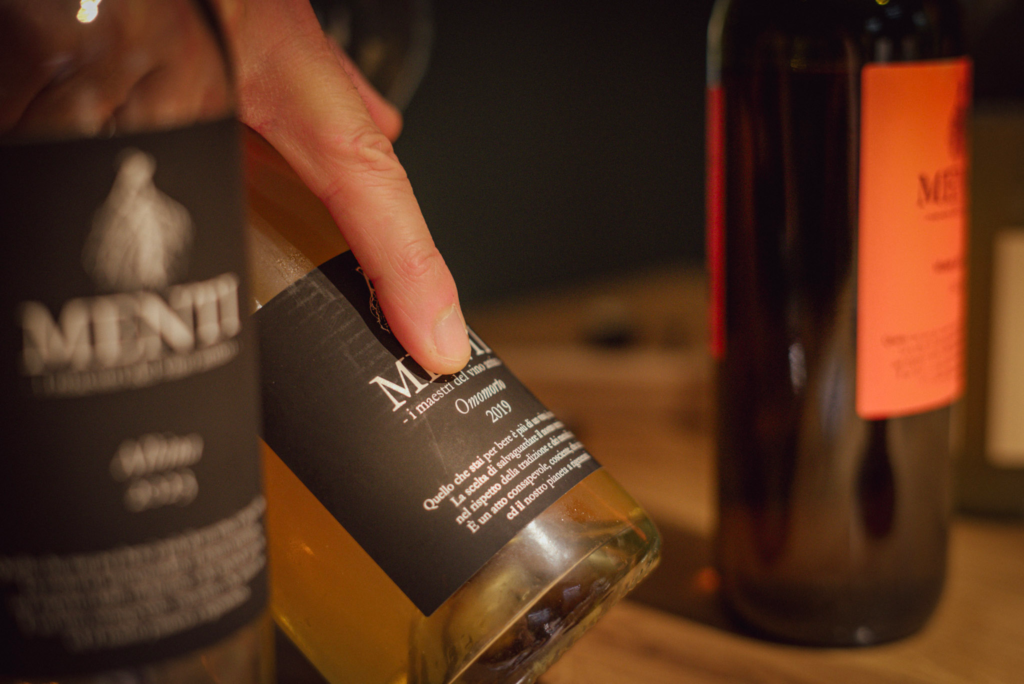
- Omomorto – A traditional-method sparkling wine without added dosage (and yes, you should absolutely ask about the name)
- Riva Arsiglia – A mineral-driven white from old Garganega vines
- Paiele – A softer, food-friendly expression with volcanic freshness
- Roncaie sui Lieviti – An unfiltered pét-nat, lightly cloudy and lively
- Monte del Cuca – A structured orange wine with extended skin contact
- Albina – The sweet wine made using the 1700s drying tower
How to Plan Your Wine Tasting Near Vicenza
Whether you’re stationed in Vicenza, staying in Verona, exploring Soave, or visiting Venice, Menti Wines makes for an easy countryside escape.
It’s close to the A4 highway, making it a convenient stop between Verona and Vicenza. And because it’s in Gambellara, not in a heavily commercial wine region, it feels quiet and intentional rather than crowded.
If you’re building a northern Italy itinerary and want:
- A sustainable winery near Verona
- A wine tasting experience near Vicenza
- A day trip from Soave
- A slower alternative to Venice tourism
Menti Wines checks every box, and I have a feeling you will love your visit!
How to Plan Your Visit to Menti Wine and Vineyards
25–30 minutes from Vicenza
15 minutes from Soave
30 minutes from Verona
About 1 hour from Venice
Reservations are required and can be made directly through the winery’s website.
The best time to visit is October through December, when the drying tower is full and actively in use.
Wine can be purchased directly at the tasting.