Who is Krampus and What to Expect at a Krampus run in South Tyrol
Last Updated on April 14, 2026 by Kimberly
Krampus isn’t just a creepy Christmas character—it’s one of the most chaotic, fascinating, and completely misunderstood holiday traditions in the Alps.
If you’ve ever seen photos of horned figures covered in fur, chasing people through snowy streets, you’ve probably wondered:
What is actually going on here?
I had the same question—until I found myself standing in the middle of a Krampus run in South Tyrol… getting my hat stolen and hit with a switch.
And that’s when it clicked:
This isn’t something you watch.
You step into it.
In this guide, I’ll break down who Krampus really is, where the tradition comes from, and what you can actually expect if you decide to experience a Krampus run for yourself.
If you’re wondering what this actually looks like in real life, I’ve attended multiple Krampus runs in South Tyrol—including [Dobbiaco/Toblach] and [Kastelruth/Castelrotto], go ahead and give those a read as well.
Keep reading to find out more about this alpine tradition and who krampus is!
What Is Krampus?
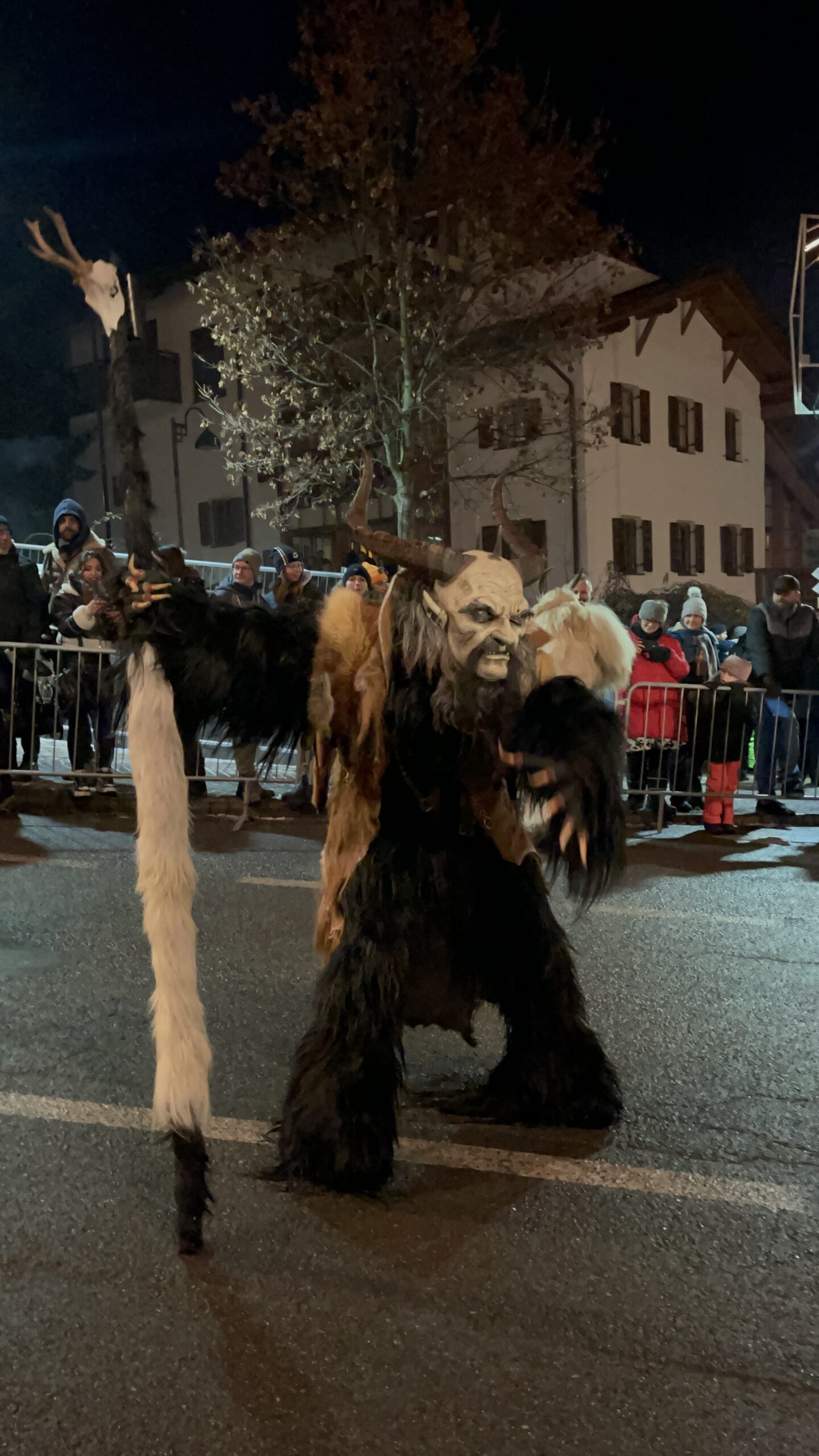
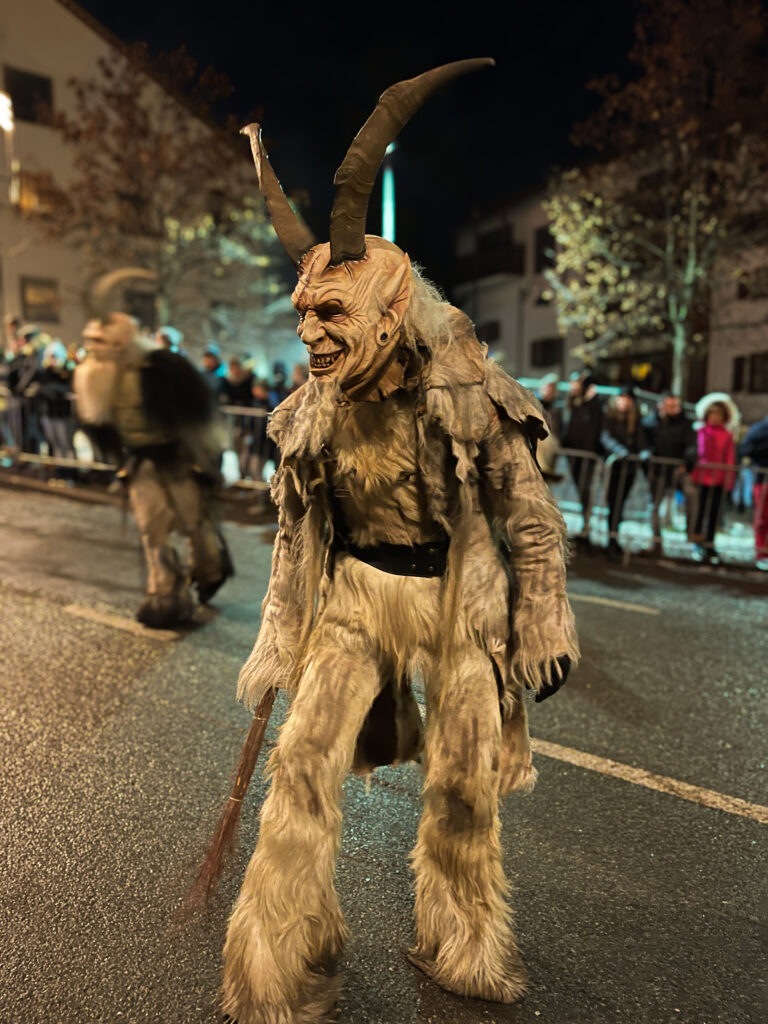
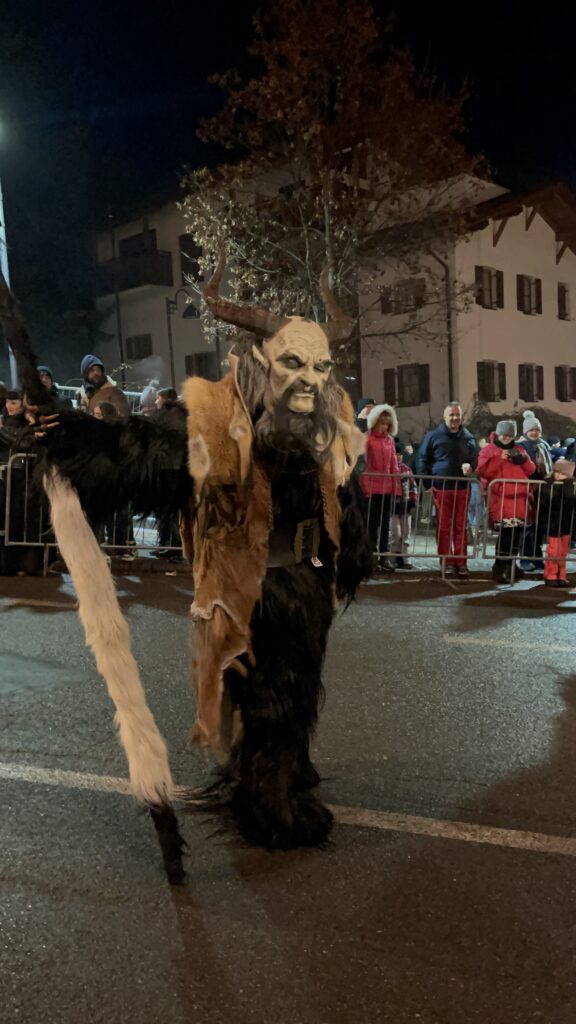
Krampus is a horned figure from Alpine folklore who appears during the Christmas season as the counterpart to St. Nicholas.
While St. Nicholas rewards good children, Krampus is said to punish the naughty—traditionally with switches or by scaring them into behaving.
Today, Krampus appears in festivals across Austria, Germany, and northern Italy, especially in events called Krampus runs (Krampusläufe), where performers dress in elaborate costumes and parade through the streets.
How I came to experience Krampus Runs
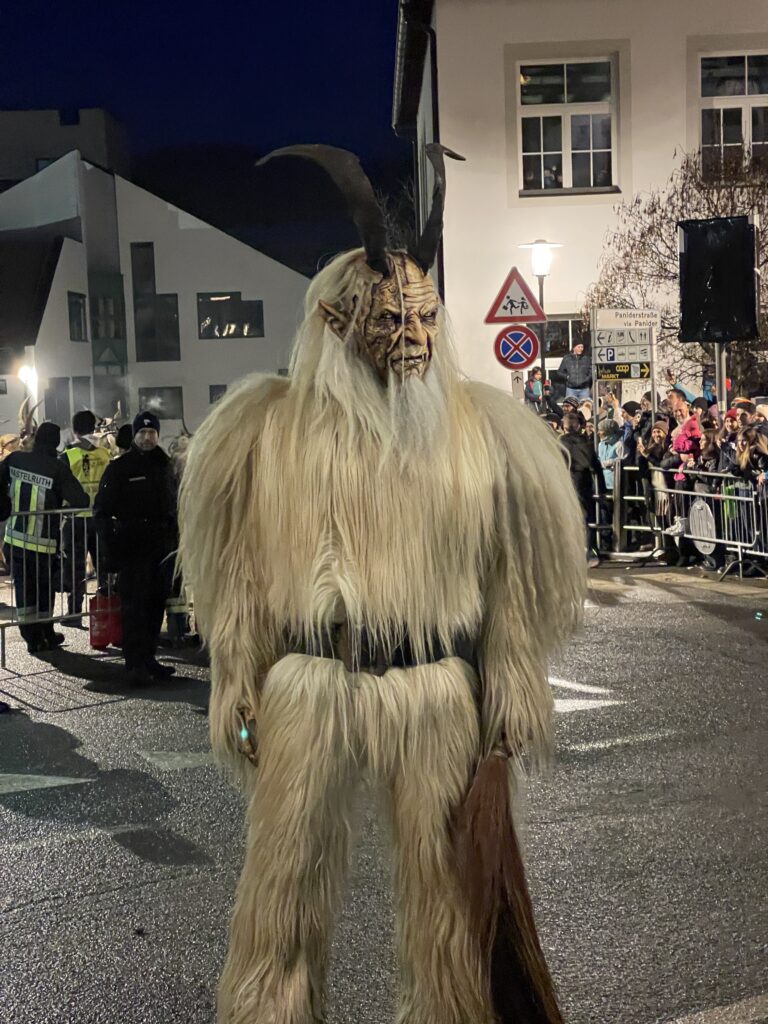
The first time I saw a Krampus run was in Kastelruth, a small village in South Tyrol—and I was not prepared. I expected something like a parade with what I assumed were gentle giants.
What I got was chaos.
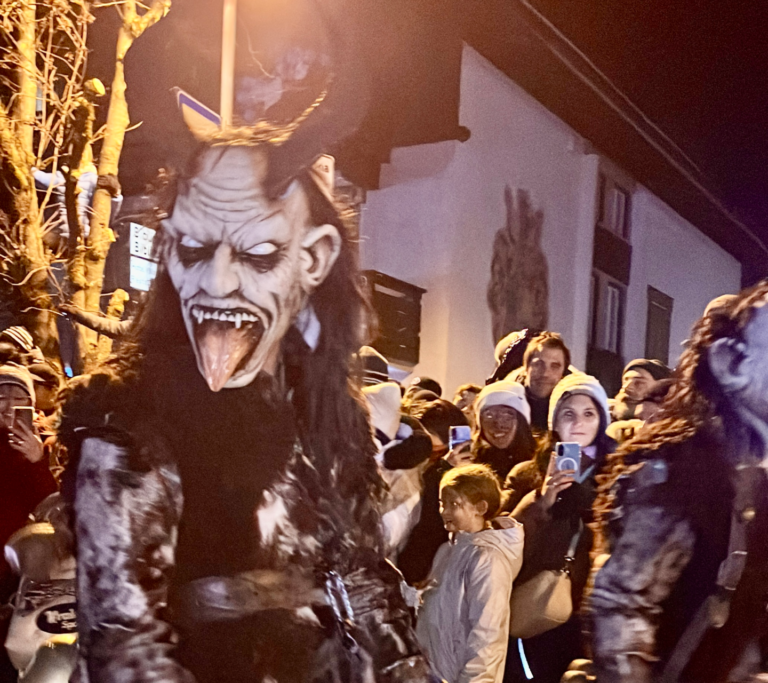
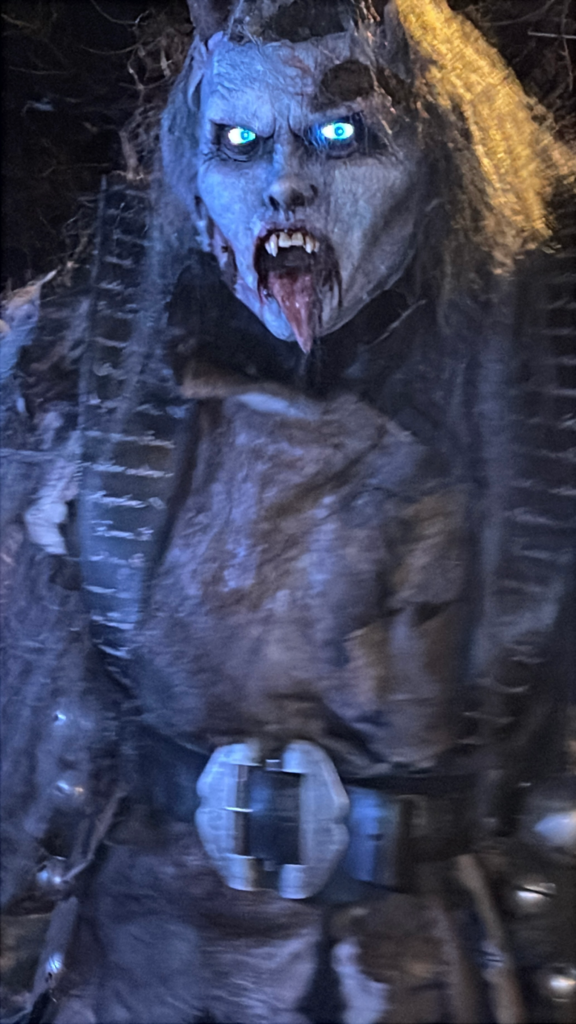
Krampus didn’t just walk past—they got in your face, rattled bells inches from your ears, and made it very clear that standing too close was a mistake.
At one point, a group of local kids started taunting them—and within seconds, we were all targets.
I got hit with a switch. My beanie got pulled over my face. A child next to me burst into tears.
And then, just as quickly, one of the Krampus crouched down and comforted her.
That moment stuck with me.
Because it made something very clear:
This isn’t random chaos—it’s tradition, and it’s deeply rooted in local culture.
👉 If you want to see what a larger, more chaotic run looks like, my experience at the [Dobbiaco/Toblach Krampus Run] takes this to another level.
What to Expect at a Krampus Run
If you’re planning to attend one, here’s what it actually feels like:
Loud bells echoing through the streets
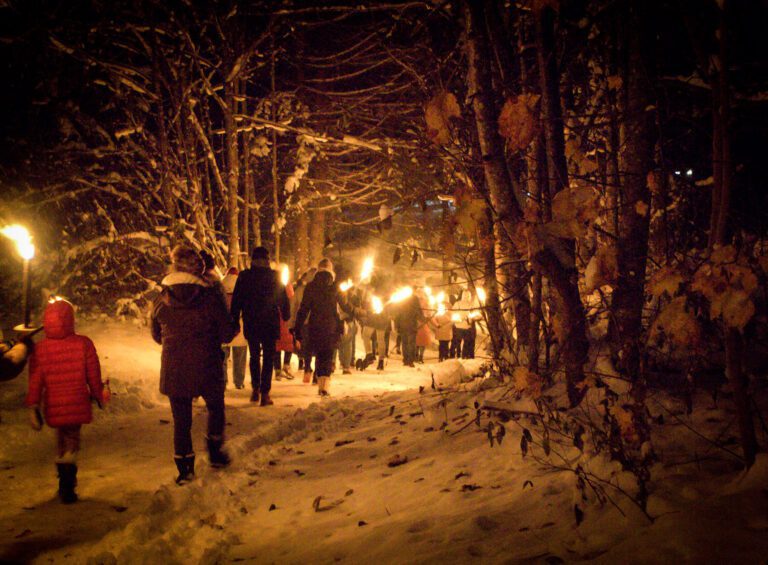
Fire, smoke, and torchlight
Krampus getting very close—sometimes too close
Hats getting stolen, people getting chased
A mix of fear, laughter, and adrenaline
It’s not a passive experience.
If you’re near the front, you’re part of it.
👉 For a full breakdown of how to survive one (and where to stand), read my [Dobbiaco Krampus Run guide] and [Kastelruth/Castelrotto Krampuslauf Guide]
History Of Krampus
Krampus has roots in ancient Alpine traditions, dating back to pre-Christian folklore. Legend has it that Krampus is the offspring of Hel, the Norse goddess of the underworld. As Christianity spread, Krampus became linked to Christmas, despite the Catholic Church’s attempts to suppress his presence. Krampus and St. Nicholas make their appearance on the evening of December 5th, known as Krampusnacht (“Krampus Night”).
The name “Krampus” derives from the German word “Kampen,” which means “claw.” Artists often depict him as a goat-like creature with horns, fangs, and a long tongue, dressed in ragged fur. I’m not exaggerating when I say that those who don the costumes go all out to bring this character to life.
In some portrayals, there is a large woman who whips tiny men with her birch sticks, carrying them off in her satchel. In another depiction, a smiling woman dangles a defeated-looking Krampus in the air, hiding his bundle of birch sticks behind her back.
I of course, think these depictions are hilarious.
What is Krampusnacht?
Ah, Krampusnacht—one of the most thrilling nights on the holiday calendar!
Celebrated on December 5th, this evening bursts with folklore, excitement, and a dash of delightful terror. While many people around the world prepare for the cozy, gift-giving festivities of Christmas, others in Central Europe gear up for a very different kind of celebration.
Just to clarify, Krampus runs, or Krampusläufe, can take place any night before or after December 5th!The Origins of Krampusnacht
The term “Krampusnacht” literally translates to “Krampus Night,” and it marks the eve of the feast day of St. Nicholas, which is observed on December 6th.
While St. Nicholas is known for his generous spirit—bringing gifts to well-behaved children—Krampus serves as his darker counterpart, embodying the consequences of naughtiness.
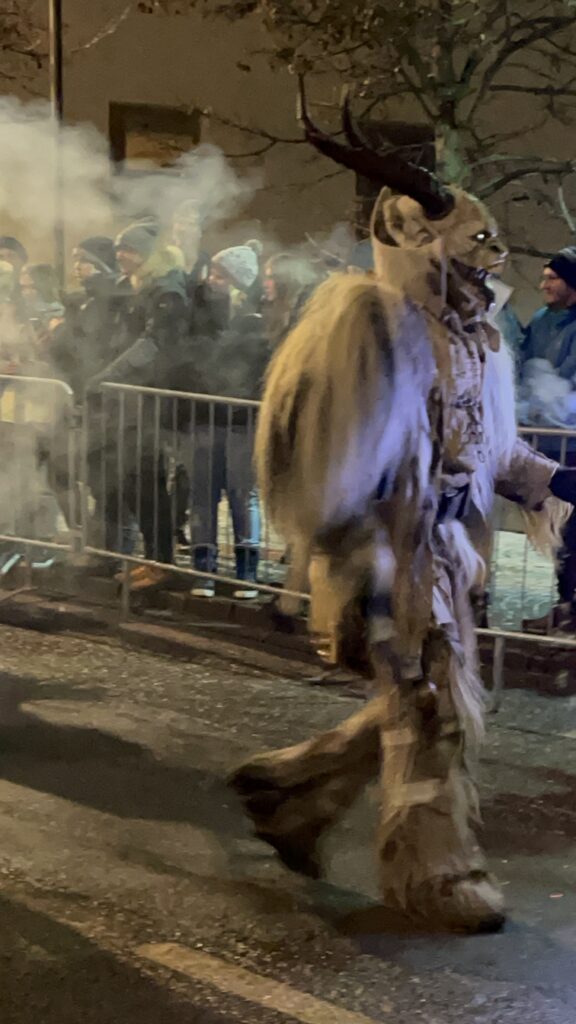
According to folklore, this is the night when Krampus roam the streets, bringing a blend of fear and fun. Traditionally, Krampus is depicted as a horned, goat-like creature, covered in fur, with a long tongue and a mischievous grin. Think of him as Santa’s devilish twin, equipped not with a sack of toys but rather a bundle of switches for the naughty ones!
The Celebrations
As night falls on December 5th, communities in Austria, Germany, and parts of Italy gear up for lively festivities. This is no ordinary holiday evening; it’s a full-on spectacle!
Krampus Runs
One of the highlights of Krampusnacht is the Krampuslauf, or Krampus Run, where revelers dress up in elaborate costumes, complete with intricate masks and bells that jingle and jangle. As they parade through the streets, the air fills with a mix of excitement and fear. Picture it: a group of towering Krampus thundering through town, brandishing chains and switches, while townsfolk cheer, and shriek.
It’s not really people running everywhere it’s more a parade of Krampus going through the street scaring everyone behind barriers. The official tourism website for Naturns, a village near Meran, says that
“Krampus devils nowadays are more constrained in what they can get up to. While the old Krampus runs were a bit of a free-for-all, and one didn’t quite know who had just doled out a beating, the event has been toned down considerably. Supported by local municipal authorities, this old custom has evolved into a folk spectacle and is subject to strict rules. The anonymity of the Krampus is also something of the past. Nowadays, each ‘devil’ has to wear an ID number, allowing traceability in the event of malpractice.”
Community Bonding
Amidst the playful frights, Krampusnacht fosters a strong sense of community. People gather to watch the parade, share hot drinks like mulled wine, and enjoy seasonal treats. You’ll see locals going around with the round coolers full of mulled wine and small cups, and for a small donation, you can get a drink. They even take it a step further and you can get Schnaps.
Mischief and Mayhem:
Traditionally, Krampus would visit homes to check on the behavior of children. If they had been naughty, they might find themselves on the receiving end of a playful scare! Folklore suggests that Krampus might leave a switch for poorly behaved children or, more humorously, take them away in his sack—though thankfully, he’s not as terrifying as he sounds.
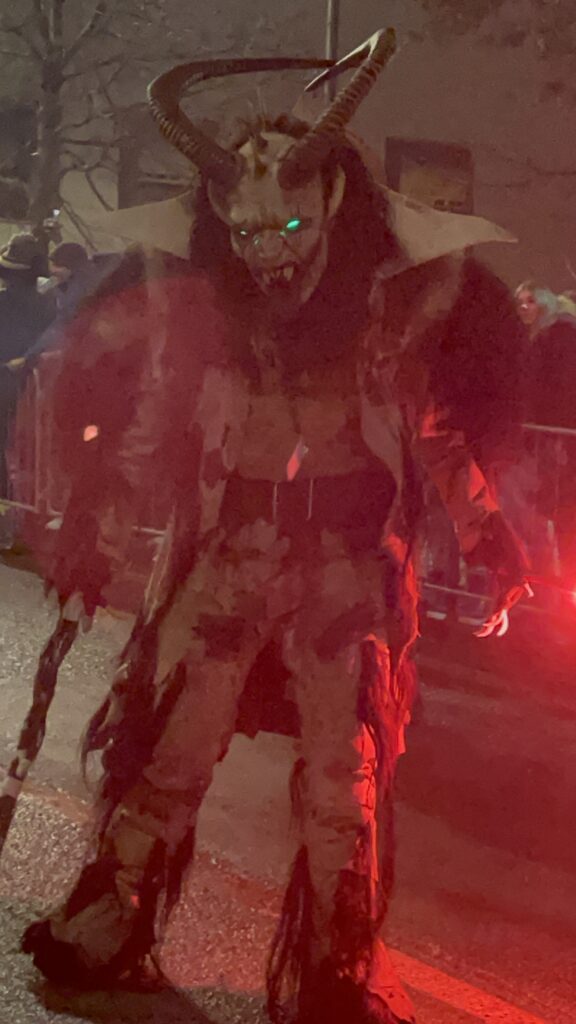
One of my favorite things I discovered at the Krampuslauf is that anyone who dares to challenge a Krampus earns the title “Tuifeltratzer,” or devil baiter. I learned this when the kids next to me were called that by another onlooker.
The Cultural Significance
In many ways, Krampus embodies the spirit of old-world folklore—he’s a relic of a time when storytelling held sway over moral lessons, and the line between good and naughty was much clearer (and much more entertaining).
While St. Nicholas rewards nice children by leaving presents, Krampus beats those who are naughty with branches and sticks. I can attest to this, as we were at the Krampuslauf and I got hit with a switch several times.
The lore surrounding Krampus varies by region. In Austria, for instance, he is often described as a playful trickster, while in other areas, he can take on a more menacing role. This duality adds to the charm and mystery of the Krampus legend.
Village-Specific Variations
- Val Gardena: In this region, Krampus is known for his frightening appearance, often described with massive horns, a long tongue, and fur-covered skin. Local stories emphasize how he would roam the streets on the night of December 5th, visiting homes and scaring misbehaving children.
- Merano: In Merano, Krampus is often associated with the region’s winter markets. Folktales recount how he would appear at these markets, engaging with the crowd, and ensuring that children behaved well as they sought sweets from St. Nicholas.
- Brixen (Bressanone): Here, Krampus’s stories often include him carrying chains and bells, which he would rattle to create a terrifying atmosphere. Local legends speak of him lurking in the woods, waiting for naughty children to stray too far from home.
Debunking common myths
Let’s dispel a few myths about poor ol’ Krampus!
Krampus represents the devil
Couldn’t be further from the truth. Krampus is based on Pagan traditions, as previously stated. Remember where the Christian faith is derived from?
Krampuslauf is dangerous
In recent years the Krampuslauf has had a reputation for being rowdy, but remember when I quoted the local tourism website as to why they wear numbers on their costumes? This is to make things traceable. We did see a fight occur after a spectator grabbed a mask. The Krampus had to defend himself because the masks were heavy and the person wearing the costume could get injured.
Keep your hands to yourself, and find a comfortable place so you don’t have to deal with the Krampus touching you if that is not your thing.
Krampus is not St. Nicholas sidekick
He is very much St. Nicholas’s sidekick. He is not meant to be terrifying but rather to remind folks that good always prevails. This is according to some associations in Austria. To quote an article from the Guardian
“The aim of the Krampus is not to hurt people,” said Aleksander Andonov, who heads the Anif Krampus Association. “On the contrary: we want to take away their fear. In the end, good always wins over evil.”
It’s all evil and not Christian
I don’t even want to delve into this. Rather, I’ll just say that just because you don’t understand it doesn’t mean it’s evil. You just need to research the area’s folklore and culture before you dismiss it.
Where to Experience a Krampus Run in South Tyrol
If you’re thinking about seeing Krampus in real life, South Tyrol is one of the best places to do it.
I’ve personally attended multiple runs here, and they are not all the same.
Dobbiaco/Toblach Krampus Run
One of the largest and most intense runs, with hundreds of Krampus flooding the streets.
Kastelruth Devil’s Course
Smaller, more immersive, and extremely interactive.
Resources
- St Nicholas and the Krampus
- For an extensive list of events, visit the SuedTirol Official Tourism Office
- Check out a master craftsman while in South Tyrol, Gerhard Ploner
Should you go to a Krampus Run?
If you’re curious about Krampus, reading about it is one thing.
Experiencing it is something else entirely.
It’s loud, chaotic, deeply cultural, and unlike anything else you’ll encounter during the Christmas season.
But where you go—and how prepared you are—makes all the difference.
If you’re considering it, start here:
→ [Dobbiaco/Toblach Krampus Run: What It’s Really Like]
→ [Kastelruth Devil’s Course Guide]
And then decide how close you want to stand.